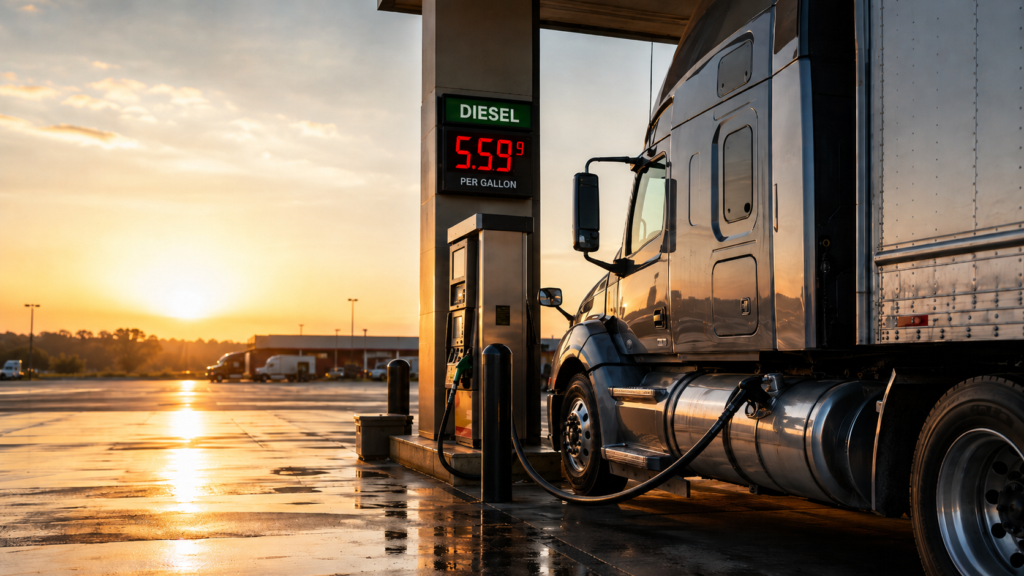
Diesel prices are one of the biggest variable costs in trucking. When diesel prices move quickly, it affects quotes, surcharges, route planning and capacity. The past few months have highlighted just how volatile fluctuating fuel prices can make the trucking market. This has largely stemmed from the recent conflict related supply constraints in the Middle East. From this, the US trucking industry has been significantly impacted with diesel prices exceeding $5.50 per gallon in some areas. Although regional impacts vary these figures a lot, and areas of California are seeing prices as high as $7.36!
With the continued uncertainty in geopolitics right now, it’s difficult to see an end in sight to these high fuel prices and diesel costs. So, let’s take a deeper look into the what, where and why this is happening, and we will also include some actionable plans for shippers to squeeze the most out of their freight budget in the current economic climate.
What Is The Conflict In The Middle East That We’re Talking About? 🤔
The ongoing conflict involving the US, Israel and Iran has caused a significant amount of disruption in the Strait of Hormuz, which has in turn driven up the cost of US fuel prices. The Strait of Hormuz has been closed, or restricted on and off for some weeks which has created the largest global oil supply disruption in history. The Strait of Hormuz transports around 20% of the global supply of oil on a daily basis. The disruption to this movement is what has caused crude oil prices to be pushed above $100 per barrel.
Attacks on tankers, oil infrastructures and passage strikes on vessels through the Strait of Hormuz, has left ships with no choice but to reroute which means much longer, more expensive travel. Not only delaying goods but also driving up costs, and not only on oil, but on every import and export that would normally travel along this shipping lane. So what are the wider effects?
Global Disruption & Economic Impact 🌎
We just touched on it slightly above, but this conflict has been described as causing the “largest supply disruption in the history of the global oil market“. Even surpassing the 1973 and 1979 oil crises. The rising costs of diesel and oil are increasing costs to transportation, food costs, consumer goods, travel, agricultural production, construction, etc. which is threatening inflation and affecting the whole US economic outlook.
How Is The Conflict Affecting Fuel & Diesel Prices In The US? ⛽️
Fuel
The conflict in the Middle East is disrupting global oil supply chains, reducing the availability of crude oil and refined fuels. Creating a supply and demand issue, and resulting in gasoline and diesel prices rising. For most consumers and businesses fuel is just one of the ways that the conflict is being felt and gasoline prices have the most visible impact. AAA’s national average for gasoline is currently, at the time of writing this (5/14/2026) around $4.53 per gallon. With some states having dramatically more expensive per gallon costs, including: California, Washington, Hawaii, Oregon and Alaska being among the most expensive, with California alone averaging $6.15 per gallon.
Diesel
While the above gasoline prices are one marker of the rising costs to most people in the states. For shippers and carriers the most important metric is the price of diesel. Diesel and jet fuel prices have risen even faster than crude oil rates, because global oil supplies have tightened. The IEA reported Gulf producers cut output by around 10 million barrels per day earlier in the crisis. This scarcity is running up rates and putting immense pressure on transportation and logistics companies in the US. The national average diesel price is now $5.62 per gallon. Compared to $3.52 per gallon at the beginning of the year. This is a big jump and one that is being felt across the states.
Diesel fuels most commercial freight movement across the nation, and diesel costs are particularly sensitive in these situations because they’re heavily influenced by:
- Crude oil costs.
- Stricter refining regulations which creates higher refining costs.
- Distribution of crude oil per barrel is biased towards gasoline, meaning less diesel is made and creating tighter supply.
- Higher federal taxes. Diesel is currently federally taxed at 24.3 cents per gallon, compared with gasoline at 18.4 cents per gallon.
- Diesel demand is tightly linked to economic activity from trucking and construction, so there’s a supply and demand angle.
- Marketing.
How Are The Diesel Prices Affecting Trucking Companies In The US? 🚚
Everyone that owns a vehicle is being hit with the “jump at the pump” as people are calling it. But, when diesel prices rise, carriers are the first to feel the sting in the freight world, as it directly impacts their bottom line and customer satisfaction. Here are the main impacts that we’re seeing on carriers:
Increased operational costs
Diesel costs are already the second most expensive cost for carriers, after driver salaries. In the current climate, some trucking companies are spending anywhere between $1400-$1600 to fill up their tanks, and they can be doing so around three times or more a week. That’s around a huge $4500 on diesel per truck per week. For companies with a large fleet, this is multiplied across tens or hundreds of vehicles, so as you can imagine carriers operational costs have skyrocketed. But it’s just as impactful to smaller carriers, or owner/operators that may only have one or two trucks but might have less of a cash cushion to absorb the increase, as some other carriers are.
While some companies will raise their rates and utilize fuel surcharges to bring pricing inline with their increased operational costs. Smaller companies don’t always feel like they have the option to do this without risking losing business. Because losing one customer could be detrimental to them. Many smaller carriers win work by offering competitive rates, but this leaves them with lower margins. When diesel prices rise sharply, as they have in these past few months, there is then very little room to absorb extra costs. If they raise prices, they risk losing customers. If they do not, profitability can quickly disappear.
Reduced profitability & Delayed surcharges
For the carriers that try and remain competitive they will see that the hike in diesel prices directly reduces profit margins. Despite utilizing fuel surcharges, carriers are facing significant profitability pressures and in many cases are losing money on shipments. Without flexible fuel surcharge agreements in place, carriers might be locked into contracted rates that no longer cover their operational costs. This is damaging for any carrier, but especially smaller carriers or owner-operators that typically operate on tighter margins. Often fuel surcharges and quotes that are calculated pre-shipping are not adjusted quick enough to the changing rates, leaving carriers to absorb the higher costs.
Disrupted supply chain
The need for alternative routes around the Strait is creating longer lead times for some imports and exports. When those delays reach the US, domestic freight networks are under more pressure to keep final mile and inland deliveries on schedule. Less predictable timelines can make the whole supply chain harder and more expensive to manage.
All of these additional costs ripple through the entire supply chain and eventually down to consumers. But after carriers feel the pinch, it’s then onto the shippers.
How Are Shippers Being Affected By The Heightened Diesel Prices? ⛽️📈
Mirroring carriers, shippers are left to make a couple of tough choices. Do they pass extra costs onto their customers? or absorb the extra cost themselves?
When shippers pass the cost to their customers, they, like carriers run the risk of losing their customers to a competitor. This is why it’s so important that shippers try and negotiate the best rate they can with their carrier, to keep costs steady for themselves and their customers. Here’s some of the more common challenges shippers are seeing from increased diesel prices:
Unpredictable freight spend & higher landed costs
Higher diesel prices can make predicting freight spend much more difficult. A rate that might look competitive one week, might become a lot more expensive once fuel surcharges are added/updated.
Surcharges are also calculated differently from one carrier to another, so accurately and fairly comparing freight quotes becomes difficult. Even a small increase per load can quickly add up across multiple shipments.
Customer pricing becomes difficult
Once you quote a customer a price, going back and changing that can be difficult, without upsetting them. But when freight prices are changing so regularly, quoting accurately is hard. Therefore, a lot of shippers in these situations are absorbing the extra costs.
Risk of choosing a cheaper carrier
Some shippers might seek a cheaper carrier which opens up a can of worms and can present new risks. Ask yourself, why are they cheaper? What is their level of service? Using a new “cheaper” carrier, rarely works out cheaper in the long run. It could result in delays, becoming victim to fraudulent activity, miscommunication, and the list goes on. All of which leaves shippers back at square one: higher landed costs, more significant delays, unhappy customers, financial pressure and inefficiencies.
Capacity challenges
Typical routes that carriers use may become unprofitable, which might make your carrier reduce their capacity on those lanes. Carriers might also become more choosy, and only move freight with the best profit margin on these lanes or only travel the most efficient routes. This can make it harder for shippers to secure space, and in an already tight market, it can push freight rates even higher, as shippers compete for available capacity.
Our Advice 🔎
It’s important to remember that we have experienced a similar diesel price hike back in 2022 when Russia invaded Ukraine. We weathered that storm, and now we can weather this one together too. Because ultimately, shippers have three choices: absorb the rising costs themselves, pass the cost onto their customers, and/or try and optimize their shipping strategy, leaning into different modes of transport, etc. But, here are our top tips that we believe can help most shippers to minimize the impact of the rising fuel costs.
Work with a carrier that explains surcharges early
Understanding how surcharges work helps you to avoid surprise costs and make better, more informed decisions before your loads move. Making it easier for shippers to:
- Budget more accurately
- Compare quotes fairly (with all additional costs built in)
- Plan around cost spikes (consolidation loads, adjusting delivery windows, choosing more effective lanes)
- Explain costs to customers
- Build trust with your carrier
Consolidate shipments where possible & reduce empty miles
When you consolidate your shipments, you reduce the number of separate trips needed to move your goods, therefore reduce costs. But remember, transit times may become longer as there will likely be more stops, but by doing this you can also potentially reduce empty miles. If you work with an expert partner they might be able to line up shipments to coordinate loads and minimize empty backhauls. Saving on wasted fuel and bringing down costs.
Optimize your supply chain
Depending on your freight and its needs, you might find that using a multimodal shipping method could be beneficial to offset some costs as it could work out more fuel efficient. Explore all options with your freight partner.
Negotiate fuel clauses
Work with your carrier to agree on clear fuel surcharge terms upfront, this way you will know how rising diesel prices will affect your freight costs. Outline when surcharges change, what diesel benchmark is being used and how often the rate is reviewed. This can again help to protect your budgets, compare quotes and avoid surprise charges.
Conclusion 💭
The current freight market is overwhelming. Trying to navigate rising costs, limited capacity, maintain profit margins, create an optimized shipping strategy and keep customers happy are all challenges that shippers are facing daily. If you need help understanding how the changing fuel costs might be affecting your regular routes, then speak to one of our expert team members about your domestic freight options.
⬇️ Use the link below to get help with your shipment or call us directly on: Phone: 888-SHIP-911 we can’t wait to hear from you!
Need help with any of your specialized shipments?
Today can be the day you stop struggling with your logistics problems.
At PEI we’re experts in dealing with specialized freight and can handle yours with any custom requirements.
Need help planning a shipment?
Talk with PEI about expedited freight, specialized freight, or your next shipping challenge.
