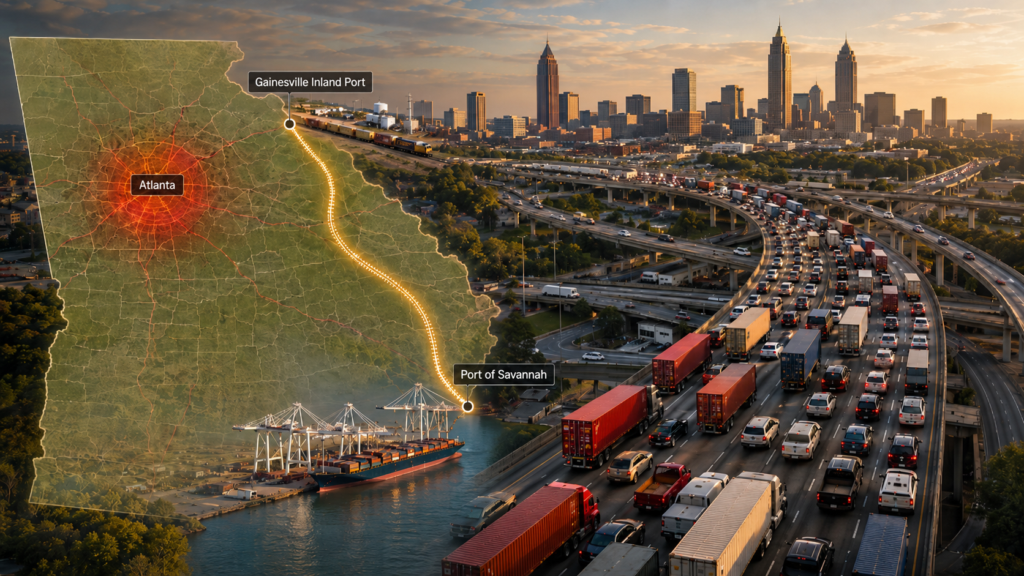
Metro Atlanta trucking sees some of the worst traffic congestion in the whole of the US. In fact, according to the ATRI, American Transportation Research Institute four of the nation’s top 10 bottleneck congestion areas are located in the metro Atlanta region, including three major I-285 interchanges and I-75 in McDonough. Here’s where it’s the worst:
- I-285 at I-85 North
- I-75 at I-285 North
- I-20 at I-285 West
- I-75 at McDonough
The traffic around and through Atlanta can be extremely frustrating for all road users. Commuters, tourists, everyday local drivers but there’s especially an emphasis on truckers in the area that are known to spend multiple hours on these roads each day. Truck drivers said in an interview with CBS News “it is really hard to manoeuvre large trucks because of the traffic and restrictions in place around Atlanta”.
Savannah Port Plays A Large Part In Atlanta Traffic 🤔
The Port of Savannah has been an appealing import/export option for shippers to and from the US for some time. This is because it has been proven to be one of the most cost-effective routes for companies moving their goods into the Southeast. Researchers have found that shippers could save $1000 per container when utilizing the Port of Savannah to get their goods to cities including: Atlanta, Memphis, and Nashville compared to West Coast Ports, which have for a long time been the busiest ports in the US. A lot of Atlanta trucking traffic stems from this containerised freight from the port, as it’s a huge distribution hub to access North Georgia and further afield.
Introduction To Gainesville Inland Port
This is where hopefully, the new Gainesville Inland Port comes in, which we will go into depth about in the next few sections. The port will not only be beneficial to Gainesville, it will also benefit how Georgia moves products, manages growth and it will attempt to take some of the pressure off of Atlanta’s already strained highways.
About Gainesville Inland Port 🚝
An inland port is a rail connecting freight terminal that is located away from the coast. It helps to move containerised freight between seaports and inland markets via rail, instead of solely relying on trucks and other modes of transport.
The new Gainesville Inland Port managed by Georgia Port Authority is located in Gainesville, GA and was formerly known as the Blue Ridge Connector. The project has had a significant investment of $134 million poured into it and is served by Norfolk Southern offering a direct rail service between Northeast Georgia and the Port of Savannah five days a week, one of Georgia’s busiest freight gateways.
It’s no wonder the Georgia Port Authority decided to open the port in Gainesville-Hall County. It already has strong manufacturing and global business ties. Being the home to 330 manufacturing and processing facilities, as well as 60 international company locations representing 21 foreign countries. Businesses here include: poultry, it’s actually nicknamed the “poultry capital of the world”, forest products, heavy equipment and other manufacturing and distribution hubs. Which all give it a ton of demand for freight movement, making it a natural location for an inland port.
The new port opened recently, on May 4th 2026, so it is hard to say at this stage just how it will perform. But, it was opened with the aim of not just being a freight yard, and instead to play a part of a larger logistics strategy to better connect Northeast Georgia manufacturers to Savannah.
How Will The Gainesville Inland Port Effect Atlanta Trucking Traffic 🛣
If the Gainesville Port activity goes as planned, there could be major improvements to the traffic congestion around Atlanta, and through Georgia.
1.Reduced Atlanta and surrounding areas traffic
Trucks moving freight to and from Savannah, North Georgia, Tennessee, Alabama and other inland markets often pass through or around Atlanta. Adding even more large heavy haul trucks to the already congested roads, like the I-285, I-75, I-85 and I-20. Georgia Ports estimates that this new inland port could replace 52,000 truck round trips in its first year. It’s aiming to remove around 18 million truck miles from Georgia’s roads in this first year too, growing to a huge 43 million truck miles removed by 2045. But it’s important to remember that the inland port will not “solve” Atlanta traffic. Trucks will still be very much needed and a huge part of Georgia’s freight network, and the congestion has many other causes including: commuters, population growth, construction. However, shifting a portion of drayage container freight to rail can reduce truck volume, emissions, road ware and tare and delays.
2.Reduced long-haul traffic
The port is a direct rail terminal that handles freight from Savannah, when this freight moves via truck it means a 300 mile each way, so 600 mile round trip to Gainesville. The new port does not remove the need for trucking entirely, as trucks will still handle the local, more regional deliveries and will still be used for long-haul to other locations as well as still to the port of Savannah, because rail will not be the answer to all of these kinds of movements. But for those that utilize a multi-modal method could see shorter drayage routes and reduce time spent in long-haul congestion.
3.Shift in trucking demand
Again, we cannot stress this enough, the new inland port will not remove the need for trucking. It will instead change where trucks are most valuable. Rail can only handle a part of freight movement, never the entire trip. Leaving trucks to be as essential as ever, for the first and last mile, regional, urgent and specialized shipments that rail simply cannot handle.
4.Infrastructure Impact
Less truck traffic on the city roads will lower the impact on our infrastructure.
Other Benefits of Gainesville Inland Port ✅
1.Reliability moving via rail
As we mentioned above, this port will not “solve” Atlanta traffic. There will always be heavy congestion in Metro Atlanta, therefore, moving your freight via rail, where the route is direct and not affected by congestion could make movement windows more reliable.
2.More options & potentially improve supply chain efficiency
The inland port gives shippers another option to long distance trucking from Savannah. Freight can move directly by rail to the Northeast of Georgia using this inland port, instead of long-haul drayage. This can make movement more predictable, reducing delays, and fuel costs.
3.Increased local efficiency
Gainesville is home to a ton of manufacturing and global businesses like we covered before. This inland port will offer local companies a direct route to global markets through Savannah.
4.Large capacity through Gainesville Inland Port
The new inland port at full build out is expected to be able to handle a whopping 200,000 containers annually. Proving lots of capacity to help out trucking and take some strain off our roads.
Benefits Of The New Inland Port Might Not Be Instant ⏳
As the port only opened recently, it needs some time to breath, once people have found their feet with it, then experts can measure its full impact. But it could take some time for local businesses to switch up their routes and build rail into their supply chains. They will want to see that the port schedules are reliable, and other benefits of switching before they adopt any kind of rail service.
While Atlanta might benefit from fewer drayage traffic, Gainesville will begin to see more short-haul truck movement around the inland port. This project brought with it the need for local road improvements and in depth traffic planning for the area. Luckily, Georgia Port Authority thought ahead on this one and late last year invested $4.8 million into Hall County for infrastructure improvements ahead of time to mitigate the new rail yards impact to the surrounding community.
Environmental Benefit ♻️
Rail can reduce emissions on specific long-haul container routes. Less long-haul truck trips means lower fuel consumption, less idling on already congested freight corridors and fewer emissions. Georgia Port Authority has estimated that moving long distance freight by rail through the utilization of the new Gainesville port could reduce CO2 emissions by 22,510 metric tons in the facilities first year.
But that’s not to say that trucks are not also becoming a lot more economical, Georgia is rapidly transforming into a major hub for green trucks and more sustainable trucking transportation. Both for heavy duty freight and everyday consumer goods. In fact, Georgia has become a huge testing ground for zero emission freight through Hydrogen powered semi-trucks and Electric vehicles to ferry freight from the port of Savannah to inland factories. So both modes are doing their bit towards a greener future.
Economic Development 💰
The new port has initially created 20 new jobs, which could grow and will draw investment and business to Hall county and surrounding areas.
What Will Success Look Like? 👏
Measurable results will take some time, there is no overnight fix. Shippers, carriers and manufacturers will need time to adjust their supply chains, test the rail service and decide if its a feesable option for their operations. Therefore, success should not solely be based off of how many containers the port can handle, but instead by how consistently shippers actually use it. Other key metrics to watch are:
- Number of containers handled each month
- Rail service reliability
- Did the first year meet expected truck mile reductions
- Adoption of moving goods by rail by local manufacturers
- Reduction of long haul container traffic in Atlanta
- Local congestion on roads surrounding the Gainesville Port
These are all interesting to follow as indicators into how the port is performing. One way of understanding how the future of Gainesville Port could look is by taking a look at Georgia’s other inland port.
Georgia’s Other Inland Port 🚝
Georgia already has another inland port, Gainesville is not the first of its kind, there is also the Appalachian Regional Port. After looking closely at how this inland port works and has affected its local area, we can kind of look to the future of Gainesville. However, it’s important to remember that these ports don’t all work in the exact same way.
Appalachian Regional Port
The Appalachian Regional Port is located in Crandall, Georgia. It connects Northwest Georgia to the Port of Savannah by CSX rail service. With a purpose of moving containerised freight inland by rail, to relieve more trucks of making the long journey from Savannah.
This port has been very successful. Data shows that in November 2025 alone, the Appalachian Regional Port moved 3,876 containers, which was a 35% increase from the previous years November. Georgia Port Authority also recorded the facility handling over 41,000 containers in the year of 2025. Already figures for 2026 are up 20%, when compared with the same period from last year.
From the above figures, surface level it looks like the Appalachian Regional Port has been a success for the state of Georgia. But how has it helped with traffic relief? Well, each of those containers that we mentioned earlier that moved via rail, removed a 710 mile truck round trip from our roads.
These stats are encouraging for Atlanta traffic, if Gainesville Port follows a similar pattern, then we can expect another step in the right direction for Georgia’s congestion issues.
Why This Matters For Shippers 🤔
This is an exciting step for shippers. It could offer more options and flexibility when moving freight across Georgia and the Southeast. When trucking and rail work together it can reduce exposure to Atlanta congestion, help to enhance delivery planning including schedules, etc. and help to make costs more predictable.
Should Truckers Be Worried?
Absolutely not, we’ve been moving freight on the Georgia roads for decades and that will not change. We see this as an extra shipping option, not a replacement of trucks. Businesses will still rely heavily on trucking, and in reality, a stronger rail connection can present new opportunities for truckers too. Especially around drayage, and supporting the movement between inland hubs, warehouses, distribution centres, and customers.
Conclusion 💭
It’s important to remember that the number one goal here is not to eliminate trucks on our roads. But to better distribute drayage freight movement via methods that suit the type of freight, distance and budgets. Trucks will always be an essential part of moving goods there’s no question about it, especially those more regional, local deliveries and there will still be a huge need for long-haul too. This is more about giving shippers another option for specific containerised routes, while helping reduce pressure on already busy roads.
If the port of Gainesville performs or outperforms as expected then it could become an important piece to the puzzle of moving goods in Georgia and helping to minimize containerized loads moving through Atlanta’s busy roads. Gainesville port is about creating a new, balanced freight system where rail takes some pressure off long distance container movement.
We’re trucking experts, the last thing we’re here to do is talk you out of moving goods via roads. We simply want to inform you of new freight progressions in the area, with a brief explainer as to how it can be beneficial to trucking, i.e. less congestion for the freight still moving on trucks through and around Atlanta.
If you need help moving any of your domestic trucking freight, no matter how crazy the ask is then get in touch with us to discuss your needs. We move all kinds of freight across the whole of the US and we’d love to hear from you. You can reach out directly by cellphone on: 888-SHIP-911 or by using the link below ⬇️
Need help with any of your specialized shipments?
Today can be the day you stop struggling with your logistics problems.
At PEI we’re experts in dealing with specialized freight and can handle yours with any custom requirements.
Need help planning a shipment?
Talk with PEI about expedited freight, specialized freight, or your next shipping challenge.
