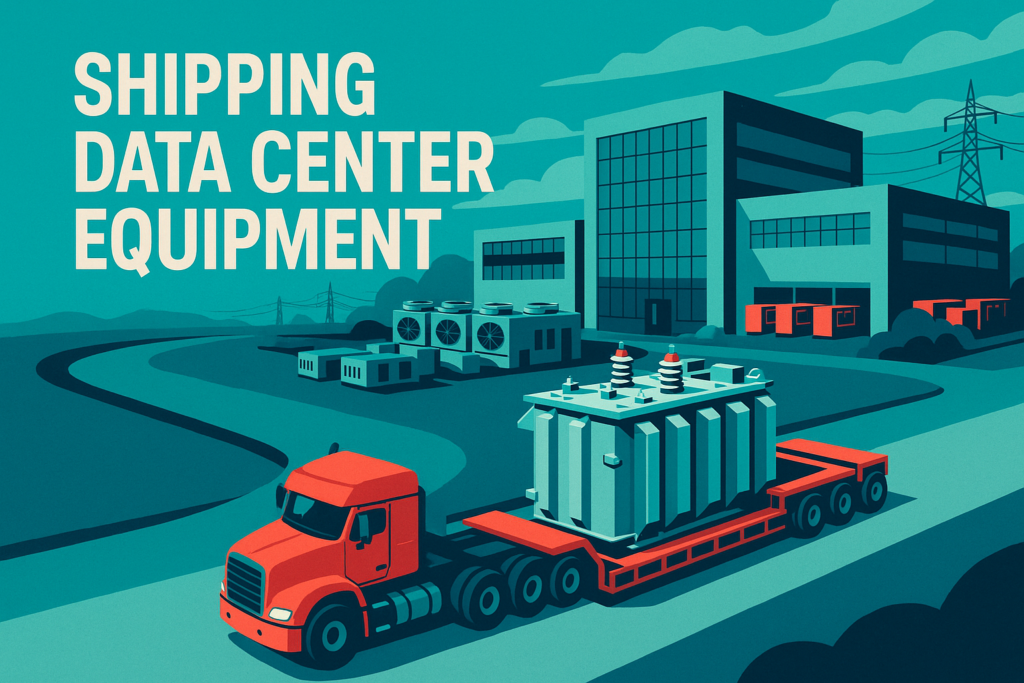
There’s a good chance the heaviest, most expensive, most schedule-critical freight moving through your state right now is headed to a data center. U.S. data center construction starts reached $84.1 billion through July 2026, nearly three times the level of a year earlier and already well past 2025’s full-year total of $72.5 billion. The monthly numbers swing hard: June alone accounted for $22.3 billion, the second-biggest month on record, while July came in at $2.7 billion across 23 projects.
Look past the month-to-month noise and the pipeline is what matters: 85 projects sit in late-stage preconstruction with start dates before the end of the year, carrying $78.7 billion in planned value. This is not a wave that has passed.
For manufacturers, EPC contractors and equipment suppliers, that boom shows up as a very particular kind of freight problem. Data center gear is oversized, overweight, extremely valuable, in genuine short supply and bolted to a construction schedule that does not move. Most freight gives you one of those challenges. This freight hands you all five at once.
So let’s get into what’s actually rolling down the road and what it takes to get it there in one piece and on the right day.
What We’ll Cover:
- What Actually Ships to a Data Center Site
- Why Equipment Lead Times Changed the Risk Math
- Why a Two-Day Delay Costs More Than the Freight
- What This Freight Needs From a Carrier
- The Sensitive Side: Racks, CDUs and IT Gear
- Where It’s All Happening
- A Planning Checklist for Shippers
What Actually Ships to a Data Center Site?
People picture servers. Servers are the small part. The freight that keeps project managers awake is the power and cooling equipment:
- Power: Large power transformers run between 100 and 400 tons, and the biggest units measure more than 50 feet across. Add pad-mount units, medium-voltage switchgear lineups, busway and substation steel.
- Backup generation: Diesel gensets in the 1,500 to 4,000 kW class, fuel tanks, paralleling gear and acoustic enclosures.
- Cooling: Chillers, cooling towers, CRAH units, piping skids and coolant distribution units. A 1.35 MW floor-mount CDU runs around 2,400 lbs filled, and the 2.3 MW units approach two tons.
- IT hardware: Purpose-built AI cabinets are rated for static loads up to 5,000 lbs, and they often ship pre-populated.
- Structure: Precast panels, modular skids and pre-assembled electrical rooms that each arrive as a single awkward oversized load.
Why Have Equipment Lead Times Changed the Risk Math?
This is the part shippers underestimate. If you damage a pallet of standard industrial parts, you reorder. If you damage a substation transformer, you wait years.
Wood Mackenzie puts lead times for large substation power and generator step-up transformers at 80 to 210 weeks. The average has climbed from around 50 weeks in 2021 to roughly 120 weeks by 2024, and contractors report the same stretching on medium-voltage switchgear and large diesel gensets. That is eighteen months to four years of manufacturing before the unit is ready to move, so the order goes in years ahead of energization.
Put plainly: the cargo on that trailer may be irreplaceable inside the project’s schedule. That changes how you pick a carrier, how you insure the load and how much route planning is worth paying for. If you want the fuller picture on coverage gaps, our guide to liability in oversize and high-value freight is a good companion read.
Why Does a Two-Day Delay Cost More Than the Freight?
Data center construction is a tightly sequenced critical path. The transformer has to land before the electrical contractor can terminate. The gensets have to be set before commissioning. Utility interconnection windows are scheduled months out and are not easily rebooked.
When a load misses its date, you’re not paying for a late truck. You’re paying for an idle crane crew, a rescheduled utility outage, a commissioning team on standby and, in many contracts, liquidated damages. We’ve written before about the hidden costs of delayed freight. On a data center job, multiply every one of those numbers.
What Does This Freight Need From a Carrier?
Considerably more than a truck and a tarp. A properly planned data center move usually involves:
- Route surveys and bridge analysis: Many sites are greenfield, which means rural county roads, tight turns and bridges whose load rating was never run for a configuration like this.
- Multi-state permitting: Every state has its own thresholds, curfews and travel-hour restrictions, and a single move can require permits in five or more.
- Escorts and utility coordination: Police escorts, pilot cars and sometimes a utility crew to lift lines.
- The right equipment: Step decks and lowboys, including fixed-neck double drops and RGNs, for mid-range loads; multi-axle and dual-lane trailers for the heavy end; hydraulic platform trailers and SPMTs for final positioning on site.
- Site access planning: An active construction site with one gravel entrance is not a loading dock. Delivery sequencing matters as much as transit.
If you’re vetting providers for this kind of work, our list of red flags when choosing a heavy haul carrier and our breakdown of heavy haul freight cost factors will save you some pain.
What About the Sensitive Side: Racks, CDUs and IT Gear?
Different problem, same stakes. A pre-populated AI rack is a seven-figure asset that cannot be tipped, dropped or bounced. One detail catches people out: the headline 5,000 lb rating is a static figure, measured with the cabinet standing still. Cabinets carry separate, lower dynamic and shipping ratings, typically around 20% below the static number. Plan the move against the shipping rating and the rigging against the dynamic one.
That freight typically calls for air-ride equipment, shock and tilt indicators, liftgate or ramp offload, inside delivery and no cross-docking at all. This is where exclusive use vehicle shipping and white glove transportation stop being a premium and start being the cheapest option available. One trailer, one driver, no transfers, direct to the floor.
Where Is All of This Happening?
Not evenly, and that is the useful part. So far in 2026, North Carolina, Indiana, Illinois and Michigan have each passed $10 billion in data center construction starts, with Virginia and Texas close behind. The near-term pipeline points at Texas, North Carolina, Virginia, Arkansas and Utah, followed by Georgia, Oklahoma, Ohio and Indiana.
Those lists matter because they tell you where the freight is going, and the equipment almost never starts anywhere near where it ends up. Transformers, switchgear and generators come out of a short list of plants and ports, then run long distances into sites that were chosen for cheap power and open land rather than road access. That combination is what makes the freight profile so specific: heavy oversize loads, long lanes and a final few miles on county roads that were never built for them.
Several of those states sit squarely in the corridors we run every day. See our guides to moving freight in North Carolina, Virginia, Georgia and Arkansas for the route-level detail.
How Should Shippers Plan for It?
- Book transport when you book the equipment, not when it ships. Permit and survey work needs weeks, not days.
- Confirm cargo limits in writing before the load is tendered and check them against replacement lead time, not purchase price.
- Ask for the route survey. A carrier who hasn’t driven the final mile hasn’t planned the move.
- Sequence deliveries with the site superintendent, not just the procurement team.
- Keep a recovery plan on the shelf. Breakdowns, weather and permit revocations happen. Know who you call at 2 a.m.
Data center freight rewards planning and punishes improvisation harder than almost anything else we haul. Treat it like project cargo, because that’s exactly what it is.
Frequently Asked Questions
How Far in Advance Should I Book Transport for Data Center Equipment?
Book it when you place the equipment order, not when the unit is ready to ship. Route surveys, bridge analysis and multi-state permits take weeks, and on a superload they can take longer than the trucking itself. Large transformers carry manufacturing lead times of eighteen months to four years, so they are ordered years ahead of energization. Transport planning belongs on that same clock, not at the end of it.
Do I Need Permits to Ship a Transformer?
Almost certainly. Anything over standard legal weight or dimension needs an oversize or overweight permit in every state it passes through, and a single move can require permits in five states or more. Each state sets its own thresholds, curfews, travel-hour windows and escort rules, so the permit package is built route by route rather than once.
What Trailer Moves a Large Power Transformer?
It depends on weight, and often it is not a trailer at all. Most of the largest units move by rail on purpose-built Schnabel cars, and with only around 30 of those in North America, car availability is itself a scheduling constraint. On the road, mid-range electrical gear rides on step decks and lowboys, including double drops and RGNs. Into the hundreds of tons, you are looking at multi-axle or dual-lane trailers, with hydraulic platform trailers or self-propelled modular transporters handling the first and last legs, plus final positioning on site.
Can Server Racks Ship on Standard LTL?
Usually not. A pre-populated AI cabinet sits at or beyond standard LTL single-skid limits, which run about 5,000 lbs at national carriers and lower at regionals, with a height cap near 96 inches. Many carriers will refuse it or re-rate it. Even where one accepts it, LTL means repeated terminal transfers, and every transfer is a chance to tip, drop or shock a seven-figure asset. Exclusive use vehicle service keeps the rack on one trailer with one driver from origin to the data hall floor.
What Happens if the Equipment Is Damaged in Transit?
That is the question worth asking before you tender, not after. Under the Carmack Amendment a motor carrier is liable for the actual loss to the goods, but two things cut that down in practice: the carrier’s cargo insurance limit, often $100,000 for general freight, and any declared or released value written into the tariff or bill of lading. Delay and consequential losses are generally not recoverable at all, which matters when the replacement takes years. Confirm the cargo limit in writing and check it against replacement lead time, not purchase price.
Plan Your Data Center Shipment With PEI
Data center freight is not the kind of move you improvise. The equipment is heavy, the replacement clock runs in years rather than weeks and the delivery date is usually tied to a utility window that nobody can push.
At PEI we plan these moves with you from the order date rather than the ship date, covering route surveys, bridge analysis, multi-state permits, escorts and site sequencing. If you have a transformer, a genset, a chiller or a floor of pre-populated racks heading to a site, talk to us early about what the move actually needs. You can reach us directly at 888-SHIP-911.
For more on the equipment side of oversize moves, read our guide to heavy haul freight cost factors.
Need help planning a shipment?
Talk with PEI about expedited freight, specialized freight, or your next shipping challenge.
