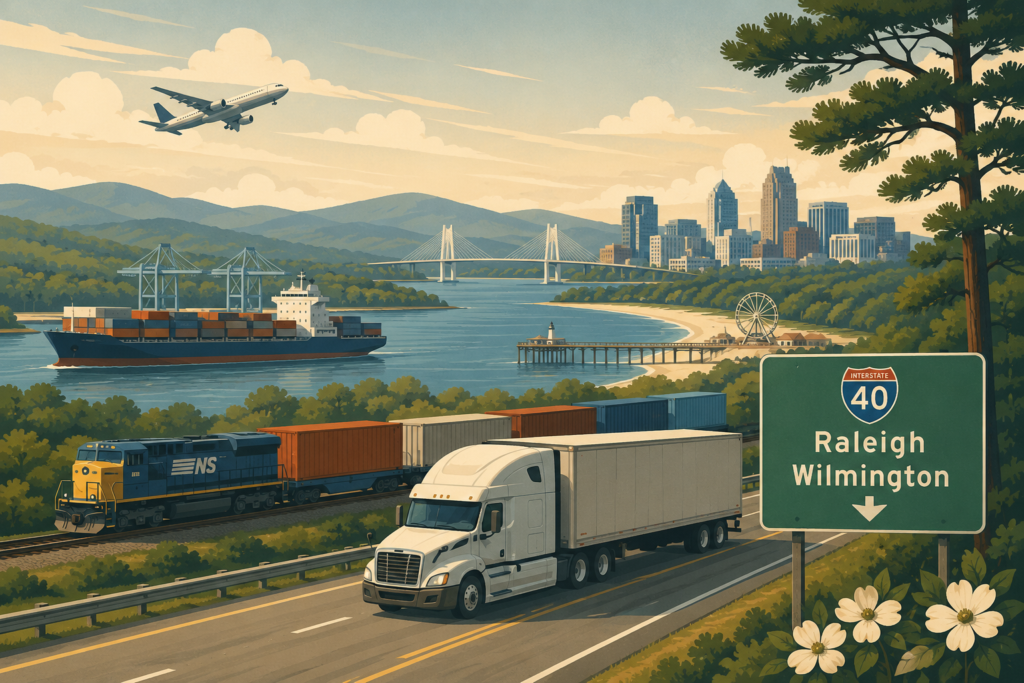
North Carolina serves as a major national and international freight hub. It’s the home to an extensive multimodal freight network that supports the efficient movement of goods across the state. The state utilizes an interconnected system of trucks, Class I railroads and short line rail connections, deepwater ports, and air cargo hubs to distribute goods to over 150 million customers, all within one day’s drive. Over a huge 80% of cargo here is carried via road, especially highlighting the importance of the highway networks here.
In this blog we will deep dive into how freight moves to, from and through North Carolina. While also highlighting how its robust multimodal logistics network keeps everything connected.
Top Industries Relying On Freight Movement In North Carolina
North Carolina handles hundreds of millions of tons of goods each year. The top industries contributing to this volume include:
- Agriculture
- Food
- Automotive manufacturing
- Aerospace
- Pharmaceuticals
- Life sciences
- Retail and e-commerce
- Furniture and textiles
- Manufacturing
- Coal & other bulk commodities
- Wood products
Major Roadways In North Carolina
We touched on it earlier about road freight being the backbone of freight movement in North Carolina, but it’s driven by key major Interstates. The Interstates here connect major East Coast distribution centers, ports and industrial hubs. Primary trucking corridors here include:
I-40
The I-40 is the longest Interstate Highway in North Carolina, and is the only Interstate to span the entire state from West to East, with a total of 420 miles from the Tennessee border to Wilmington. It’s heavily used for transcontinental and cross state distribution. To put into perspective how heavily utilized the I-40 is, it handles roughly $300 billion of goods annually, with over 12 million commercial trucks travelling the route each year. Daily volumes average around 10,000-16,000 trucks per day on the busiest segments of the road.
I-85
The I-85 is a major manufacturing and logistics corridor. It stretches 232 miles from the Virginia state line near Henderson through the Piedmont Triad and Charlotte regions and down to the South Carolina border. It’s one of the heaviest utilized highways and carries daily volumes similar to the I-40 between 10,000-16,000 commercial trucks. The busiest section is at the I-85 and I-40 intersection, making it one of the busiest freight zones in the state. Although the I-85 bypasses central Charlotte, it can still directly connect via the I-77 and I-485
I-95
The I-95 is a major freight corridor with its’ entire length running through 15 different states. The length it runs through North Carolina is 182 miles north-south along the eastern seaboard. It is an essential roadway for moving freight from Northeastern markets and Florida. To highlight its importance, this popular route, carries 15% of all US freight by value.
I-77
Interstate 77 handles between 8,000-11,000 trucks per day in North Carolina, making it one of the heavily utilized freight roadways in the state, behind the I-40 and I-85. This Interstate sees much more traffic but trucks account for 32% of total vehicle volume at certain segments. In total this highway runs 610 miles from South Carolina to Ohio, and the North Carolina section totals 105 miles.
I-26
I-26 serves as a major high volume trucking freight corridor in North Carolina, even though in this state it only runs almost 53 miles in length. It carries around 9,000 trucks per day just south of Asheville, between U.S. 25 and I-40. It connects the Charleston port in South Carolina, and Spartanburg, through western North Carolina and onto Tennessee.
Major Trucking Bottleneck Areas In North Carolina
The American Transportation Research Institute picked out the 100 worst bottlenecks for trucks across the country. Roads in North Carolina took up three of those spots. The biggest bottlenecks in the state are primarily concentrated around the Charlotte area. Below they’re highlighted:
⚠️ I-77 Lake Norman area – The Lake Norman stretch is heavily congested with commuted traffic regularly. This traffic slows trucks travelling north and south of Charlotte.
⚠️ I-85 at I-485 – A busy interchange located near Charlotte Douglas International Airport, this route handles a significant amount of commercial and freight traffic.
⚠️ I-77 at I-485 – This interchange is close to the South Carolina state line, and experiences frequent congestion as traffic enters and leaves the Charlotte region.
Restrictions Around Trucking Freight In North Carolina
Every US state has different restrictions when moving freight. Below are the standard legal limits for moving freight without needing an oversize permit, according to North Carolina Department Of Transportation (NCDOT).
Size Limits
Width: 8ft 6 in
Height: 14ft
Length: 40ft for a single vehicle, combination vehicles up to 60ft
Weight Limits
Gross Vehicle Weight: 80,000lbs
Single Axle: 20,000lbs
Tandem Axle: 38,000lbs
Tire Weight Limit: 600lbs per inch of tire width
For any loads bigger or heavier than these specified standard limits, an oversize/overweight permit is needed before travel along any roads in North Carolina.
Movement Restrictions Of Oversize Freight
Standard freight, or any loads that don’t exceed any of the above limits or require special permits are generally speaking able to move 24/7, 365 days a year. But, although standard loads don’t have any statewide curfews, specialized oversize/overweight loads do and they face some pretty strict travel bans.
It’s important not to categorize every overdimensional load in the same way though, not every oversize load has movement restrictions. For example, continuous travel is still permitted for vehicles and combinations weighing no more than 112,000lbs and measuring no more than 10ft wide. But to qualify for continuous movement, that same load must not exceed the standard limits for height or length also.
The following are the state movement restrictions for loads bigger, heavier, longer and wider:
Operating Hours
Daylight hours: Travel is heavily restricted to daylight hours only, meaning between sunrise and sunset. However, loads that are wider than 8ft 6, but no wider than 10ft may also travel between sunset and sunrise, as long as there are at least two working amber lamps fitted and positioned at the widest parts of the load, to make it visible in both directions.
Days of operation: Permitted loads are allowed to travel between sunrise and sunset seven days a week, with no Sunday ban and no Saturday restrictions. As long as the permit allows it.
Holiday Restrictions
North Carolina has fewer holiday movement restrictions than other states. Travel on a valid permit is still allowed during these holidays: New Year’s Day, MLK Day, Good Friday, Memorial Day, Labor Day, and Veterans Day. However, permit offices will be closed on these dates.
The other three holidays are total travel blackouts, for any load that is oversize in: width, length or height, or that exceed 112,000lbs gross, these dates include: Independence Day, Thanksgiving, and Christmas. This blackout travel window is not only in action on the holiday date, it starts at noon the weekday before the holiday and lasts until noon on the weekday after. If the holiday falls on a weekend then it comes into action at noon on the Friday before and finishes at noon on the Monday after.
Metro area curfews
Metro areas carry their own curfews, they restrict the movement of any permitted load that is wider than 12ft to move within a 10 mile radius of Charlotte, Raleigh, Durham or Chapel Hill between the hours of 7:00-9:00am and 16:00-18:00pm.
Weather Restrictions
No load is permitted to move when visibility is less than 500ft or when the road is covered in snow or ice or is otherwise deemed unsafe for travel. Also, during severe weather where movement is allowed, multiple permitted vehicles must not travel in convoy, there must be at least a 2 mile gap in between each vehicle.
Pilot Vehicles
Over dimensional loads that exceed the standard limits require the assistance of escort vehicles, but the number of them depends on the size of your load. Always double check with your shipping partner and the NCDOT to arrange the appropriate aid for smooth moving.
Air Freight
There are twenty airports in North Carolina that facilitate air cargo needs. However, over 99% of the state’s air cargo passes through three major airports: Charlotte Douglas International Airport (CLT), Piedmont Triad International Airport (GSO) and Raleigh-Durham International Airport (RDU)
Charlotte Douglas International Airport (CLT)
The busiest air cargo airport in North Carolina is the Charlotte Douglas International Airport. CLT handled almost 225,000 tons of cargo in 2025, through its 570,000 sqft air cargo center which has direct access to I-77 and I-85. The facility runs seven days a week and offers the infrastructure to handle both domestic and international shipping, while connecting air cargo and the region’s trucking and intermodal rail networks.
Piedmont Triad International Airport (GSO)
Piedmont Triad was the second busiest airport in terms of cargo during 2025, just slightly busier than Raleigh Durham International Airport (RDU). GSO or locally known as PTI acts as the central hub for major integrated logistics operations. In 2025, it handled around 89,000 tons of cargo and mail and is a major cargo hub for FedEx Express Mid-Atlantic Hub. Making GSO a crucial overnight distribution point for shipments moving across North Carolina and further Southeast.
Raleigh-Durham International Airport (RDU)
Raleigh Durham International Airport handled over 87,000 tons of air cargo in 2025. Putting it at the third busiest for cargo in North Carolina, it primarily serves the Research Triangle and supports the movement of time sensitive goods in the region, mainly pharmaceutical, life science and manufacturing industries. Operations here are split into two main facilities, the North cargo area houses dedicated carrier facilities operated by FedEx and UPS. While the South cargo area handles freight transported onboard commercial passenger aircraft.
Waterway Freight
North Carolina is the home to two deepwater ports, located in Wilmington and Morehead City.
The Port of Wilmington
The Port of Wilmington is the state’s primary container gateway. It has access to highways and intermodal rail services connecting Charlotte, Rocky Mount and markets throughout the Midwest. It handles over 4 million tons of cargo annually through facilities with the capabilities of handling: container, bulk, break bulk, and ro-ro operations, it handles around 320,000 TEU’s annually, features 42 foot deep navigational channels and 7 huge cranes capable of handling large container vessels.
The Port of Morehead City
The Port of Morehead City is primarily used for breakbulk and bulk goods. It handles around 1.1 million tons of cargo each year and is strategically located only 4 miles away from the Atlantic Ocean. It provides shippers with extensive warehousing, open storage and convenient road and rail connectivity, particularly Interstates 95 and 40 and Highways 70 and 17.
Rail Freight
North Carolina’s extensive rail freight system is a huge driver of the state’s economy, generating more than $20 billion in annual economic output and keeps industries connected to domestic and global markets. The rail lines here total to approximately 3200 miles and serve 86 of the state’s 100 counties. The network is comprised of two Class I railroads, Norfolk Southern Railway and CSX Transportation, and these are supported by 24 short line railroads. The most common commodities moving via rail include: grain, coal, crushed stone and sand, chemicals, and intermodal containers. The railway offers highway traffic relief, and it has been calculated to take around 1.6 million truck trips off of North Carolina roads annually.
Planning Freight Movement In North Carolina?
North Carolina has very diverse geography and also has one of the fastest growing freight markets in Charlotte. Both of which makes in depth freight planning essential for seamless movement here. Freight demand peaks in September through December in NC, with major holiday retail distribution pressure on Charlotte’s distribution corridors.
When planning routes and delivery timeframes, weather should be seriously considered too. Atlantic hurricane season starts around June and lasts through November. This brings a lot of risk of damage to the area, like flooding and road closures, particularly on I-95 and I-40. During winter, this state also sees snow and ice, both of which can disrupt routes like the I-26 and I-40 near Asheville and Piedmont and central parts of the state between December and March.
PEI Can Help
If you’re planning on moving freight to, through or from North Carolina then let us take the pressure off. We have agencies spread across various states meaning we can handle freight movement throughout the entire US. We also have decades of experience moving all different kinds of loads. Whether they’re oversize, extra heavy, LTL, FTL, or urgent, the list goes on, we can build bespoke solutions for every need.
Get in touch directly on: 888-SHIP-911 or get in touch using the link below for some friendly advise or to book a load. ⬇️
This blog is actually a part of a wider series all about moving freight through the Southeastern states. To read more about how you can utilize multimodal networks to get your goods moving in the Southeast then follow this link and see what state by state has to offer. ➡️ Moving freight in the Southeastern states.
Need help planning a shipment?
Talk with PEI about expedited freight, specialized freight, or your next shipping challenge.
