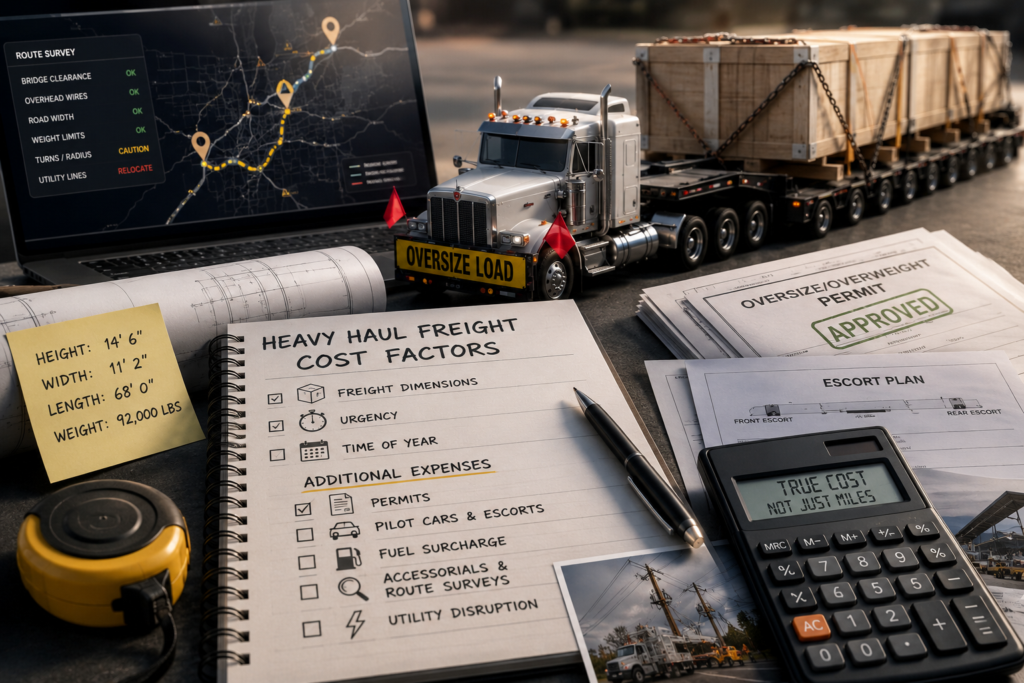
It might seem pretty obvious but moving heavy haul freight comes with a lot of complexities that make it much harder than dealing with regular loads. You see, when moving loads that are larger, heavier, wider, taller, longer and generally more complex than standard freight, calculating the cost to ship it is no longer simply based off of mileage alone. Many more factors must be considered when building a quote for loads of this kind including:
- Extra planning
- Risk
- Special equipment needed to fulfil the movement
- More workers needed to assist with the movement
- Extra layers of coordination when using special equipment
- Planning around route restrictions
- Obtaining necessary permits
- More time working on each load
This is why heavy haul freight is so dynamically priced, there really is no one size fits all solution when moving this kind of cargo. Unfortunately, due to the greater risk and stricter regulations the price tag is ultimately steeper. When working with a trustworthy freight partner, quotes are built on real, measurable costs. This can make your heavy haul movement costs more predictable if you’re aware of what these extra costs are for.
What Is Classed As Heavy Haul Freight In Trucking?
The term “heavy haul freight” refers to a shipment that exceeds standard legal size or weight limits, often abbreviated to OS/OW (oversize/overweight) and requires special measures to move it safely. When you read “heavy haul” it insinuates that the freight is always heavy in weight, but it’s not always just about the weight of the shipment. Width, height, length, axle loading and whether the load can be broken down all matter too.
Legal Weight & Size Limits
Weight: 80,000lbs gross vehicle weight (varies slightly by state/province)
Height: 13.5 feet
Width: 8.5 feet (102 inches)
Length: 53 feet for trailers (varies by configuration)
Loads exceeding these limits often require specialized equipment and trailers, more permits, escort vehicles, and in depth routing strategies.
All kinds of industries move heavy haul goods, some of the more common ones include: construction, manufacturing, energy, aerospace, agriculture, and any others that consistantly have large, oversize or overweight pieces of freight.
Main Heavy Haul Freight Cost Factors
No two heavy haul freight shipments are priced in the same way. The final and true cost depends on a combination of factors, understanding these can make it easier to see how a quote is built and where additional costs can arise down the line. Lets take a look at what factors affect your heavy haul freight costs.
Freight Dimensions
We’ve spoken about what makes a load classify as heavy haul above, i.e. weight, height, length, width, etc. But, not only do these influence the status of the freight, they also heavily influence the cost of moving them. This is because it’s the dimensions of cargo that create the need for extra services like: increased planning time, extra special equipment, permits, escort vehicles, additional warning lights and the list goes on, spoiler alert, we go into more detail below, but first let’s take a look at different trailers and equipment needed to perform a heavy haul move, because this is also determined by the dims.
Different Truck & Trailers To Fulfil Heavy Haul Freight Needs
Choosing the most suitable truck and trailer type to move your heavy haul freight makes all of the difference to efficiency, loading, unloading and extra requirements. But, they all come at different rates.
A flatbed service tends to be the base rate, and then each of the following, more specialized trailer types add additional costs. Here’s the common trailer types used in heavy haul trucking:
- Flatbed & Stepdeck: Flatbeds and stepdeck trailers are ideal for heavy and oversize hauls because of their open, barrier free design, which allows irregular shaped freight or large freight to overhang and makes loading and unloading of large, heavy and awkward freight easier. Step decks also have room for taller freight and more height clearance with a lower section of deck.
- Multi-Axel Removable Gooseneck (RGN) Trailer: RGN’s are the standard trailer used to move super heavy, tall and/or self propelled machinery, i.e. bulldozers and excavators. The front detaches to allow the trailer to drop flat to the ground for drive on and drive off. A standard 2-axel RGN can carry weight up to 40,000lbs but where the super heavy freight benefits is using a multi-axel that can handle 150,000lbs.
- Lowboy Trailer: Lowboy trailers are a great choice because of their ultra low clearance. Their unique drop deck design can accommodate oversize, overweight and over height.
- Extendable Trailer: Extendable trailers, like the name alludes to extend and collapse in length to fit extra long or indivisible freight, preventing long overhangs. It also means that it can distribute extreme weight across multi-axel configurations.
- Multi-Axel & Specialized Trailers: Multi-axel trailers are great for distributing extreme weight evenly. Preventing structural damage to roads, improves stability and ensures compliance with strict legal axel weight limits.
Urgency
Heavy haul freight isn’t typically something that should be planned at the last minute, because the carrier needs time to obtain permits and thoroughly survey, plan routes and coordinate escorts, extra movement support and equipment.
However, that being said, it can still be done, because let’s face it, sometimes there is no other option. When a specialized shipment is urgent, several planning steps including: the planning, obtaining permits and escort vehicles, organizing specialized equipment, etc. must be completed simultaneously or in an expedited manner, which is charged accordingly. And as options for equipment and carriers may be slimmer due to tight timeframes, this could also potentially drive the price up.
Where you can, providing as much notice as possible means you have more options and can find suitable solutions at a better price.
Additional Expenses
Before shipping any freight, it’s normal to shop for a quote, but the price you first see isn’t always the “true cost”. A true cost includes any additional expenses that are incurred to complete the job. When moving heavy haul freight there are a ton of extras that must be accounted for. Here’s some “true costs”, we’ve briefly mentioned earlier that must be factored in when moving heavy haul:
Permits
Every state has their own individual oversize and overweight limits that require different permits. Costs range from $15 – $100 for routine, single state passes, issued within 1-3 business days and upwards of $100 – $500+ for a superload, generally issued in 5-10 business days. These permits can be expedited in most states for an additional fee, there are also annual blanket permits available for frequent moves within some states, again for a fee.
To put it into perspective, a long haul load passing multiple states can rack up additional fees between $500-$2000 in permits alone.
Pilot Cars & Escorts
Extra wide or long loads require escort vehicles by law, also known as pilot cars. But again, each state and freight dimensions call for different escort needs.
1 rear escort is usually sufficient for a load that exceeds 12-14 feet.
1 front + 1 rear escort required in most states when the load exceeds 16 feet wide or is extremely long.
Law enforcement escorts are needed when superloads are moving through busy areas.
An escort vehicle adds additional fees, they typically cost $1.50-$3.00 each per mile. Which as you can imagine over a long haul journey, that cost can quickly rack up.
Fuel Surcharges
Fuel surcharges are adjusted weekly using the national diesel averages. With fuel prices being so up and down at the moment, it’s tricky to judge how much a fuel surcharge will add to your journey.
Accessorial & Route Surveys
Complex loads and complex routes require pre trip route surveys to check for overhead and bridge clearances, and other infrastructure restrictions that could lead to potential risks. These checks and surveys incur additional fees, billed directly to the shipper. When detours are necessary increased milage can add on extra costs.
Utility Disruption
Oversize loads with a height of over 4.2m can catch overhead power lines, traffic lights or communication cables and become tangled, causing significant damages. This is a major safety hazard and can cause supply chain delays and significant fines, should damage be caused. To mitigate the risk of disruption carriers must:
- Physically perform route surveys to ensure clearance
- Use permitting systems such as, AASHTO Transportation Uniformity Guide to notify DOTs and utility owners of potential conflicts.
- Organize with local utility companies to raise, disconnect, or temporarily move power, telecom, fiber lines and any others that could cause disruption.
- Use high pole escort vehicles which can be arranged to travel ahead of the tall load and lift wires and confirm clearance.
Securing Specialized Freight
Large and heavy freight tends to require bespoke securing methods over standard strap downs to keep it secure during transportation. Oversize/overweight cargo might require things like: custom tie downs, weight balancing, chains, binders, blocks, braces, protective coverings or custom support frames, etc. This extra labor and equipment will influence your quote. Providing drawings, lift points, and all important information about your cargo can help your carrier to prepare the right securement plan in advance.
Diesel & Fuel Consumption
Heavy hauling is famously bad for fuel efficiency, and miles per gallon are low. Because the higher the gross weight of a load, directly increases diesel consumption on each journey, which is tied to market indices. Meaning, a higher total cost of movement.
Insuring Your Heavy Haul Loads
Heavy haul cargo generally has higher insurance costs than regular freight (with the exception of some high value goods). Purely because they typically have severe financial risk of total loss, complex salvage requirements, potential for huge infrastructure damage, and high value business interruption claims should things go wrong. Premium insurance rates reflect these risks to cover the liability.
Time Of Year Shipping
The time of year that you need to ship your heavy haul load, can significantly affect your total freight cost. Seasonal weather, holiday restrictions, road works, construction zones and equipment availability can all affect how and when a load can travel and ultimately have a knock on effect to your quote.
Wide and tall loads are particularly vulnerable to extreme weather conditions, making it unsafe for travel during certain conditions. Holidays, weekends and peak commuter travel times limit the movement of heavy haul freight through many states. Roadworks and construction projects can both create route restrictions, forcing alternate routes that may not be accommodating to heavy haul freight. Demand for specialized trailers, drivers and pilot vehicles may also increase during busy times, reducing availability.
When a heavy haul load is left at a stand still because of any of these factors, it can result in; driver layovers, pilot car standby charges, storage fees, and rescheduling routes, permits and support crews. All of which creates additional charges.
How To Keep Your Heavy Haul Freight Costs Down Per Mile
Heavy haul freight is always going to come with a higher price tag than standard transportation, but there are still ways that you can keep costs under control. You’re most likely to make savings when planning early, providing accurate information and avoiding changes once the movement has already been arranged.
Providing exact measurements and weight allows your freight partner to select the most appropriate trailer, route, permits, and escort requirements from the get go. And if you can, be flexible with collection and delivery dates and times, this gives your carrier more time to source specialized equipment if needed and avoid particularly busy periods. Finally, compare all quotes based on true costs, not just the first initial rate. Check that all permits, pilot cars, fuel surcharges, route surveys, and other accessorial charges are included. If they’re not, factor them in before comparing to get the real picture.
Conclusion
After reading all of this, it’s obvious that a lot more goes into a heavy haul freight quote than the distance between pick up and delivery addresses. All of the above factors from the dimensions, route, urgency, planning, permits, equipment type and support needs, heavily influence the final cost of moving your heavy haul goods.
The main thing to do to ensure the movement of these types of loads runs as smoothly as possible is, identify your full needs early on. Then you can create a safer and more efficient movement process with fewer unexpected expenses.
If you’re looking to move any heavy haul, or other specialized freight that requires an experts touch, then PEI could be the team for you. We have decades of experience moving overdimensional freight, in fact, the tougher the requirements the more we love to get ourselves stuck in. You can contact us directly by cell on: 888-SHIP-911 or use the link below to reach out ⬇️, and get some advice or book a load. We’d love to take your shipping nightmares out of your hands so you can focus on your business.
Give us a shot, you won’t regret it. 😊
Need help planning a shipment?
Talk with PEI about expedited freight, specialized freight, or your next shipping challenge.
