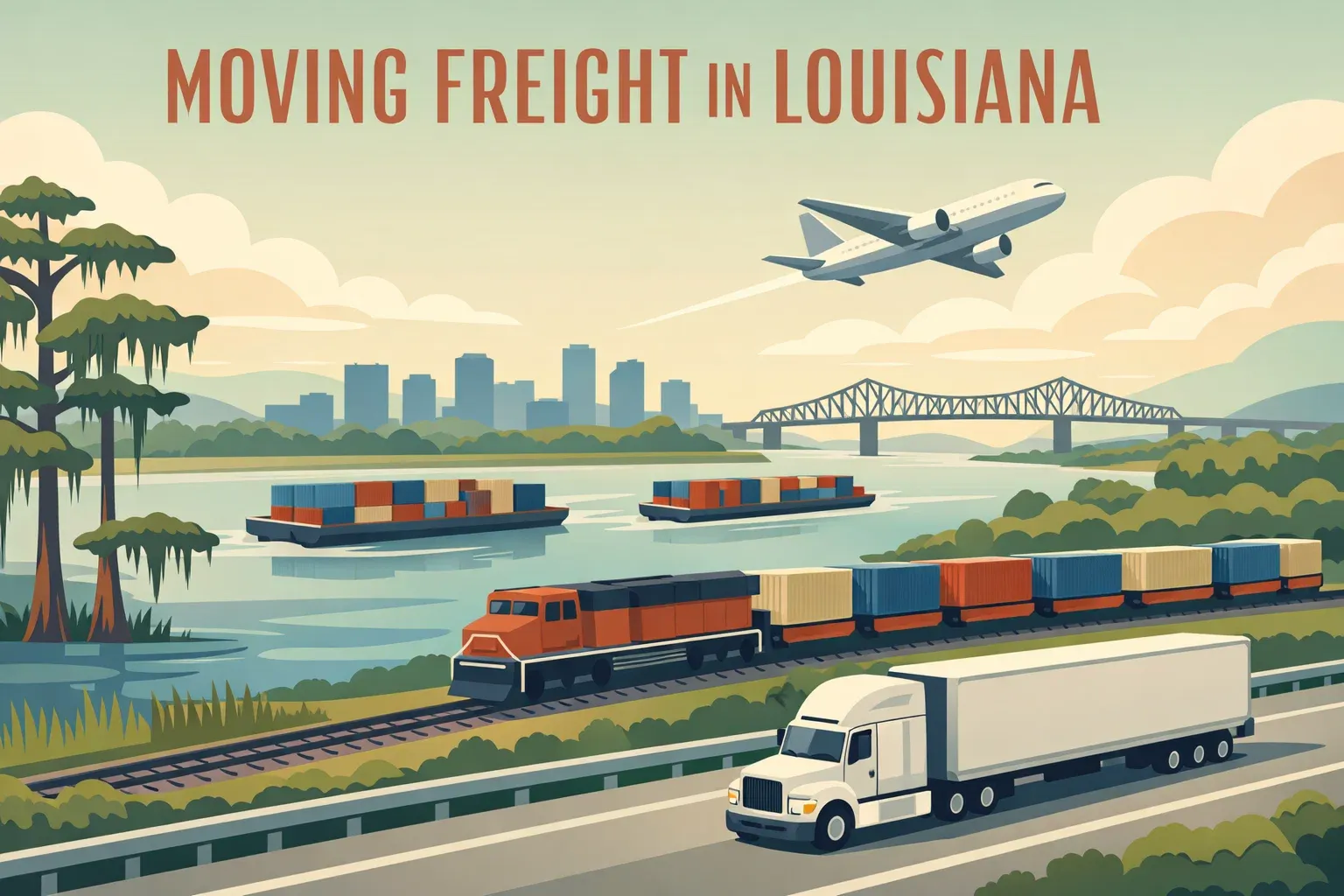
Moving Freight In Louisiana
The next Southeastern state, on our radar, if you’re keeping up with the mini-series is Louisiana. Louisiana is another state that excels in the movement of freight through an extensive network of multimodal shipping options. In this blog we will cover all of the major freight networks that Louisiana has to offer. We will include popular freight routes, bottlenecks and congested areas and restrictions around moving different over-dimensional truck freight. But, let’s get straight into it, because Louisiana has a ton of freight options to cover, we could be here a while!
Freight Solutions In Louisiana 🚛
The states economy relies heavily on freight movement, and the 1.4 billion tons of cargo moved annually here, is valued at a huge $581 billion. It’s a major US multimodal freight hub, connecting ports, railways, interstates, highways, extensive pipeline networks and cargo airports.
Key Industries Relying On Freight Movement In Louisiana 🏭
There is a wide variety of freight regularly moving through the state of Louisiana. With key industries moving here consisting of: petrochemicals, agricultural, manufacturing products, oil and gas.
Major Sea & River Ports ⚓️
As we’ve just mentioned Louisiana is a major US freight hub, but arguably it has the best sea and river port access in the US. It’s the home to 8 deep draft ports and 32 active shallow ports that make up its’ maritime cargo system, creating 2800 miles of navigable waterways. What’s even more impressive 5 of which are in the top 15 ports in the nation, ranked by tonnage. Some of these busy ports are perfectly positioned at the mouth of the Mississippi River and these ones alone carry 20% of US waterborne commerce mounting up to more than a whopping 500 million tons of goods, that’s more than 50% of the nation’s grain and 23% of the nation’s coal. Below we’ve highlighted some of the busier ports in Louisiana.
Port of South Louisiana 🚢
The Port of South Louisiana is a river port, that serves as a major international sea gateway. It covers 54 miles along the Mississippi River, located between New Orleans and Baton Rouge on the Gulf Coast. It’s an extremely busy port, in fact it ranks in second place in the United States for overall tonnage. It handles around 250 million short tons of cargo year on year and is the primary export port for grains, handling over 60% of all grain cargo in the Midwest. The facilities at the port allow for the handling of bulk, breakbulk and containerized cargo, most often in the agricultural, chemicals and petroleum industries.
Port of New Orleans 🚢
The Port of New Orleans is another busy deep draft river port and international sea port in Louisiana. It handles over 81 million metric tons of cargo each year and this numbers keeps climbing! In 2025 we saw a 9% increase in TEU’s compared to late 2024. Most commonly the freight moving through this port is petroleum products, containerized goods and agricultural products. The facilities at this port allows for container, breakbulk and bulk cargo, and the port acts as gateway to international trade to global markets via the Mississippi River.
Port of Greater Baton Rouge 🚢
The Port of Greater Baton Rouge follows the two ports above and also fall into the top 10 US ports by tonnage. It handles over 71 million metric tons of cargo annually and with extensive port facilities it allows for bulk, breakbulk and containerized cargo. The most common types of freight moving through this port are: petroleum, chemical and agricultural products and it’s fantastic positioning makes it a deepwater river port with the ability to serve central America by efficient movement via the Mississippi River. This location also means it connects inland waterways with the Gulf Intracoastal Waterway.
Port of Lake Charles 🚢
The Port of Lake Charles is a major deepwater seaport and ranks as the nations 10th busiest port district, handling over 64 million tons of cargo annually. This port is located at and manages the Calcasieu Ship Channel, running inland 36 miles and another 32 miles out into the Gulf of Mexico. It offers breakbulk, project and speciality cargo solutions and is the port known as “America’s Energy Corridor” as it’s the world’s number 1 LNG export provider. However, it also handles a range of international lumber and industrial shipments.
Louisiana Gateway Port 🚢
Some of you reading this might know the Louisiana Gateway Port to be called the Port of Plaquemines, it is a busy growing freight hub and ranks in the top 20 largest ports in the US by tonnage and handles around 50 million tons of cargo annually. This is a deepwater river port situated at the mouth of the Mississippi River and is a critical link for ocean going ships at the mouth of the Gulf of Mexico. It handles a diverse range of cargo and makes up 1 of the 5 major ports, along with the others discussed above on the lower Mississippi River. Jointly these ports handle over 500 million tons of cargo each year.
Air Freight ✈️
While Louisiana is renowned for it’s maritime ports, air cargo solutions are a growing part of Louisiana’s transportation infrastructure. In fact, air solutions in this state handle over 212 million pounds of cargo annually. Below is the main air cargo hub in the state:
Louis Armstrong New Orleans International Airport (MSY) 🛬
The MSY airport is a major freight hub particularly for FedEx, UPS and DHL and it operates as the states primary airport for cargo. It offers services for very varied freight types, including pets, seafood and other perishables, high-value goods, priority freight and can move goods domestically and internationally. It’s the largest airport within a 300 mile radius, and handles a substantial portion of Louisiana’s air cargo, as it easily links freight to major hubs like, Memphis, Louisville and Cincinnati. The airport covers 1500 acres, with two runways making it suitable for large cargo aircraft.
Rail Freight 🚆
Rail freight in Louisiana is critical to the states cargo movement and transports over 1 million tons of goods annually, using a network of six Class I railroads and 14 plus short lines. Key commodities moved through rail include: chemicals, petrochemicals, agricultural products, lumber and metal goods. The network connects to industrial sites, making national and international trade run much smoother.
Pipeline Movement 🛢️
Louisiana is the home to an extensive network of thousands of miles of oil, gas and chemical pipelines both onshore and in the Gulf of Mexico, approx. 81,000 miles of pipelines. The major pipelines in Louisiana are used to move crude oil from offshore marine terminals in the Gulf Coast, to refineries and terminals. The volume moving through these pipelines is over 500,000 barrels of crude a day!
Key Freight Roadways in Louisiana 🛣️
Freight lanes through Louisiana pass across coastal paths, plains, swamps, etc. But there are a handful of freight corridors that carry the majority of trucking traffic. Here’s a list of the most popular freight corridors in the state:
I-10 Texas to Mississippi (East – West)
The I-10 passes through the Southern area of Louisiana through Lake Charles, Baton Rouge and New Orleans and is the undisputed primary popular freight route, carrying almost 170 million tons annually.
I-12 Baton Rouge to Slidell (East – West)
The I-12 provides a form of relief for truckers and passenger traffic alike wanting to bypass downtown New Orleans. It’s a 95 mile stretch that connects the I-10 in Baton Rouge to I-10 Slidell.
I-20 Mississippi to Texas (East – West)
The I-20 is a major freight route, spanning across northern Louisiana and connects Shreveport, Monroe, and the border of Texas.
I-49 Lafayette to Shreveport (North – South)
The I-49 connects Lafayette to Shreveport and the I-10, creating a major North-South freight lane.
LA1
LA1 is a critical freight lane to Louisiana as it’s the only road with access to Port Fourchon and the Louisiana Offshore Oil Port.
LA23
The LA23 is the main industrial corridor along the west bank of the Mississippi River and connects the Louisiana Gateway Port with I-10 networks.
⚠️ Major Trucking Bottleneck Areas
I-10: The Louisiana Airborne Memorial Bridge, a twin span, 18 mile long bridge on the I-10 that connect Baton Rouge and Lafayette remains a chokepoint enhanced by the new 60mph truck only speed limits and frequent accidents leading to road closures.
I-10 New Orleans Metro Link: The interstate connecting in the city frequently experiences heavy traffic.
I-12: The I-12 used to experience significant congestion near the US 190 interchange, particularly on a Friday afternoon/evening. However, the LaDOTD invested a significant portion of funds into widening, adding lanes and a new bridge over Bogue Falaya River which are now all open and operating, hopefully easing some bottleneck traffic.
Trucking – Legal Size & Weight Limit 🚚
Louisiana’s legal freight limits tend to follow federal standards. Allowing the following dimensions:
Weight Limits –
Gross Weight: 80,000lbs
Single Axel: 20,000lbs
Tandem Axel: 34,000lbs
Size Limits –
Width: 8.5 feet
Height: 14 feet on interstates & 13 feet, 6 inches on non-interstate highways
Length: 45 feet for single unit trucks & 65 feet for combination vehicles.
What Other Trucking Restrictions Should You Know When Moving Freight In Louisiana? ⛔️
To be sure freight is moving compliantly, it’s important that shipping partners follow state laws, regulations and designated routes closely. In order to do so, shippers and freight providers need to know the restrictions, checking by region and state as they can vary. Below are restrictions that the state of Louisiana enforce.
Oversize/Overweight Permits & Insurances 📝
Any loads exceeding the above limits would require a specific permit to be obtained before movement, which can all be acquired from the LaDOTD website. But it’s important to note that as of late 2025, all new annual oversize and overweight heavy equipment permits require a registered route to be approved prior to movement. Oversize and overweight loads must also be able to provide a certificate of insurance for a minimum of $100,000 and proof of general liability and motor vehicle liability insurances.
Single Trip vs Annual Permits 🗓️
When moving over-dimensional freight it’s important to choose between single or annual trip permits. Single trip permits could work better for non-regular transports. Whereas, an annual permit can save tons of time on admin, and work as a blanket permit, which can be obtained for businesses that regularly transport oversize loads.
Superload Permit 📑
A load that exceeds 232,000lbs in Louisiana is deemed as a “superload” and requires a special permit. But, a superload has much more stringent requirements, including: providing dimensions and detailed engineering drawings of the assembled vehicle, i.e. showing axel spacing, and weight distribution, etc.
Escort Vehicles 🚓
Escort vehicles are required for over-dimensional loads to warn other road users of the large load. They’re typically needed in Louisiana when:
Width: Loads over 12 feet wide, up to 16 feet require one or more escort vehicles. Any over 16 feet require a police escort.
Length: Loads that total over 90 feet long and up to 125 feet require escort vehicles.
Height: Loads over 15 feet and 10 inches up to 16 feet and 8 inches require escort vehicles with a high pole on the lead vehicle.
Travel & Operating Times ⏰
Oversize loads are generally restricted to only move during daylight hours, sunrise to sunset and are completely prohibited on weekends and through metropolitan areas during rush hours (between 7am-9am and 4pm-6pm).
Holiday Travel Restrictions❗️
Major holidays restrict the movement of cargo across the entire U.S. In Louisiana, these restrictions span:
- New Year’s Day
- Memorial Day
- July 4th
- Labor Day
- Thanksgiving
- Christmas
Mardi Gras 🎭
While this is common in all states, Louisiana has an extra holiday, Mardi Gras. During Mardi Gras, there is a ban on large vehicles, i.e. box trucks within two blocks of parade routes starting 4 hours before the event and resuming 4 hours after. Besides this, Mardi Gras brings a ton of traffic congestion to the surrounding areas causing delays and there are major closures in the French Quarter and Uptown, affecting passenger traffic and the movement of freight.
Conclusion 💭
If you didn’t already know the full extent of how freight moves in Louisiana, then hopefully this blog has highlighted some key freight corridors in the state. From the lower Mississippi River ports, ocean ports in the Gulf of Mexico, expanding air cargo solutions, rail links, pipeline movement and critical interstate routes this state dominates in domestic and international freight.
If you’re looking to move freight to, from or through Louisiana then rest assured, we can navigate the state like the backs of our hands. Get in touch with us directly via cell on: 888-SHIP-911 or use the link below to reach out, we’d love to hear from you!😊
Need help with any of your specialized oversize and high-value domestic shipments?
Today can be the day you stop struggling with your logistics problems.
At PEI we’re experts in dealing with specialized freight and can handle yours with any custom requirements.
