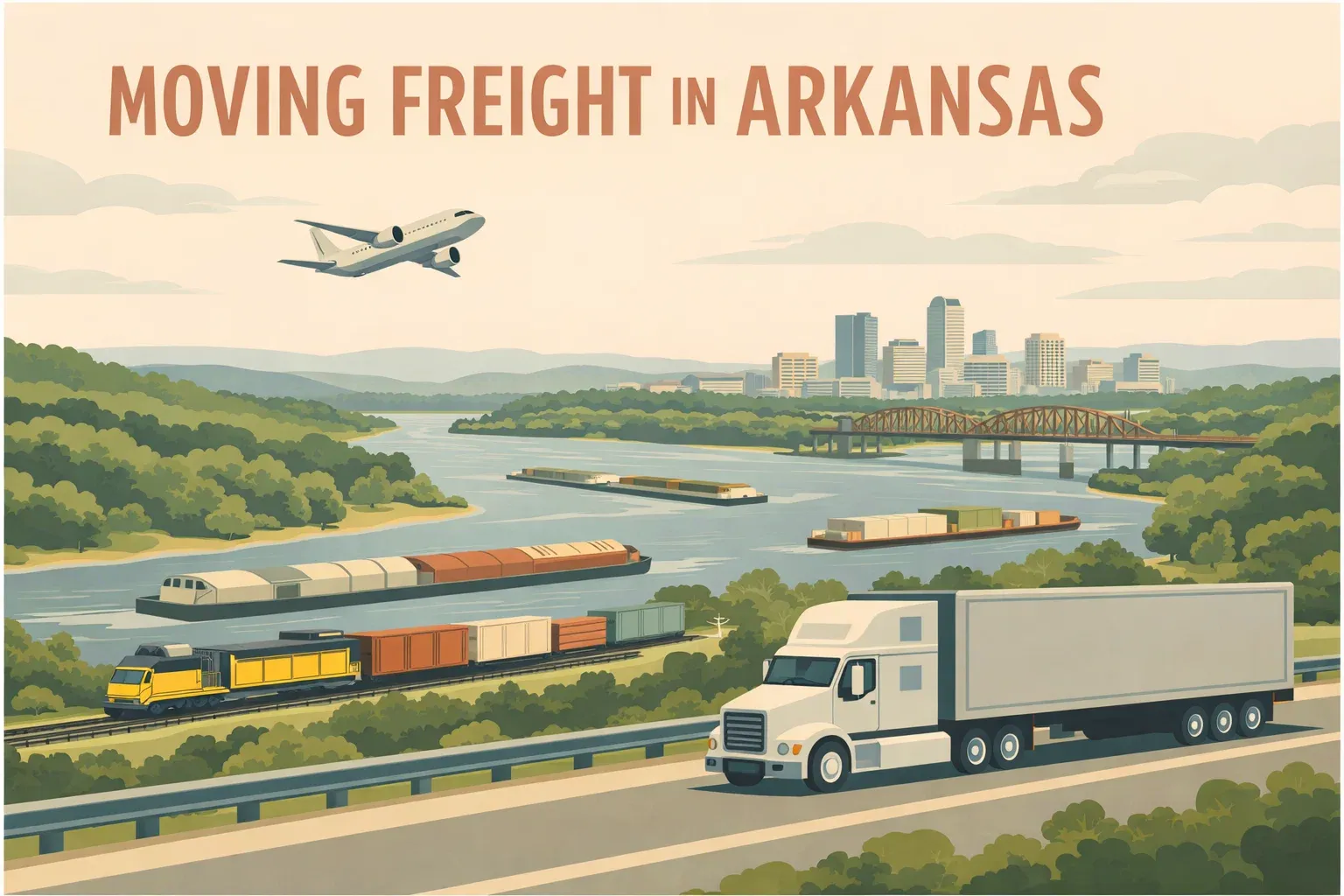
Moving Freight In Arkansas
Arkansas is considered a major freight and logistics hub within the Southeastern states. Which is why we wanted to cover all things freight movement through this state as our next entry to our Southeastern states mini-series. If you haven’t already seen, in previous blogs we’ve covered: Alabama, Florida, Georgia, Tennessee, Kentucky, Louisiana and Mississippi. If you’re moving freight through any of these states then go ahead and give them a read, you might gain some useful information that perhaps you didn’t know before.
But for now, let’s focus on Arkansas, a state known for its gorgeous and diverse landscapes like the Ozark Mountains, this state has a ton to offer in terms of logistics, from vast railroads, airfreight solutions, to major waterways and roadways. So let’s look at the main freight modes and the restrictions set around freight movement through Arkansas in this blog.
How Does Moving Freight In Arkansas Work? ⁉️
Freight transportation through Arkansas primarily moves using an extensive multimodal system. Here, transportation companies utilize strong interconnected trucking, rail, water and air solutions, though air freight here is much less common than the other modes mentioned. The state boasts over 1,800 miles of navigable waterways, over 1,600 miles of Class I railroads, and more than 16,000 miles of state and US highways. Through these routes, the state has direct access to a market of around 100 million people, which is approximately a whopping 30% of the US population!
Top Industries That Rely On Freight Movement In Arkansas 🏭
There is a broad range of industries that rely on the movement of freight through Arkansas, including but not limited to:
- Agricultural
- Mineral
- Fuel
- Chemical
- Machinery
- Industrial
- Food
- Textile
- Furniture
- Apparel
- Other consumer goods and products.
So what are the common ways that these industries move cargo through Arkansas?
Rail Freight 🚝
Rail freight across Arkansas is a major player in transportation solutions in the state. It’s the home to 23 railroads, 3 x Class I Railroads and 20 Short Line Railroads, totalling over 2,500 miles of rail. These vast railroads carry more than 160 million tons of freight valued at more than $300 billion, the equivalent to 8.6 million truckloads on our roads, taking a lot of pressure off Arkansas’ roads and traffic congestion. The amount of rail freight moving is expected to climb around 25% through 2050 to around 200 million tons valued at around $500 billion. The type of freight travelling via rail in Arkansas varies widely, including: food, chemicals, grain, coal, stone, sand, steel products, lumber and wood products.
Air Freight ✈️
Air freight plays a smaller but important role in Arkansas, especially for the quick movement of urgent, time-sensitive and high value shipments. Most of the air freight activity happens in one key airport in this state:
Bill and Hillary Clinton National Airport (LIT), Little Rock
LIT supports services ranging from expedited small package shipments to international freight forwarding. It has a 104,000 square-foot foreign trade zone, providing manufacturing and distributing companies with an ideal international shipping solution. This helps to avoid financial burdens when goods are imported and cleared through customs immediately. Businesses using the trade zone can benefit from: duty exemption on re-exports, duty deferral, inverted tariffs, streamlined customs procedure, and export exemption from state taxes.
Waterway Freight 🚢
Utilizing waterways to move freight offers a low cost, high capacity method to move bulk goods. Arkansas is the home to over 1,800 miles of navigable waterways, ranking it third in the nation for the most waterway miles. The waterways here are a real hotspot for cargo especially the Arkansas River from Port Smith to the Mississippi River and the movement of freight on these waterways generates billions of dollars in sales to the Arkansas economy. Let’s take a look at some key waterway ports and inland water systems dominating Arkansas.
Key Waterways
McClellan-Kerr Arkansas River Navigation System (MKARNS)
This waterway is 445 miles long with 18 locks and dams that ensure a year round channel from the Mississippi River to Tulsa, Oklahoma. It carries over 12 million tons of cargo each year, transporting key commodities like, iron, steel, fertilizers, petroleum products, grain and wood products.
Mississippi River
The Mississippi River forms the Eastern border of Arkansas, separating it from Tennessee and Memphis. Arkansas is one of ten states that this major river runs through and it acts as a major waterway for the state. The Mississippi River serves as a high volume shipping channel that connects Arkansas to major national and international markets. Primarily moving agricultural products, coal and petroleum products and handles millions of tons of cargo annually.
Ouachita River
The Ouachita River is a 605 mile long river, with 351 miles of it being navigable. It’s responsible for smaller volumes of freight movement in the state and is often overlooked, but still a crucial commercial navigation channel in Arkansas. The river is primarily used to transport bulk materials, including lumber, wood products, and chemicals, etc.
Key Ports
Along the above waterways, there are multiple key public ports facilitating the movement of commodities. Here’s a list of the more popular ports:
- Port of Little Rock
- Port of Pine Bluff
- Port of Fort Smith
- Port of Osceola
- Helena-West Helena Port
- Yellow Bend Port
Major Roadways In Arkansas 🛣
Road freight is vital to Arkansas’ economy and here trucking utilizes multiple major corridors like the I-40 and I-30 to handle significant interstate traffic. Let’s take a look at the main trucking freight routes through the state.
Interstate 40 (I-40):
The I-40 is a major East – West Interstate Highway that spans almost 285 miles through the state of Arkansas and connects Oklahoma with Tennessee. It enters Arkansas north of the Arkansas River, near Dora and travels East across the Northern section of the state and connects multiple cities including: Fort Smith, Clarksville, Russellville, Morrilton, Conway, North Little Rock, Forrest City and West Memphis. As a major connecting route, it serves a ton of truck freight and experiences heavy traffic.
Interstate 55 (I-55):
Interstate 55 is a key 72 mile North – South route in the Northeastern area of the state that connects Memphis to Missouri. It enters the state at the Memphis and Arkansas Bridge, crosses the Mississippi River and overlaps with the I-40 for almost 3 miles, where it then splits from it in West Memphis and passes through Marion, Turrell, and Blytheville before entering Missouri.
Interstate 49 (I-49):
The I-49 is a major North – South Interstate Highway that spans 500 miles between Louisiana, Arkansas and Missouri. In Arkansas it is broken up into two sections that total 127 miles. The Southern section runs 42 miles and starts at the Louisiana state line to Texarkana at the Texas state line and the Northern section begins its 85 miles at the I-40 and US Highway 71 in Alma and runs North to the Missouri state line, where the freeway then continues into Missouri.
Interstate 30 (I-30)
Interstate 30 is a major Interstate Highway in the Southern states of Arkansas and Texas. It runs Northeast from the Texas border in Texarkana to its terminus at Interstate 40 in North Little Rock. The entire interstate is almost 367 miles long, with the Arkansas portion taking almost half of that, being 143 miles long.
US Highway 67
The US Route 67 runs from Texas up to Iowa. The Arkansas leg of the route is almost 280 miles in length, entering the state at Texarkana, northeast up to the Missouri state line near Corning. It travels through several cities along the way including: Hope, Prescott, Arkadelphia, Malvern, Benton, Little Rock, North Little Rock, Beebe, Searcy, Walnut Ridge and Pocahontas.
⚠️ Major Trucking Bottleneck Areas
Most traffic bottlenecks in Arkansas are concentrated around major interstate junctions, particularly around the Little Rock and Northwest Arkansas regions. These congested areas have significant effects on freight movement in the state.
Little Rock Area
The junction at the I-30 and I-40 in central Arkansas, is one of the state’s most critical and congested bottlenecks. The intersection is a major hub for freight movement, combining heavy local traffic and interstate commerce movement.
West Memphis/Memphis Border
The I-40 and I-55 junction in West Memphis is a critical high congestion freight bottleneck that ranks among the worst in the United States. It’s a 15 mile route that connects Arkansas to Tennessee that experiences significant and long lasting backlogs of traffic.
Northwest Arkansas
Congestion is growing along the I-49 around the Fayetteville/Springdale area, due to increased freight movement activity along this corridor.
⛔️ Restrictions Around Trucking Dimensions & Freight In Arkansas ⛔️
The legal limits of a vehicle’s size and weight vary state by state, each one has its own regulations and permits for oversize and overweight freight. In Arkansas, the legal limits of a truck are as follows:
Gross Vehicle Weight: 80,000lbs
Length: 53’6″ long
Height: 13’6″ high
Width: 8’6″ wide
If any vehicle exceeds any of these dimensions then it is likely overweight or it’s deemed as an oversize load. For an over-dimensional load in Arkansas, the Arkansas Department of Transportation (ARDOT) can issue permits via their online portal. It’s important to note that ARDOT will not issue an oversize permit to a load that can be reduced or dismantled in size or weight to meet the legal requirements across multiple loads.
Loads exceeding the following dimensions, are classed as a superload and a different permit would be required and further restrictions apply to the movement of your freight. This kind of load usually requires case by case permissions from ARDOT:
Gross Vehicle Weight: 180,000lbs
Length: Length is route dependent
Height: 17′ high
Width: 20′ wide
Always check ARDOT for specific requirements before the movement of any load.
Other Considerations When Moving Oversize Freight In Arkansas 🤔
- Infrastructure – along a planned route, a permit issuance does not mean that bridges and structures, etc. can accommodate the oversize vehicle’s weight and height clearance. Always check your routes!
- Weather – Tornadoes and flooding are big problems in Arkansas, causing shipment delays, route closures and dangerous travel conditions.
- Oversize load signs – An oversize load must have a sign displaying “OVERSIZE LOAD” on the front of the vehicle and at the rear of the load and red or orange flags must be attached to the rear corners of the load and at the front of the vehicle. Again, check what stipulations are in place for the movement of such large cargo.
Movement Restrictions Of Oversize Freight ⛔️
Oversize freight permits come with set restrictions, here’s some of the more common ones:
- Movement is only permitted during daylight hours.
- Permits are void if visibility is less than 500 feet or during severe weather like rain, sleet, snow and other hazardous conditions.
- Oversize freight is not permitted to move through the Greater Little Rock area between 7am-9am and 4pm-6pm on sections of Interstate 30 and 40 and all of Interstate 630.
- Restricted movement of oversize freight during strong winds (23 mph or greater)
- No permits allow movement of oversize freight on the following holidays: New Year’s Day, Memorial Day, Independence Day, Labor Day, Thanksgiving Day and Christmas Day.
- Permits can be gained for oversize freight movement on the following dates: Martin Luther King Day, President’s Day, Veterans Day and Christmas Eve.
Conclusion 💭
As you can see, Arkansas plays an important role in freight movement across the Southeast, it offers a well connected multi-modal network that helps to support regional and national supply chains. There is a freight solution for every kind business or individuals cargo needs here. The state has strong access to highways, railroads, navigable waterways and air freight services, giving businesses the pick of efficient transportation options to key markets. The reliable freight infrastructure here enables a whole range of different industries, like agricultural, and chemical to machinery and fuel to move goods effectively across state.
Are you looking to move freight to, from or through Arkansas? If you are then we can assure you that we can navigate the state like the backs of our hands. Get in touch with us directly via cell on: 888-SHIP-911 or use the link below to reach out, we’d love to hear from you!😊
Need help with any of your specialized oversize and high-value domestic shipments?
Today can be the day you stop struggling with your logistics problems.
At PEI we’re experts in dealing with specialized freight and can handle yours with any custom requirements.
