
2026 is looking like it’ll be a year of transition, rather than direct, fast recovery.
In this blog, we’re going to share how we’re viewing 2026, with market predictions based on real-world data, ongoing market research and more than 35 years of first hand experience in the freight world. Instead of making bold predictions, we have one simple aim, and that is to help shippers understand the signals we’re seeing and to prepare for another changing year.
But, before we fully immerse ourselves into what we’re seeing and what we predict to see in 2026, we thought it’d be a good idea to share our 2025 performance in brief snapshots. Using our previous years data, gives us a clear, data backed view of how freight has actually been behaving, not how it’s “supposed” to. So, we wanted to let you in on this, being open with our data can help you, the shipper by giving you transparency, instead of working on assumptions and market noise.
We’ve focused on the number of miles travelled, millions of chargeable pounds moved and the thousands of shipments we delivered through 2025 to give us better insight into how we left last year, helping us to better predict the 2026 market.
2025 Stats Round Up 📊


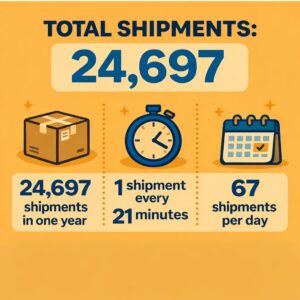
This data helps us to compare year on year how we’ve performed. But, it also does so much more than that, it grounds this conversation in reality. Volume over time reveals more than isolated peaks and consistent shipments shows patterns that one off surges never could, including how capacity held during a changing environment. The number of shipments moved is also just as important to gain insights into consistency and repeat demand.
It’s easy to read about how the logistics industry was affected last year, but until the facts are laid out like this, it’s just words. We’ve already shared in depth reflections on 2025 in our latest two blogs, so now we’re closing that door. We’re strictly looking forward, and after just one month of operating in 2026, we’re already seeing clear signs of how this year might unfold, so let’s get into our 2026 predictions.
What Do We Expect For The Rest Of 2026? 🤔
As excess capacity is slowly being absorbed, the signals point us to believe that we’re in for an uneven and inconsistent recovery this year. We anticipate 2026 to be a transitional year, shifting from a prolonged down cycle toward a more balanced, although slow growth environment, and not yet full recovery. It’s also important to note that although capacity is shrinking, there are still more trucks than loads in most areas. Until capacity tightens further, upward pressure on rates will remain limited, creating a cautious operating approach instead of aggressive expansion for carriers.
But, the new more “balanced” market will still be shaky. There isn’t a one size fits all conclusion for freight markets, conditions will continue to vary by region, lane and seasonality. So, even when the market seems stable, there will be pockets of tightness when you look at the data on a micro level.
What Has January Shown Us? 👀
As we’re writing this, we’ve just made it to the end of January and we’re getting fully into the swing of February. And if there is one thing that January has shown us when we dig that bit deeper into the data, it’s that trucking capacity is actually much tighter than it looks on surface level.
Tender rejection rates have climbed to almost 13%, meaning that almost one in every eight truckload shipments has been rejected by carriers, either for a lack of capacity or for better rates elsewhere on the spot market. This is the highest tender rejection rate that the industry has seen in previous years. In fact, this level of rejection has not been seen since 2022, when the industry was rapidly coming down from COVID highs.
However, spot rates are still proving to be elevated. They have dropped from December highs, but the signals are pointing to a healthy supply and demand balance. The fact that carriers are able to turn down tenders, means that they still have enough leverage to be selective of loads.
What The Data Doesn’t Show At A First Glance? 👩💻
Surface level only tells us so much. There are factors as to why capacity may be tight, including the English language proficiency testing minimizing a pool of truck drivers, in an already struggling pool of talent. Import volumes have also remained more muted than previous years, and much of the imported freight is being absorbed by rail, instead of trucking options. But, this could shift if shippers lean more into urgency, and begin to rely more on trucking options.
Weather Disruptions 🌨
On paper, most of January’s statistics look unremarkable. Winter weather disruptions are nothing new to the trucking industry and is often the root cause of volatility during the colder months, so it has a lot to answer for as far as what we’re seeing is concerned.
Spot Rates ﹩
Turbulent spot rates have been noticeably sharper than previous winters. The National Truckload Index (NTI) climbed to $2.71 per mile, inclusive of fuel which does mirror previous January’s however, with greater intensity. In earlier years, winter weather creates delays and reduced capacity. In more relaxed markets this can be absorbed easier, but this year we’re not seeing that.
Tender Rejection Rates 🙅♂️
Combining the above with the rising tender rejection rate, which we mentioned earlier is hovering at 13%, the current market has less ability to absorb the disruption. Severe weather events don’t just cause delays, they force carriers to become more selective, prioritize lanes and ultimately shippers with loads in areas that aren’t affected.
Lane Imbalance ⚖️
Following on from the above, this is where we see lane imbalance another factor that is hidden in the data. Capacity may be available nationwide, but weather disruptions and selective tendering can often mean that it’s unavailable where and when it is needed. Shippers see this in the form of short notice rejection, longer lead times, or unexpected shifts to the spot market. And data doesn’t show the “micro” changes, it uses averages across the industry and nation, so a lot of this gets hidden in the numbers.
How Important Reading Between The Lines Can Be 👩🏫
So you can see how “normal” numbers can still lead to unwanted outcomes. The data may show a degree of stability, but reduced flexibility can cause operational friction, way before rates shift. Service reliability tends to be the first thing to deteriorate and then pricing pressure follows later and it’s not until then that it’s visible in the figures.
2026 Is A Decision Making Year, Not A Forecasting Year 📑
In recent years, shippers relied on predictable forecasting where the market will go and when conditions would likely change. But, after last year it’s proven that this tactic has become much less reliable. Waiting for certainty before acting can mean reacting too late, especially when flexibility is reduced. By the time trends show in the data, capacity is often lower, making decisions more expensive.
The challenge now is no longer about timing the market perfectly to get the best deal, it’s much more about being prepared to respond to changing conditions unexpectedly. One of the biggest take aways from 2025, that we’re taking into 2026 is that control comes from being ready and not uncertainty.
How Are Planning Conversations Different From This Time Last Year? 🗣
The biggest difference this January compared to last, is that shippers and carriers are no longer operating in reaction mode. Conversations this year seem more deliberate, businesses are still very risk aware but they’re no longer paralysed by the fear of the unknown. This year we’re seeing more conversations like “How do we build a more resilient supply chain?” instead of last years’ “what if rates spike?” or “what happens if capacity disappears again?”.
Another change this year is acceptance, regular shippers by now have accepted that uncertainty is a constant and not a temporary phase. Because of this shippers are happier to lock in plans for six to nine months ahead, whereas last year this was unheard of, shippers wouldn’t look to make plans beyond the next quarter.
Perhaps the biggest change though, is relationships. In January 2025, conversations were dominated by talks of survival and cost control. However, this year conversations are more led with talks of optimisation, reliability and building on making true partnerships that do more than just move their freight.
All of these changes in conversation are subtle, but they’re shaping how shippers and carriers are working together proactively to design supply chains for the year ahead.
So, How Can You Prepare Your Supply Chain For 2026 ✅
As we mentioned earlier, this year relationships truly matter to ensure shippers get the best deals, rates and outcome for their budget and shipping needs. Work closely with your shipping partner to develop the following:
1.Develop Thorough Contingency Plans
Create detailed plans and playbooks for high risk scenarios, including holidays and severe weather events. These plans should include alternative routes, booking strategies and strategic capacity commitments. Extensive planning can help you to stay nimble, and avoid expensive spot rates.
2.Monitor Market Indicators
It’s super important to track key market indicators closely, this way shippers can make more informed decisions. Here’s some to look out for:
Tender Rejection Rates: Rising rates indicate tightening capacity. Monitor these closely as this directly effects spot rates.
Load To Truck Ratio (LTR): These stats are published by DAT and measure the ratio between freight demand versus available capacity.
Fuel Costs: Fuel costs are a key operational cost factor. So, this will directly impact shippers costs with fluctuations, having visibility on fuel costs can help budgets to keep on track.
World Container Index (WCI): This is a key indicator showing how the market is changing so following this closely helps shippers to shift between contract and spot strategies efficiently.
3.Switch Up Contract Structures
Don’t lock yourself into fixed long-term rates in a volatile market. Flexibility matters more than anything, in times like these so shorter term contracts could work out more beneficial. Combined with indexed pricing, this is where pricing is linked to recognised market benchmarks, will allow costs to adjust in line with real conditions rather than remain fixed.
What PEI Are Doing To Help Shippers For The Year Ahead? 💭
We’ve approached 2026 with a clearer view of what did and didn’t work last year. One of the biggest key messages was that waiting around for certainty proved costly across the entire supply chain and for shippers. Markets moved faster than plans did last year, and trying to make assumptions of when capacity would loosen or rates would stabilize for the most part broke down because of real-world conditions.
We’ve always advised customers to build flexibility into their shipping schedules over trying to time the market and last year reinstated why we do that. So this year, we’re trying to help more shippers to start planning conversations earlier, to have clearer visibility around risks in their supply chain and emphasising the importance of having strong relationships across their key lanes.
As a result, we’re trying to teach shippers the importance of preparation, and not prediction. Rather than reacting to disruptions as they happen, we’re trying to reduce the number of decisions shippers need to make under pressure, as this is what creates stability.
If you’re having any concerns around moving any of your freight this year, speak to one of our expert team and they will assist you in any way they can, we’re always happy to talk you through things. Whether you’re planning ahead or dealing with something unexpected we’re here to help. You can contact us directly by calling: 888-SHIP-911 or get in touch using the link below. We look forward to hearing from you!
The PEI Team ❤️
Need help with any of your specialized oversize and high-value domestic shipments?
Today can be the day you stop struggling with your logistics problems.
At PEI we’re experts in dealing with specialized freight and can handle yours with any custom requirements.
Need help planning a shipment?
Talk with PEI about expedited freight, specialized freight, or your next shipping challenge.
