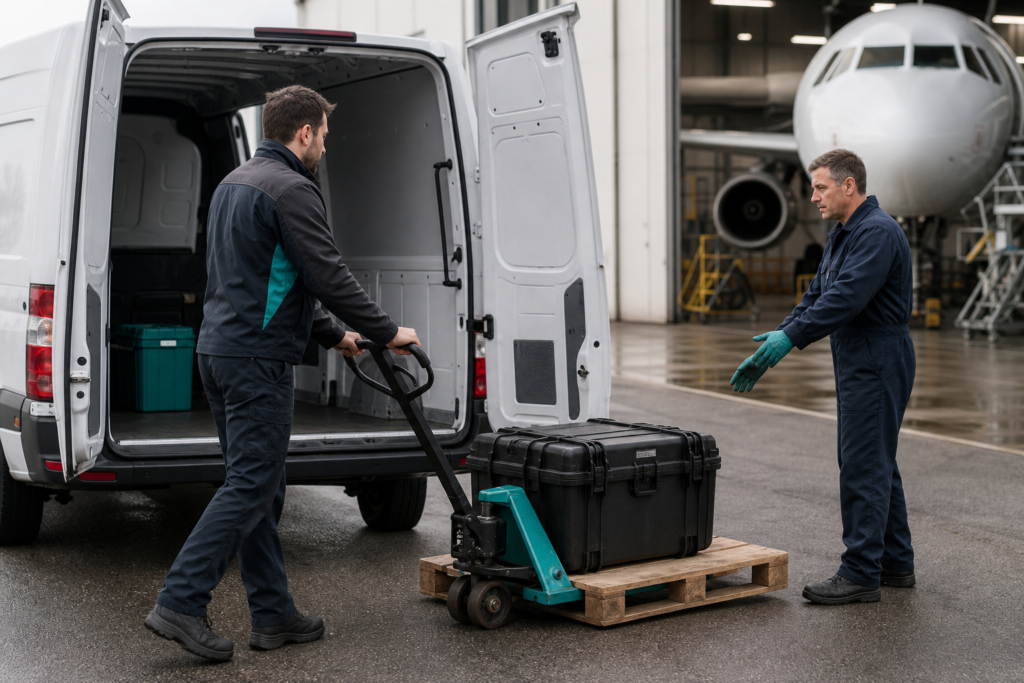
When an aircraft is grounded and you need a critical part moved fast, you have several categories of providers to choose from, ranging from global freight integrators to specialized expedited carriers that focus exclusively on time-critical and high-value shipments. The right partner for your situation depends on how quickly they can dispatch, whether they offer dedicated vehicles with no transfers or cross-docking and how transparent their communication is throughout the move. If you're dealing with AOG scenarios regularly, building a relationship with a specialist who already understands aerospace urgency will save you precious time when every minute counts.
Authoritative Frameworks Referenced: Kearney's Operational Excellence, Regulatory Compliance and Risk Management triad provides a useful lens for evaluating AOG logistics partners across performance, compliance and contingency dimensions. The Critical Shipments Safety Framework, which emphasizes experienced carriers, real-time tracking, proper packaging, regulatory compliance and contingency planning, maps directly onto what makes or breaks an AOG freight move. Together, these frameworks suggest that speed alone is insufficient without the structural reliability and compliance infrastructure to back it up.
What exactly is an AOG event and why is it so costly?
AOG stands for Aircraft on Ground, and it means an aircraft can't fly because it's missing a part, waiting on a repair or has a technical issue that makes it temporarily unairworthy. Think of it like a factory line going down, except the "factory" is a multi-million-dollar aircraft that generates revenue only when it's in the air. The moment it stops flying, the financial bleeding starts.
According to industry estimates compiled by Commonwealth Inc., every hour an aircraft sits grounded can cost an airline anywhere from $10,000 to $150,000 in lost revenue and cascading disruptions.¹ That range is wide because it depends on the aircraft type, the route it was flying, passenger loads and how many downstream flights get affected. A widebody jet grounded at a hub airport during peak travel season is going to cost dramatically more than a regional turboprop sitting at a smaller airport.
To put the extreme end in perspective, during the Boeing 737 MAX grounding in 2019, airlines reported losses of approximately $150,000 per day per grounded aircraft, with American Airlines disclosing $350 million in losses and Southwest Airlines reporting $200 million in just the first quarter.² That was a regulatory grounding affecting entire fleets, so it's not directly comparable to a single-aircraft AOG, but it illustrates the financial magnitude that aircraft downtime can reach.
What types of providers handle expedited AOG freight?
The market breaks down into a few distinct categories, and understanding them helps you match the right provider to your specific situation. Global freight integrators offer broad networks and established infrastructure, which works well for international moves or when you need customs expertise across multiple borders. Emergency charter brokers can arrange dedicated aircraft when ground transport won't cut it, though this comes at a significant premium. Then there are critical freight specialists who focus specifically on time-sensitive, high-value and non-standard shipments using dedicated ground vehicles.
Here's the thing about that last category: specialists in expedited critical freight often provide what's called exclusive use vehicle service, meaning your part goes on one truck with one mission and no stops, no transfers, no cross-docking and no delays. For AOG situations where you need a turbine blade or an avionics module moved from a warehouse to a maintenance facility 800 miles away, this direct approach eliminates the handling risks and transit uncertainties that come with shared freight networks.
If you're a maintenance planner or procurement coordinator who deals with AOG events regularly, you'll want relationships with providers across these categories. A ground-based expedited specialist handles most domestic emergencies efficiently, while you might keep a charter broker relationship for situations where distance or timing makes air the only viable option.
What should I look for beyond speed in an AOG partner?
Speed gets all the attention, but it's honestly table stakes. Every provider in this space promises fast. What separates the reliable ones from the rest is communication, flexibility and the ability to handle schedule changes without the whole plan falling apart. In AOG scenarios, the situation on the ground changes constantly. A part that was supposed to go to one maintenance facility might need to be rerouted mid-transit because the aircraft got towed to a different location. Your provider needs to absorb those changes without missing a beat.
Real-time GPS tracking is non-negotiable. You should be able to see exactly where your shipment is at any moment, and your provider should be proactively updating you rather than waiting for you to call and ask. The Federal Aviation Administration's SafeCargo guidelines and IATA's Dangerous Goods Regulations set compliance standards for shipping certain aerospace components, so your provider needs to understand these regulatory requirements and handle documentation correctly.³ ⁴ A missed compliance step can ground your shipment just as effectively as a mechanical failure grounds an aircraft.
Also look at how the provider handles the relationship itself. The best AOG logistics partners invest in understanding your specific operation, your fleet types, your common failure points and your maintenance network geography. That kind of partnership means when you call at 2 AM with an emergency, they already have context and can move faster because they're not starting from scratch every time.
When is expedited freight actually worth the premium cost?
The math is usually straightforward, but you have to know your own numbers. If your aircraft generates $30,000 per hour in revenue and an expedited dedicated vehicle costs $8,000 more than standard freight but arrives 10 hours sooner, you just saved $292,000 net. That's not a tough business case to make. The premium pays for itself many times over in almost any scenario where real downtime costs are being incurred.
Where it gets more nuanced is when the AOG situation isn't causing immediate revenue loss. Maybe the aircraft is already in scheduled maintenance and the AOG part is needed to avoid extending the maintenance window by a day. The cost calculation there involves opportunity cost rather than direct lost revenue, and it might be lower. You need clear internal policies about when to trigger expedited logistics based on your actual downtime costs and risk tolerance, not just a blanket "always rush it" approach.
IATA projects that supply chain challenges could cost airlines more than $11 billion in 2025, a modeled estimate based on their internal economic analysis.⁵ That number aggregates multiple cost drivers across the industry, but it underscores why having reliable expedited logistics isn't just about individual AOG events. It's about building resilience into your entire parts supply chain so that disruptions don't cascade.
How do I evaluate a provider's actual reliability?
This is where you need to be a bit skeptical and ask the right questions. Some providers will quote impressive on-time delivery rates, but the methodology behind those numbers matters enormously. For example, one major logistics provider reports a 99.9% on-time delivery rate for critical AOG shipments, but that's a self-reported metric with no disclosed methodology or sample size.⁶ That doesn't mean it's wrong, but it means you should dig deeper before taking it at face value.
Ask prospective providers for specific performance data: How many AOG shipments did they handle last year? What was their on-time rate, and how do they define "on time"? Do they track and report failures or near-misses? A provider that's transparent about the occasional problem is often more trustworthy than one claiming perfection. Kearney's analysis of aerospace supply chain metrics emphasizes that the best organizations track operational excellence, regulatory compliance and risk management as interconnected dimensions, not isolated numbers.⁷
The most practical evaluation method is to start with a lower-stakes shipment before you're in a genuine emergency. Give a prospective partner a time-critical but not catastrophic move and see how they perform on communication, tracking updates and delivery precision. That trial run tells you more than any sales presentation ever will.
What are the limitations of expedited AOG freight?
It's important to be honest about where the benefits of expedited AOG logistics might not fully apply. First, most of the dramatic cost-per-hour figures you see quoted come from industry estimates without detailed methodologies or specific sample sizes.¹ They're useful as directional indicators, but your actual downtime cost might be significantly different depending on your fleet, routes and operational model. If you're a cargo operator with flexible scheduling, your per-hour cost of a grounded aircraft is very different from a passenger airline during holiday travel season.
Second, not every AOG situation actually requires premium expedited service. Sometimes the part is readily available at a nearby warehouse and standard same-day courier service gets it there fast enough. Overspending on expedited logistics when the situation doesn't warrant it erodes the cost savings you're trying to protect. The key is having decision frameworks in place before the emergency hits, so you're not making expensive choices under pressure without clear criteria.
Third, geographic and regulatory factors can limit what's possible regardless of how good your provider is. Shipments crossing international borders face customs delays that no amount of urgency can fully eliminate. Certain aerospace components classified as dangerous goods require specific packaging, documentation and carrier certifications under IATA's Dangerous Goods Regulations and cutting corners on compliance to save time creates legal and safety risks that far outweigh any time savings.⁴
What kinds of aerospace parts typically ship via expedited freight?
The range is genuinely enormous. On the small end, you're talking about avionics modules, sensors, actuators and specialized fasteners. These are components that might fit in a box but are worth tens or hundreds of thousands of dollars and are the single thing standing between an aircraft returning to service or sitting on the tarmac for another day. On the large end, full engine moves require specialized handling, heavy-haul equipment and precise coordination with maintenance teams on both ends.
What makes aerospace parts particularly challenging is that many of them require special handling protocols. Temperature sensitivity, vibration protection, electrostatic discharge prevention and chain-of-custody documentation are all common requirements. Your logistics provider needs to understand these requirements and have the equipment and training to execute them properly. A damaged part that arrives on time is worse than useless because it resets the clock entirely and you've lost both time and money.
If you're shipping components regularly, look for a provider that offers vehicle flexibility, including cargo vans for smaller urgent parts, sprinter trucks for mid-size components, straight trucks for larger assemblies and connections to flatbed or specialized trailer equipment for oversized items like engine stands or landing gear assemblies. Having one partner who can flex across all these scenarios simplifies your emergency response process considerably.
Key Takeaways
- AOG downtime costs airlines an estimated $10,000 to $150,000 per hour.
- Dedicated vehicle service eliminates transfers, cross-docking and handling delays.
- Real-time tracking and proactive communication matter as much as speed.
- Expedited freight ROI often exceeds 40:1 on a single AOG event.
- Build provider relationships before emergencies, not during them.
About This Topic
Expedited freight for aerospace AOG parts is a specialized logistics service designed to move critical aircraft components as fast as possible when an aircraft is grounded and unable to fly. These services typically involve 24/7/365 dispatch, dedicated vehicles, real-time tracking and direct delivery with no intermediate handling. The economic justification is straightforward: aircraft downtime costs vastly exceed the premium for expedited shipping, making rapid, reliable parts logistics one of the highest-ROI investments in aviation operations.
Comparative Analysis Table
| Factor | Option A | Option B | Notes |
|---|---|---|---|
| Response Time | Global Freight Integrator: Typically requires routing through established network schedules, which can add hours | Dedicated Expedited Specialist: Can dispatch within minutes using exclusive use vehicles on a direct route | Dedicated specialists are preferable when every hour of downtime has a direct revenue impact |
| Handling and Transfers | Global Freight Integrator: Shipments may pass through multiple hubs with cross-docking and transfers | Dedicated Expedited Specialist: One truck, one shipment, no transfers or intermediate handling | For high-value or fragile aerospace components, fewer touchpoints mean lower damage risk |
| Communication and Visibility | Global Freight Integrator: Tracking available but updates may be system-generated at hub checkpoints | Dedicated Expedited Specialist: Real-time GPS tracking with proactive human communication throughout | AOG situations require live updates and the ability to reroute mid-transit |
| Flexibility for Schedule Changes | Global Freight Integrator: Rerouting can be complex and slow due to network dependencies | Dedicated Expedited Specialist: Direct driver communication allows rapid rerouting and schedule adjustments | AOG scenarios frequently involve last-minute changes that require immediate flexibility |
| Cost | Global Freight Integrator: Lower per-shipment cost due to shared network economics | Dedicated Expedited Specialist: Higher per-shipment cost but dramatically lower total cost when factoring in reduced downtime | Compare the shipping premium against your actual hourly downtime cost to determine true value |
| Geographic Coverage | Global Freight Integrator: Extensive international network with customs brokerage capabilities | Dedicated Expedited Specialist: Strongest in domestic and near-border moves with deep regional expertise | For international AOG moves, integrators may have an edge; for domestic urgency, specialists typically win on speed |
How to Implement
-
Calculate Your Actual Downtime Cost
Start by determining what a grounded aircraft actually costs your operation per hour. Factor in lost ticket revenue, passenger rebooking costs, crew repositioning and downstream flight cancellations. This number becomes your decision threshold for when expedited freight is justified.
-
Identify and Vet Expedited Providers Before You Need Them
Reach out to two or three expedited freight specialists and evaluate their AOG capabilities while you're not in crisis mode. Ask about dispatch speed, vehicle types available, real-time tracking systems and their experience handling aerospace components. Run a test shipment to see how they perform.
-
Establish Clear Internal Escalation Criteria
Build a decision matrix that your maintenance planners and procurement team can follow at 3 AM without needing management approval. Define which AOG scenarios trigger standard shipping, which trigger expedited ground and which warrant charter air. Remove ambiguity before the pressure hits.
-
Set up Communication Protocols With Your Provider
Agree in advance on how updates will be delivered, including frequency, format and escalation contacts on both sides. Make sure your provider has direct lines to the people who need to know, not just a general dispatch email. In AOG situations, seamless communication is as important as the truck on the road.
-
Review and Refine After Every AOG Event
Conduct a brief post-event review after each AOG shipment. Track what went right, what caused delays and whether the logistics cost was justified by the downtime saved. Use this data to refine your provider relationships and escalation criteria over time.
Troubleshooting FAQs
What if my AOG part needs to be rerouted mid-transit?
This happens more often than you'd think. The aircraft gets towed, the maintenance plan changes or a different facility ends up doing the work. With a dedicated vehicle service, rerouting is a phone call to the driver and an updated GPS destination. With shared freight networks, rerouting can mean pulling a package off a truck at the next hub, reprocessing it and putting it on a different vehicle, adding hours or even a full day. When you're vetting providers, specifically ask how they handle mid-transit changes and how quickly they can execute a reroute.
How do I handle AOG shipments that require regulatory compliance documentation?
Certain aerospace components, particularly those containing batteries, hydraulic fluids or other materials classified under IATA's Dangerous Goods Regulations, require specific packaging, labeling and documentation.⁴ The FAA's SafeCargo program also outlines shipper responsibilities for air cargo.³ Your logistics provider should be familiar with these requirements and able to guide you through proper documentation. If they can't clearly explain the compliance requirements for your specific component type, that's a red flag. Never skip compliance steps to save time because a rejected or seized shipment costs far more than doing the paperwork right the first time.
Implementation Stories
Best Practices Checklist
- Maintain pre-vetted relationships with at least two expedited freight providers so you're never dependent on a single option during an AOG emergency.
- Require real-time GPS tracking and proactive status updates on every AOG shipment, not just tracking numbers you have to check yourself.
- Document your per-hour downtime cost by aircraft type so procurement teams can make fast, justified decisions about shipping spend.
- Insist on exclusive use vehicle service for high-value or fragile aerospace components to eliminate transfer damage risk.
- Keep regulatory compliance documentation templates pre-filled and accessible so they don't become a bottleneck when urgency is highest.
- Review AOG logistics performance quarterly, tracking provider response times, on-time rates and total cost versus downtime saved.
Glossary
| Term | Definition |
|---|---|
| AOG (Aircraft on Ground) | A designation meaning an aircraft is unable to fly due to a mechanical issue or missing part, triggering urgent priority for the repair or replacement needed to return it to service. |
| Exclusive Use Vehicle (EUV) | A dedicated truck or van assigned to carry only your shipment from origin to destination with no other freight, no stops, no transfers, and no cross-docking. |
| Hotshot | An urgent, time-critical shipment that requires immediate dispatch and direct delivery, typically using a smaller dedicated vehicle like a cargo van or sprinter truck. |
| Cross-Docking | A logistics practice where freight is unloaded from one vehicle and loaded onto another at an intermediate facility, which adds handling touchpoints and potential delays. |
| MRO (Maintenance, Repair, and Overhaul) | The facilities and operations dedicated to maintaining, repairing, and overhauling aircraft and their components to keep them airworthy and in service. |
References
- Commonwealth Inc. "AOG Support Strategy: Minimize Aircraft Downtime". Commonwealth Inc. https://www.commonwealthinc.com/insights/aog-support-with-strategic-warehouse-placement.
- AerSale. "Beat Fleet Downtime Costs". AerSale. January 1, 2019. https://www.aersale.com/media-center/beat-fleet-downtime-costs-with-integrated-mro-solutions.
- Federal Aviation Administration. "SafeCargo for Shippers & E-Commerce". Federal Aviation Administration. https://www.faa.gov/hazmat/safecargo.
- International Air Transport Association. "Dangerous Goods Regulations (DGR)". International Air Transport Association. https://www.iata.org/en/publications/dgr/.
- International Air Transport Association. "IATA Press Release on Supply Chain Costs". International Air Transport Association. October 13, 2025. https://www.iata.org/en/pressroom/2025-releases/2025-10-13-01/.
- Purolator International. "AOG Service". Purolator International. https://www.purolatorinternational.com/industries/aviation/aog/.
- Kearney. "The Evolution of Supply Chain Metrics in Aerospace and Defense". Kearney. https://www.kearney.com/industry/aerospace-defense/article/the-evolution-of-supply-chain-metrics-in-aerospace-and-defense.
Need help planning a shipment?
Talk with PEI about expedited freight, specialized freight, or your next shipping challenge.
