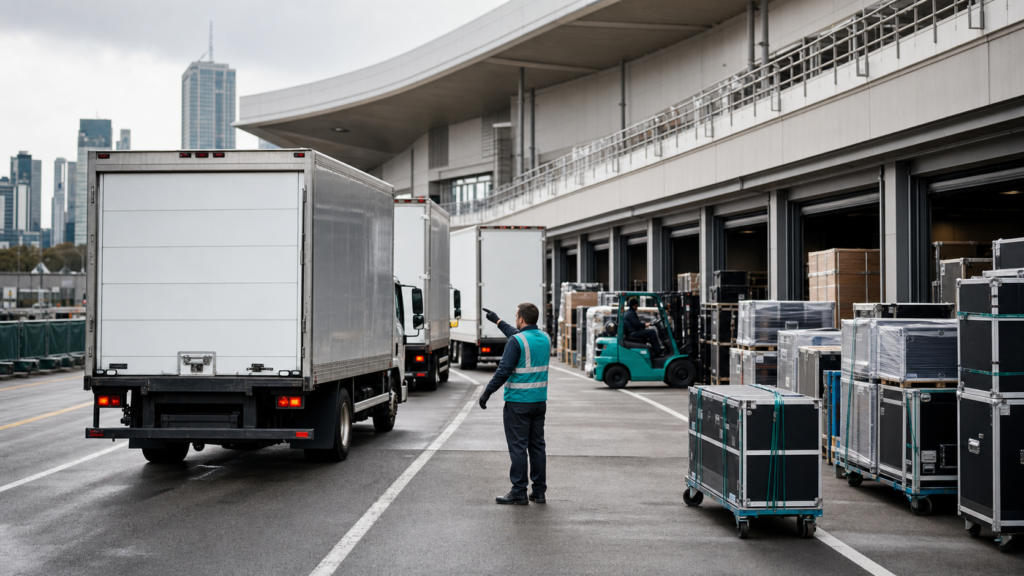
When your trade show setup window is measured in hours, not days, picking the right logistics provider isn't just a procurement decision. It's a make-or-break call for your entire event investment. You need a provider who understands show-site rules, advance warehouse timelines and marshalling yard coordination, not just one who can move freight from point A to point B. The difference between a specialized event carrier and a general freight company often shows up exactly when it matters most: the moment something goes sideways and your schedule needs to flex.
Authoritative Frameworks Referenced: The Association for Supply Chain Management's Supply Chain Operations Reference (SCOR) model provides a structured way to evaluate logistics providers across reliability, responsiveness, agility, cost and asset management, with over 250 standardized metrics.¹ On-Time Delivery (OTD), calculated as on-time deliveries divided by total deliveries times 100, is the single most relevant performance metric for deadline-driven trade show shipping.² The Plan-Do-Check-Act (PDCA) cycle from lean methodology also applies here, giving exhibitors a framework for continuously improving their provider selection and shipping processes after each show.
How early should I book trade show shipping for tight deadlines?
Here's the thing most first-time exhibitors learn the hard way: trade show shipping isn't like ordering a standard LTL pickup. Industry guidance from multiple logistics specialists recommends beginning the quoting and booking process two weeks to one month before your shipment date for domestic shows.³ That timeline isn't arbitrary. It accounts for carrier capacity constraints, advance warehouse scheduling and the inevitable last-minute changes that come with live events.
If you're shipping to a major show during peak convention season, like January in Las Vegas or October in Chicago, push that timeline even earlier. Carrier capacity tightens dramatically when multiple large shows overlap, and the providers with the best track records fill their schedules first. Think of it like booking a hotel room for the same event: the longer you wait, the fewer good options you have.
For international shows involving cross-border ground moves into Canada or Mexico, add at least another week to your planning window. Customs documentation, border crossing variability and longer transit distances all compress your margin for error. The goal is to give yourself enough buffer that a single disruption doesn't cascade into a missed setup window.
Is a specialized trade show carrier worth the extra cost?
This is probably the most common debate in exhibit logistics, and the honest answer is: it depends on what's at stake. A specialized event carrier brings show-site knowledge that general freight companies simply don't have. They understand marshalling yard procedures, advance warehouse cutoff times, decorator requirements and the specific labeling protocols that prevent your crates from sitting in a loading dock purgatory while you're inside the hall wondering where your booth is.
That said, the evidence here comes with an important caveat. According to an analytical review of trade show logistics literature, much of the available performance data comes from vendor publications and marketing materials rather than independent peer-reviewed research.⁴ There are no large-scale empirical datasets publicly available that quantify performance differences between specialized and general carriers across statistically significant sample sizes. So while the operational logic strongly favors specialists for complex, deadline-critical shipments, the hard comparative data is thinner than you might expect.
If you're shipping a simple tabletop display via a single crate, a reliable general carrier with good tracking might be perfectly fine. But if you're coordinating multi-booth shipments, oversized components on specialized equipment like stepdeck or conestoga trailers or anything requiring precise delivery appointments, a provider with dedicated event logistics experience becomes much harder to replace. The value isn't just in the truck. It's in the communication, flexibility and problem-solving when schedules inevitably shift.
Should I ship to the advance warehouse or direct to show?
Shipping to the advance warehouse seven to ten days before the show opens is widely considered the safer play, and most trade show logistics specialists recommend it as a best practice.⁵ The advance warehouse acts as a buffer. Your freight arrives early, gets checked in and is staged for delivery to your booth space on a scheduled basis by the show's official material handling contractor. It takes a huge variable out of the equation.
Direct-to-show shipping sounds appealing because it can cut costs and reduce handling, but it comes with real risks. You're working within a much tighter delivery window, often just 24 to 48 hours before the show opens. If your carrier hits traffic, a mechanical issue or a scheduling conflict at the loading dock, you have almost zero recovery time. Convention centers also have strict receiving schedules, and showing up outside your assigned window can mean your freight gets turned away entirely.
Here's a practical way to think about it: if your exhibit is simple enough that you could set it up in under two hours and you have a backup plan if freight is delayed, direct-to-show might work. For anything more complex, the advance warehouse is your insurance policy. Yes, it adds warehouse handling fees, but those fees are a fraction of the cost of missing your setup window.
What on-time delivery rate should I expect from providers?
According to aggregated logistics KPI guidance from sources like RXO and MetricHQ, good on-time delivery rates typically range between 95% and 98% depending on the sector, with 95% commonly cited as a reasonable standard for carriers.⁶ That sounds reassuring until you do the math for trade shows. If you exhibit at 20 shows per year, a 95% OTD rate means you can statistically expect one late delivery annually. For a single high-stakes event, those odds might not feel comfortable enough.
It's worth noting that these benchmarks represent aggregated shipper expectations rather than independently measured carrier performance across controlled conditions.⁶ The methodology behind these figures relies on survey data and industry consensus, not randomized studies tracking thousands of shipments. So treat them as directional guidance, not guarantees. When you're evaluating a specific provider, ask for their OTD rate on trade show and event shipments specifically, not their overall freight performance.
The SCOR model from the Association for Supply Chain Management provides a more rigorous framework for evaluating logistics reliability, breaking performance into granular metrics across reliability, responsiveness and agility.¹ If a provider can speak fluently about these metrics and share their own data, that's a strong signal they take performance measurement seriously. If they can't tell you their OTD rate at all, that tells you something too.
What documents and labels prevent trade show shipping delays?
Missing or incorrect paperwork is one of the most preventable causes of trade show shipping disasters, and yet it happens constantly. Every show has specific labeling requirements that typically include the exhibitor company name, booth number, show name, advance warehouse address and the number of pieces in the shipment (for example, "piece 1 of 4"). Get any of these wrong, especially the booth number and your freight can end up in the wrong hall or sitting unclaimed.
Beyond labels, you'll need a bill of lading that matches your shipment details exactly and if you're shipping to an advance warehouse, you'll need to reference the show's material handling kit for specific delivery instructions and cutoff dates. Some shows also require a signed exhibitor-appointed contractor form if you're not using the official show carrier. Missing this form can literally prevent your freight from being unloaded.
If you're coordinating moves into Canada or Mexico, add commercial invoices and potentially customs broker documentation to the list. The key habit to build is this: treat your shipping paperwork like your boarding pass. Triple-check it before it leaves, because fixing errors after the freight is in transit ranges from expensive to impossible.
How do international shows change provider selection?
International trade shows add layers of complexity that can turn a manageable domestic timeline into a logistical obstacle course. Customs clearance, import duties, carnet documentation for temporary exhibit imports and country-specific regulations all extend your lead time and narrow your margin for error. For ground moves into Canada and Mexico, the added complexity is moderate since many experienced domestic carriers treat these as extensions of their normal network. But for shows in Europe or Asia, you're looking at a fundamentally different logistics challenge.
The provider selection criteria shift significantly for international events. You need a partner with customs brokerage relationships, experience with temporary import documentation and the ability to coordinate across time zones. A provider that's excellent at domestic show logistics might have zero infrastructure for international moves, and that gap can be catastrophic under tight deadlines.
One important limitation to acknowledge: the evidence base for comparing international trade show logistics providers is even thinner than for domestic.⁴ Most published case studies and guidance focus on North American shows, and the recommendations may not generalize well to markets with different regulatory environments, infrastructure quality or labor practices. If you're exhibiting internationally for the first time, lean heavily on providers with documented experience in your specific destination country rather than relying on general international freight capabilities.
When might a specialized trade show provider not be worth it?
Not every exhibit shipment needs the full white-glove treatment, and it's worth being honest about when the premium doesn't pencil out. If you're shipping a single small crate to a regional show with a generous setup window of three or more days, a reliable general carrier with good tracking and communication may handle it just fine. The specialized provider's value proposition is strongest when complexity is high, timelines are compressed or the financial stakes of a missed delivery are significant.
There's also a generalization problem in the available guidance. According to analytical reviews of trade show logistics literature, optimal provider selection remains highly context-dependent based on event size, scope and exhibitor capabilities.⁴ A Fortune 500 company shipping a 50-foot island exhibit has fundamentally different needs than a startup shipping a pop-up banner and two cases of brochures. Recommendations from logistics vendors naturally tend to emphasize scenarios where their specialized services add the most value, which means the published guidance may overstate the risks of using general carriers for simpler shipments.
Finally, the case study evidence that supports specialized providers tends to highlight successful engagements while rarely discussing failures or neutral outcomes.⁴ This selection bias means you're not getting the full picture from vendor testimonials alone. The smart approach is to match your provider's capabilities to your actual risk profile: high-value, complex, deadline-critical shipments justify the specialist premium, while simple, low-stakes moves might not.
Key Takeaways
- Start booking trade show shipping two weeks to one month before your shipment date.
- Target providers with on-time delivery rates of 95% or higher for event freight.
- Advance warehouse delivery seven to ten days early is the safest approach.
- Schedule flexibility and real-time communication matter more than the lowest quote.
- Match provider specialization to your actual shipment complexity and risk level.
About This Topic
Trade show logistics provider comparison involves evaluating carriers and freight services based on their ability to meet the unique demands of event shipping, including strict delivery deadlines, advance warehouse coordination, show-site procedures and the flexibility to handle last-minute schedule changes. The event logistics market is valued at approximately $4.8 billion in 2025 with a projected 6.0% compound annual growth rate through 2030, according to Technavio market research.⁷ Selecting the right provider requires balancing cost, reliability, communication quality and specialized trade show expertise against the specific complexity and financial stakes of each event.
Comparative Analysis Table
| Factor | Option A | Option B | Notes |
|---|---|---|---|
| Trade show site knowledge | Specialized event carrier: Deep familiarity with advance warehouses, marshalling yards, and decorator rules | General freight carrier: Limited or no experience with show-site procedures and labeling requirements | Specialized carriers are strongly preferable for complex booth setups and first-time exhibitors |
| Schedule change flexibility | Specialized event carrier: Built to handle last-minute show schedule shifts and rerouting | General freight carrier: Schedule changes often trigger rebooking fees or capacity gaps | Trade shows frequently shift timelines; flexibility is critical under tight deadlines |
| Cost for simple shipments | Specialized event carrier: Higher base rates reflecting premium service and expertise | General freight carrier: Lower rates for straightforward point-to-point moves | General carriers may be sufficient for single-crate, low-complexity shipments with generous setup windows |
| Real-time communication | Specialized event carrier: Proactive updates, GPS tracking, and dedicated point of contact | General freight carrier: Standard tracking portals with limited proactive outreach | For deadline-critical freight, proactive communication prevents surprises at the loading dock |
| Multi-booth and oversized capability | Specialized event carrier: Experience coordinating multiple deliveries and specialized equipment | General freight carrier: May lack equipment options or multi-stop coordination experience | Specialized carriers are essential for stepdeck, conestoga, or multi-piece exhibit shipments |
| Recovery options when things go wrong | Specialized event carrier: 24/7 dispatch with expedited rescue options and alternative routing | General freight carrier: Standard claims process with limited emergency response capability | Emergency recovery capability is the single biggest differentiator when deadlines are non-negotiable |
How to Implement
-
Define Your Shipment Profile and Deadline Requirements
Start by documenting exactly what you're shipping: dimensions, weight, piece count, value and any special handling needs. Pin down your advance warehouse cutoff date and show-site delivery window. This profile becomes the basis for every provider conversation.
-
Request Quotes From at Least Three Providers With Event Experience
Reach out two weeks to one month before your shipment date and ask specifically about their trade show logistics experience.³ Request references from similar-sized shows and ask for their on-time delivery rate on event shipments, not just their overall freight performance.
-
Evaluate Flexibility and Communication, Not Just Price
Ask each provider how they handle last-minute schedule changes, because trade shows almost always involve them. Find out if you'll have a dedicated point of contact, whether they offer real-time GPS tracking and what their escalation process looks like when something goes wrong.
-
Negotiate a Service Level Agreement With Clear Performance Metrics
Lock in specific commitments for delivery windows, communication frequency and what happens if they miss. A strong SLA includes defined remedies for non-compliance, not just vague promises. Use the on-time delivery benchmarks of 95 to 98% as your negotiating baseline.⁶
-
Prepare Documentation and Labels Before Freight Is Picked Up
Complete all labeling with booth number, show name, piece counts and advance warehouse address. Verify your bill of lading matches every detail. Confirm the advance warehouse cutoff date one more time. Errors caught before pickup cost nothing; errors caught at the show cost everything.
-
Monitor in Transit and Confirm Delivery With Your Provider
Track your shipment actively rather than assuming no news is good news. Confirm advance warehouse check-in or show-site delivery with your provider and get written confirmation. After the show, debrief on what worked and what didn't to improve your process for next time using a Plan-Do-Check-Act approach.
Troubleshooting FAQs
My freight missed the advance warehouse cutoff. What do I do?
Contact your logistics provider immediately to explore direct-to-show delivery options. Most convention centers have limited direct receiving windows, so time is critical. Your provider should be able to coordinate with the show's official material handling contractor to secure a dock appointment. Expect to pay a premium for direct-to-show handling, and have your show management contact information ready because the venue may require exhibitor authorization before accepting the delivery. If your provider offers 24/7 dispatch and expedited rescue capabilities, this is exactly the scenario where that investment pays for itself.
My provider quoted a much lower price but has no trade show experience. Should I go with them?
Saving money on logistics only works if your freight actually arrives on time and in the right condition. A provider without show-site experience may not understand advance warehouse procedures, specific labeling requirements or marshalling yard protocols and any of those gaps can cause delays that cost far more than the savings on the quote. If your shipment is simple, like a single small crate with a generous setup window, the risk may be acceptable. But for anything complex, high-value or deadline-critical, the cheapest quote often becomes the most expensive mistake. Ask the provider directly how they'd handle a last-minute schedule change or a missed delivery window, and judge their answer carefully.
Implementation Stories
Best Practices Checklist
- Begin your provider search and quoting process at least two to four weeks before your shipment date to preserve carrier options and negotiate favorable terms.
- Always ship to the advance warehouse when possible, targeting delivery seven to ten days before the show opens to build in recovery time for any disruptions.⁵
- Verify every label includes booth number, show name, exhibitor name, piece count and the correct advance warehouse or show-site address before freight leaves your facility.
- Require real-time GPS tracking and proactive communication updates from your provider, especially for time-critical and high-value shipments.
- Negotiate a written service level agreement that specifies on-time delivery targets, communication protocols and remedies for missed commitments.
- Debrief with your provider after every show to identify what worked, what didn't and what process changes to implement for the next event.
Glossary
| Term | Definition |
|---|---|
| Advance Warehouse | A temporary storage facility designated by the trade show where exhibitor freight is received days or weeks before the event, staged, and then delivered to booth spaces on a set schedule by the material handling contractor. |
| On-Time Delivery Rate (OTD) | The percentage of shipments delivered on or before the promised date, calculated by dividing on-time deliveries by total deliveries and multiplying by 100. Industry benchmarks for carriers range from 95% to 98%.⁶ |
| Marshalling Yard | A designated staging area near a convention center where trucks queue and are assigned dock appointment times for loading or unloading freight during show move-in and move-out periods. |
| Exclusive Use Vehicle (EUV) | A dedicated truck assigned to carry only your freight with no other stops, transfers, or cross-docking, providing maximum control over timing and handling for time-critical or high-value shipments. |
| Service Level Agreement (SLA) | A formal contract between a logistics provider and customer that specifies expected performance standards, measurement metrics, responsibilities, and what happens when commitments aren't met. |
References
- Association for Supply Chain Management (ASCM). "SCOR Digital Standard (SCOR DS)". ASCM / APICS. January 1, 2024. https://www.apics.org/apics-for-business/frameworks/scor.
- NetSuite. "The Essential Logistics KPIs & Metrics You Need to Track". NetSuite. January 1, 2024. https://www.netsuite.com/portal/resource/articles/inventory-management/logistics-kpis-metrics.shtml.
- GES (Global Experience Specialists). "Trade Show Shipping Strategies and Essential Tips to Know". GES (Global Experience Specialists). Accessed July 1, 2026. https://insights.ges.com/us-exhibitor-roadmap/trade-show-shipping.
- The Decision Lab. "Survivorship Bias". The Decision Lab. Accessed July 1, 2026. https://thedecisionlab.com/biases/survivorship-bias.
- Diversified Transportation Services (DTS ONE). "Trade Show Shipping – A Guide to the Advance Warehouse". Diversified Transportation Services (DTS ONE). February 2025. https://www.dtsone.com/trade-show-shipping-advance-warehouse/.
- RXO and MetricHQ. "Logistics KPI Expectations and On-Time Delivery Benchmarks". RXO / MetricHQ. January 1, 2023. https://rxo.com/resources/research/kpi-research-study/.
- Technavio. "Event Logistics Market Analysis 2025-2030". Technavio. January 1, 2025. https://www.technavio.com/report/event-logistics-market-industry-analysis.
Need help planning a shipment?
Talk with PEI about expedited freight, specialized freight, or your next shipping challenge.
