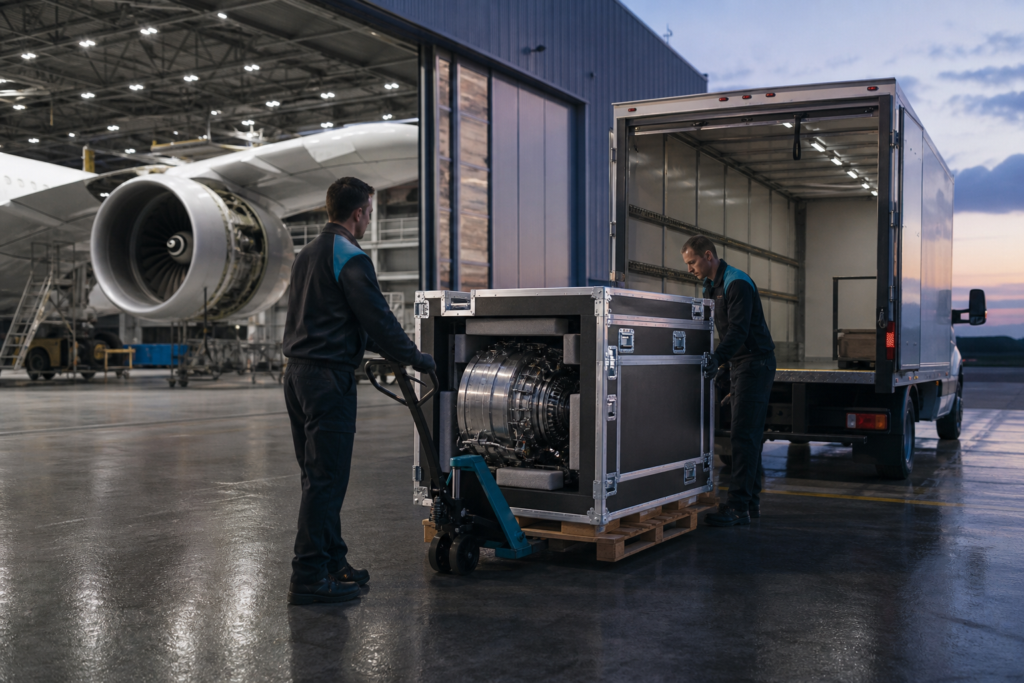
Choosing an expedited freight partner for AOG parts isn't like picking a standard carrier. You need a provider built for urgency, one that operates around the clock, dispatches within minutes and understands that a grounded aircraft hemorrhages money every second it sits idle. The right partner treats your emergency like their own, with real-time communication, dedicated vehicles and the flexibility to pivot when schedules change. Think of it less like hiring a trucking company and more like assembling a rapid-response team for your supply chain.
Authoritative Frameworks Referenced: Several recognized frameworks govern quality and compliance in aerospace logistics. AS9100, published by SAE International, is the aerospace-specific quality management standard that builds on ISO 9001 with additional requirements from the Department of Defense, NASA and the FAA. The FAA's own documentation standard, Form 8130-3, establishes the chain-of-custody and airworthiness documentation requirements that any legitimate AOG parts shipper must understand and respect.
What exactly is AOG shipping?
AOG stands for Aircraft on Ground, and it's the aviation industry's equivalent of a five-alarm fire. When a commercial aircraft can't fly because it's missing a critical part or needs an emergency repair component, every minute it sits on the tarmac costs real money. AOG shipping is the specialized logistics response to that crisis, getting the exact right part from wherever it is to wherever the grounded aircraft is, as fast as physically possible.
Here's what makes it different from regular expedited freight. A standard rush shipment might mean next-day delivery. AOG shipping often means same-day or even same-hour dispatch, with a dedicated vehicle that carries nothing but your part, direct to the aircraft. There's no cross-docking, no transfers, no consolidation with other freight. According to aviation software providers citing IATA data, each hour a commercial aircraft is grounded costs between $10,000 and $150,000 in lost revenue.¹ That kind of financial pressure means AOG logistics providers need to operate 24/7/365 with the ability to quote, dispatch and track shipments in real time.
The parts themselves also require special handling. Aircraft components must maintain their airworthiness documentation throughout the shipping process, including FAA Form 8130-3 authorization. A provider that doesn't understand this paperwork chain can actually make the situation worse, delivering a part that maintenance crews can't legally install.
How fast can AOG parts actually be delivered?
Speed in AOG logistics isn't measured in business days. It's measured in hours, sometimes minutes from the moment you make the call. The best providers can have a vehicle dispatched within 30 to 60 minutes of receiving your order, using exclusive-use vehicles like sprinter vans, cargo vans, straight trucks or hotshot trucks depending on the size of the part and the distance involved.
Think of it this way. If a replacement engine component is sitting in a warehouse 200 miles from your grounded aircraft, a dedicated hotshot driver can have it there in roughly 3 to 4 hours, door to tarmac. Compare that to standard freight, which might take 1 to 3 business days with multiple handling points along the way. The key differentiator is the exclusive-use vehicle model, meaning one shipment, one truck, one mission. No stops, no transfers, no delays.
That said, delivery speed depends heavily on the provider's network and dispatch capabilities. If you're evaluating providers, ask specifically about their average dispatch time after receiving an order, not just their transit time. A provider that takes 4 hours to find a truck has already cost you $40,000 to $80,000 in additional downtime before the vehicle even starts moving.¹
Is expedited shipping worth the cost for AOG parts?
This is probably the easiest ROI calculation in all of logistics. Industry data from AOG-focused logistics providers estimates that aircraft downtime costs airlines between $10,000 and $150,000 per hour, depending on the aircraft type, route and cascading schedule disruptions.² That same range is echoed in the hourly figures referenced by IATA.¹ An expedited exclusive-use vehicle shipment might cost anywhere from $1,500 to $10,000 depending on distance and vehicle type. The math practically does itself.
But here's an important nuance. The ROI is strongest for genuine AOG events involving revenue-generating aircraft on high-yield routes. If you're a small charter operator with flexible scheduling and a plane that wasn't booked for another two days anyway, the financial pressure is dramatically lower. In that case, a less expensive expedited option, maybe next-day rather than same-day, might make more sense. The key is matching the urgency of the shipment to the actual financial impact of the downtime.
The expedited freight services market overall is projected to reach $95.7 billion by 2032, growing at a 6.1% compound annual growth rate from its 2025 valuation of $63.5 billion, according to Worldwide Market Reports.³ That growth reflects a broader recognition across industries that speed has measurable financial value and nowhere is that more true than in aerospace.
What should I look for in an AOG logistics provider?
Start with responsiveness, because nothing else matters if you can't reach someone at 2 AM on a Saturday. The best AOG logistics providers operate genuine 24/7/365 operations with live dispatchers, not answering services or voicemail boxes. When you call with an emergency, you should be talking to someone who can quote and dispatch within minutes, not someone who will "get back to you on Monday."
Beyond availability, look for aerospace-specific expertise. That means understanding FAA documentation requirements, particularly FAA Form 8130-3 for parts airworthiness. It means knowing how to handle high-value, sensitive components without damaging them. And it means having quality management systems aligned with aerospace standards. AS9100, published by SAE International, is the gold standard here, building on ISO 9001 with additional requirements specifically designed for the aerospace supply chain.⁴ If you're shipping components that fall under dangerous goods classifications, your provider also needs to comply with IATA Dangerous Goods Regulations.⁵
Finally, evaluate their communication throughout the process. Real-time GPS tracking is table stakes, but what really separates great providers from adequate ones is proactive communication. You want a partner who calls you with updates before you have to chase them, who alerts you to potential delays before they become problems and who coordinates directly with your maintenance teams at pickup and delivery. If you're evaluating multiple providers, ask each one to walk you through exactly what happens from the moment you place an AOG order to the moment the part reaches the aircraft. The specificity of their answer will tell you a lot.
What documentation is required when shipping aircraft parts?
This is where aerospace logistics gets genuinely complicated, and where using a provider without aviation experience can backfire badly. Every aircraft part that's going to be installed on a certificated aircraft needs documentation proving it's airworthy and eligible for installation. The cornerstone document in the United States is FAA Form 8130-3, the Authorized Release Certificate, which serves as the part's pedigree. Without proper 8130-3 documentation, a maintenance crew legally cannot install the part, meaning your expensive expedited shipment was for nothing.
The FAA's Advisory Circular AC 20-62 lays out the acceptable methods for documenting aircraft parts, and your logistics provider needs to understand this chain of custody.⁶ That means knowing how to handle, store and transport parts in ways that don't compromise their documentation status. For example, if a part arrives damaged or with broken seals, the documentation may be invalidated even if the part itself is fine. Proper packaging, handling and environmental controls aren't just nice-to-haves; they're regulatory requirements.
If you're shipping internationally, even to Canada or Mexico via ground transport, additional customs documentation comes into play. And if any components contain hazardous materials like certain batteries, sealants or chemical agents, IATA Dangerous Goods Regulations require specific classification, packaging, marking and documentation procedures.⁵ Not every expedited provider is equipped or insured to handle hazmat shipments, so verify this upfront if it applies to your parts.
When might expedited AOG shipping not be worth it?
It's worth being honest about this: expedited shipping isn't always the right call, even for aircraft parts. The strongest ROI case exists for large commercial carriers operating high-yield routes where every hour of downtime cascades into rebookings, crew reassignments and passenger compensation. But the calculus changes significantly for other scenarios.
If you're a general aviation operator, a small charter company or a cargo carrier on low-yield routes, your actual downtime costs may be a fraction of the $10,000 to $150,000 per hour figures commonly cited.¹ In those cases, a standard next-day air shipment at a quarter of the cost might be perfectly adequate. Similarly, if you have spare aircraft capacity and can simply swap in another plane, the urgency drops considerably. The key question isn't "is this part important?" but rather "what is the actual per-hour financial impact of this specific aircraft being grounded right now?"
There's also an important data transparency issue to acknowledge. Most of the downtime cost estimates circulating in the industry come from vendors and logistics providers who have a commercial incentive to emphasize the highest possible figures.² Independent, peer-reviewed studies with disclosed methodologies and sample sizes are surprisingly scarce. That doesn't mean the numbers are wrong, but it does mean you should calculate your own downtime costs based on your specific fleet, routes and revenue data rather than relying solely on industry averages.
Key Takeaways
- Aircraft downtime costs $10,000 to $150,000 per hour, making expedited AOG freight high-ROI.
- Exclusive-use vehicles eliminate cross-docking, transfers and handling delays.
- AS9100 certification is the aerospace gold standard for logistics quality management.
- FAA Form 8130-3 documentation must be preserved throughout the shipping chain.
- Calculate your own downtime costs rather than relying solely on industry averages.
About This Topic
Expedited freight for aerospace AOG parts is a specialized logistics discipline focused on the fastest possible delivery of critical aircraft components when a plane is grounded and unable to fly. With aircraft downtime costing airlines tens of thousands of dollars per hour, the economics overwhelmingly favor premium shipping solutions that prioritize speed, dedicated vehicles, real-time tracking and aerospace-compliant documentation handling. The global expedited freight market is projected to reach $95.7 billion by 2032, driven in part by the aerospace industry's growing demand for rapid, reliable parts logistics. Choosing the right provider requires evaluating responsiveness, certifications, communication quality and deep understanding of aviation regulatory requirements.
Comparative Analysis Table
| Factor | Option A | Option B | Notes |
|---|---|---|---|
| Dispatch Speed | Standard Expedited Carrier: Typically dispatches within 2-4 hours during business hours | AOG-Specialized Provider: Dispatches within 30-60 minutes, 24/7/365 | AOG-specialized providers are preferable when downtime costs exceed $10,000 per hour |
| Vehicle Dedication | Standard Expedited Carrier: May consolidate with other shipments or use transfer points | AOG-Specialized Provider: Exclusive-use vehicles with no stops, no transfers, no cross-docking | Exclusive-use is critical for high-value parts requiring chain-of-custody integrity |
| Aerospace Documentation Knowledge | Standard Expedited Carrier: General freight handling procedures, limited aviation-specific expertise | AOG-Specialized Provider: Understands FAA Form 8130-3, airworthiness requirements, and proper parts handling | Documentation errors can render delivered parts uninstallable, negating the entire shipment |
| Communication During Transit | Standard Expedited Carrier: Tracking portal with periodic updates | AOG-Specialized Provider: Real-time GPS tracking with proactive phone updates and coordination at pickup and delivery | Proactive communication is essential when maintenance crews are waiting on the tarmac |
| Cost | Standard Expedited Carrier: Lower per-shipment cost, typically 30-50% less | AOG-Specialized Provider: Premium pricing reflecting dedicated service and speed | Standard carriers may be more cost-effective for non-critical or planned maintenance parts |
| Schedule Flexibility | Standard Expedited Carrier: Limited ability to adjust mid-transit; changes may require rebooking | AOG-Specialized Provider: Can reroute, adjust timing, or change delivery points in real time | AOG situations frequently involve last-minute changes as aircraft are repositioned |
How to Implement
-
Calculate Your Actual Downtime Cost
Start by figuring out what a grounded aircraft actually costs your operation per hour. Factor in lost ticket revenue, crew repositioning, passenger rebooking and cascading schedule impacts. This number drives every decision that follows.
-
Build a Shortlist of AOG-Capable Providers
Identify 3 to 5 expedited freight providers that specifically advertise AOG or aerospace capabilities. Look for 24/7/365 live dispatch, exclusive-use vehicle options and familiarity with FAA documentation requirements. Ask each provider to describe their AOG process step by step.
-
Verify Certifications and Compliance
Confirm that each provider holds relevant quality certifications. AS9100 is the aerospace benchmark, and ISO 9001 is the baseline for quality management. Ask about their handling procedures for maintaining parts airworthiness documentation during transit.
-
Test Responsiveness Before You Need It
Place a non-emergency test order or request a quote outside business hours. Measure how quickly they respond, how clearly they communicate and how smoothly the process runs. A provider that takes hours to return a quote at 10 PM will take hours during your actual emergency.
-
Establish a Partnership Before the Crisis Hits
Set up an account, exchange contact information and brief your provider on your fleet, your most common parts origins and your key airport locations. The best AOG outcomes happen when the logistics provider already understands your operation before the phone rings at 3 AM.
Troubleshooting FAQs
What if my AOG part needs to ship but the provider can't handle hazmat components?
Some aircraft components, like certain batteries, hydraulic fluids or chemical sealants, fall under IATA Dangerous Goods Regulations and require specialized packaging, labeling and insurance. Not every expedited provider is equipped or insured for hazmat. If your parts inventory includes hazmat-classified items, identify a secondary provider specifically certified for dangerous goods shipments and keep their information readily accessible alongside your primary AOG logistics partner.
What happens if the delivery location changes mid-transit during an AOG event?
Aircraft get repositioned, maintenance plans shift and suddenly your part needs to go to a different airport than originally planned. This is exactly why exclusive-use vehicles matter. With a dedicated driver carrying only your shipment, rerouting is a phone call, not a logistical nightmare. When evaluating providers, specifically ask how they handle mid-transit changes. The best ones treat schedule flexibility as a core capability, not an exception that requires rebooking and surcharges.
Implementation Stories
Best Practices Checklist
- Keep your AOG logistics provider's direct dispatch number saved in your phone and shared with all maintenance supervisors, not buried in an email chain.
- Pre-register your account and share your most common parts origins and destination airports so your provider can quote and dispatch faster during actual emergencies.
- Verify that your provider understands FAA Form 8130-3 requirements and has documented handling procedures that preserve parts airworthiness throughout transit.
- Request real-time GPS tracking on every AOG shipment and establish a communication protocol specifying when and how updates will be delivered.
- Review your provider's performance quarterly, tracking dispatch time, transit time, communication quality and any documentation or handling issues.
- Calculate your own fleet-specific downtime costs per hour rather than relying on industry averages, and use that number to set thresholds for when expedited shipping is justified.
Glossary
| Term | Definition |
|---|---|
| AOG (Aircraft on Ground) | A designation indicating that an aircraft is unable to fly due to a mechanical issue or missing part, triggering the highest priority for parts sourcing and logistics. |
| Exclusive-Use Vehicle (EUV) | A truck or van dedicated entirely to a single shipment with no other freight on board, ensuring direct routing with no stops, transfers, or cross-docking. |
| FAA Form 8130-3 | The Authorized Release Certificate issued by the FAA that documents an aircraft part's airworthiness and eligibility for installation on a certificated aircraft. |
| AS9100 | An aerospace-specific quality management standard published by SAE International that adds defense, space, and aviation requirements on top of the ISO 9001 framework. |
| Hotshot | An urgent, time-critical shipment typically handled by a smaller dedicated vehicle like a cargo van or sprinter truck for rapid point-to-point delivery. |
References
- OBC ONE. "AOG (Aircraft on Ground): The Forwarder's Guide to Aviation's Most Expensive Wait". OBC ONE. July 2026. https://obc-one.com/industries/aog-aircraft-on-ground/.
- Commonwealth Inc. "Aircraft Downtime Cost Industry Report". Commonwealth Inc. January 1, 2024. https://www.commonwealthinc.com/insights/aog-support-with-strategic-warehouse-placement.
- Worldwide Market Reports. "Rising Trends of Expedited Freight Services Market Generated Opportunities, Future Scope 2025-2032". Worldwide Market Reports. October 6, 2025. https://www.openpr.com/news/4210020/rising-trends-of-expedited-freight-services-market-generated.
- SAE International. "AS9100 Aerospace Quality Management Standard". SAE International. January 1, 2024. https://www.sae.org/standards/as9100d-quality-management-systems-requirements-aviation-space-defense-organizations.
- International Air Transport Association. "IATA Dangerous Goods Regulations (DGR)". International Air Transport Association. January 1, 2024. https://www.iata.org/en/publications/dgr/.
- Federal Aviation Administration. "Advisory Circular AC 20-62 – Acceptable Aircraft Parts Documentation". Federal Aviation Administration. January 1, 2024. https://www.faa.gov/regulations_policies/advisory_circulars/index.cfm/go/document.information/documentid/780198.
Need help planning a shipment?
Talk with PEI about expedited freight, specialized freight, or your next shipping challenge.
