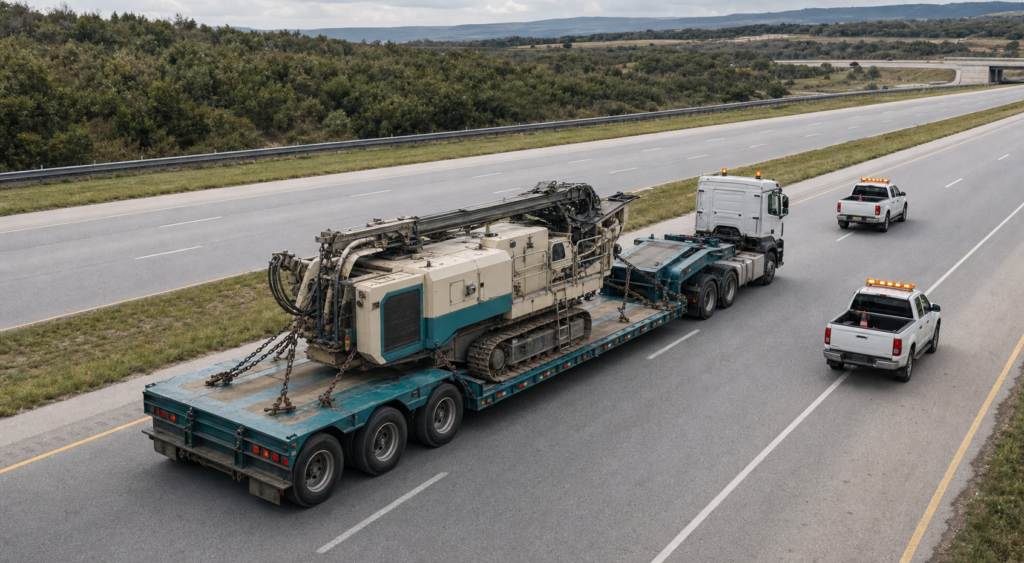
If you're shipping something that doesn't fit neatly into a standard trailer, whether it's too wide, too tall or too heavy, you need permits before that load can legally move. The responsibility for getting those permits typically falls on your carrier, a third-party permit service or sometimes your freight broker. Your job is to make sure someone qualified is handling it, because the consequences of moving without proper permits range from hefty fines to having your load detained on the side of the highway.
Authoritative Frameworks Referenced: The Federal Motor Carrier Safety Administration (FMCSA) Regulatory Framework governs interstate motor carrier operations including cargo securement and driver qualifications, forming the baseline for all specialized freight moves. State Departments of Transportation follow a structured permit process model where applicants provide load and vehicle data, states review routes and infrastructure capacity and permits specify allowable routes, travel times and escort requirements. The Specialized Carriers and Rigging Association (SC&RA) publishes best practices covering safety standards, permit procedures and professional practices for heavy-haul operations.
How do I know if my load needs special permits?
Here's the simplest way to think about it. According to the Federal Highway Administration, federal law caps standard loads at 80,000 pounds gross vehicle weight, 8.5 feet wide and 13.5 to 13.6 feet tall, though height limits vary by state.¹ If your shipment exceeds any of those dimensions or if it hangs over the back or front of the trailer beyond standard limits, you're in oversize or overweight territory and you'll need permits.
The tricky part is that every state sets its own additional restrictions on top of those federal baselines. A load that's perfectly legal in Texas might need a special permit in Oklahoma. So if your freight crosses multiple states, you could be looking at a different permit for each one, each with its own rules about travel times, required escorts and approved routes.
Think of it this way: if you look at your shipment and think 'that's a big one,' it probably needs a permit. Common examples include construction equipment, industrial machinery, large fabricated components and energy sector equipment. When in doubt, get the exact dimensions and weight from your shipper and have your carrier or permit service run a quick compliance check before anything moves.
Should the carrier or a separate permit service handle my permits?
This is one of the most practical decisions you'll make, and the answer depends on the complexity of your move. According to industry analysis from Anderson Trucking Service, specialized carriers either maintain in-house permitting staff or rely on third-party permit services to handle the regulatory side.² Both approaches work, but they serve different situations.
If you're working with a carrier that specializes in oversize and overweight freight day in and day out, there's a good chance they have dedicated permitting people on staff who know the quirks of each state's Department of Transportation. That's convenient because it keeps everything under one roof, and your carrier already knows the equipment dimensions and route plans. For straightforward moves within a couple of states, this is often the most efficient path.
But for complex multi-state moves, loads with unusual dimensions or routes through states with notoriously complicated permitting processes, a dedicated third-party permit service can be worth the investment. These companies do nothing but permits all day, every day. They often have established relationships with state DOT offices and can expedite approvals that might otherwise take days. If you're shipping frequently across many states, having a permit specialist in your corner can prevent the kind of delays that cost real money.
What happens if my oversize load gets stopped without permits?
Picture this: your 120,000-pound piece of equipment is halfway across Missouri on a tight delivery deadline and a DOT enforcement officer pulls your driver over. No valid permit for that state. What happens next isn't pretty. The load gets detained right there, sometimes for hours, sometimes for days, until proper permits are obtained. Meanwhile, you're paying for the truck, the driver and potentially pilot cars to sit idle.
Fines vary by state but can easily exceed $10,000 for a single violation. Some states calculate penalties based on the degree of overweight, meaning a significantly overweight load without permits could generate fines in the tens of thousands. Beyond the immediate financial hit, repeated violations can affect a carrier's safety rating with the Federal Motor Carrier Safety Administration, which tracks compliance records and can restrict a carrier's operating authority.
There's also the liability question. If an unpermitted oversize load is involved in an accident, the lack of proper permits can complicate insurance claims and dramatically increase legal exposure. The permitted route exists for a reason: it's been reviewed for bridge weight limits, overhead clearances and road conditions. Skip the permit, and you're essentially gambling that every bridge and overpass on your route can handle what you're carrying.
How big is the specialized freight market right now?
It's massive and growing. According to IBISWorld's proprietary modeling based on company financials and macroeconomic indicators, the U.S. long-distance specialized freight trucking industry is valued at approximately $61.4 billion as of 2026.³ That's just the domestic picture. The Business Research Company projects the global specialized freight trucking market will grow from $1.17 trillion in 2025 to $1.71 trillion by 2030.⁴
Why does this matter to you? Because a market this large means there are a lot of players, and not all of them are equally equipped to handle truly complex, non-standard freight. The sheer size of the industry can make it harder to find the right partner, not easier. You want a carrier or logistics provider that lives and breathes specialized freight, not one that handles it occasionally as a side business.
It's worth noting that these market figures are modeled estimates rather than direct survey results, so they should be treated as directional rather than precise.³ ⁴ But the trend is clear: demand for specialized freight handling is climbing, driven by infrastructure projects, energy development and manufacturing growth.
Can technology simplify the permit management process?
Yes, and it's evolving fast. According to analysis from Bear Down Logistics, AI and automation are now being deployed for automated permit checks, real-time regulation updates, predictive route planning and continuous compliance monitoring.⁵ Think of it as having a digital assistant that knows every state's permit rules and flags issues before they become problems.
Here's where it gets practical. Instead of a permitting specialist manually checking each state's current regulations, which can change with little notice, an AI-enabled system can cross-reference your load dimensions against every state on the route in seconds. It can suggest alternative routes when a bridge weight restriction makes your planned path impossible. Some systems even integrate with state DOT databases to streamline the actual permit application.
That said, the technology has real limitations. AI permit management depends on accurate input data, and if your load dimensions or weights are off even slightly, the system's output is unreliable. Implementation also requires significant infrastructure investment, and rapid regulatory changes can outpace even well-designed systems.⁵ If you're a shipper moving a handful of oversize loads per year, the technology benefits are mostly indirect, flowing through the carriers and permit services you hire. But if you're moving specialized freight regularly, asking your logistics partners about their technology capabilities is a smart move.
What should I look for in a specialized freight carrier?
Start with equipment. A carrier that handles non-standard freight needs the right trailer types: step decks, removable gooseneck (RGN) trailers, lowboys, Conestogas and extendable trailers for long loads. If they don't have access to the specific equipment your load requires, nothing else matters. Ask them directly what equipment they run and whether it's owned or sourced from partners.
Next, dig into their communication practices. Specialized freight almost always involves schedule changes, venue restrictions or last-minute adjustments. You need a carrier that responds quickly and keeps you informed throughout the process, not one that goes silent after dispatch. Real-time tracking and GPS visibility should be standard, not a premium add-on. The best specialized carriers build partnerships with their customers so they understand your specific challenges before problems arise.
Finally, verify their compliance and insurance frameworks. The FMCSA regulatory framework governs everything from driver qualifications to cargo securement standards, and your carrier should be fully compliant.¹ Ask about their safety record, insurance coverage levels and how they handle permit acquisition. If you're shipping high-value or time-critical freight, look for carriers that offer exclusive use vehicles, meaning your shipment is the only thing on that truck with no cross-docking, no transfers and no unnecessary handling.
When might third-party permit services not be worth it?
Not every oversize move needs a dedicated permit service, and paying for one when you don't need it is just wasted money. For infrequent moves that are only slightly oversize, say a load that's 9 feet wide instead of 8.5 feet, traveling through just one or two states, your carrier's in-house team can likely handle the permits efficiently and at lower cost. The added layer of a third-party service makes the most sense when complexity increases.
There's also a quality variability issue to be aware of. Not all permit service companies have equal expertise across all routes and load types. A company that's excellent at permitting wind turbine components through the Midwest might have limited experience with your specific freight type or the states on your route. Always verify that any permit service you're considering has handled similar loads through your specific jurisdictions.
If you're evaluating whether to invest in permit services, ask yourself three questions: How many states does my load cross? How far outside standard dimensions is it? And how often do I ship non-standard freight? If the answers are 'one state,' 'barely oversize,' and 'twice a year,' you can probably rely on your carrier. If the answers are 'six states,' 'significantly overweight,' and 'monthly,' a dedicated permit service will likely pay for itself in avoided delays and fines.
Key Takeaways
- Federal law caps standard loads at 80,000 pounds, 8.5 feet wide and 13.6 feet tall.
- Every state sets its own additional oversize and overweight restrictions beyond federal limits.
- Moving without proper permits can result in fines exceeding $10,000 per violation per state.
- AI-enabled permit management is emerging but depends on accurate data and significant investment.
- The U.S. specialized freight trucking market is valued at approximately $61.4 billion.
About This Topic
Specialized non-standard freight with permit services refers to the process of legally transporting shipments that exceed standard size or weight limits on public roads. This involves coordinating between specialized carriers equipped with the right trailers, permit service companies that navigate state-specific regulations and sometimes escort vehicles that ensure safe passage. The process touches federal regulations from the Federal Highway Administration and FMCSA, individual state Department of Transportation rules and industry best practices from organizations like the Specialized Carriers and Rigging Association. As the U.S. specialized freight trucking market approaches $61.4 billion, technology including AI-driven permit management is beginning to streamline compliance, though the fundamentals remain the same: accurate load data, proper permits for every state on the route and clear accountability for who is managing the regulatory process.
Comparative Analysis Table
| Factor | Option A | Option B | Notes |
|---|---|---|---|
| Permit Handling | Carrier In-House Permitting: Carrier staff manages all permit applications directly with state DOTs | Third-Party Permit Service: Dedicated permit company handles applications across all states on the route | Third-party services are preferable for complex multi-state moves; in-house works well for simpler, regional hauls |
| Cost Structure | Carrier In-House: Permit costs typically bundled into the freight rate with less line-item visibility | Third-Party Service: Separate fees of $150 to $300 per move plus actual permit costs, providing clear cost breakdown | Third-party transparency helps with budgeting; bundled rates can be simpler for infrequent shippers |
| Speed of Permit Acquisition | Carrier In-House: Depends on carrier's staffing and state relationships; can be slower during peak seasons | Third-Party Service: Dedicated staff with established DOT relationships often expedite approvals | For time-critical shipments, third-party speed advantage can justify the additional cost |
| Multi-State Expertise | Carrier In-House: Expertise may be concentrated in the carrier's primary operating regions | Third-Party Service: Typically covers all 48 contiguous states with specialists for complex jurisdictions | If your loads regularly cross five or more states, broad geographic expertise becomes critical |
| Technology Integration | Carrier In-House: Technology varies widely; smaller carriers may rely on manual processes | Third-Party Service: Leading firms use automated compliance checks and real-time regulation tracking | Ask about technology capabilities regardless of which approach you choose |
| Accountability | Carrier In-House: Single point of responsibility for both transport and permits | Third-Party Service: Shared responsibility requires clear communication between carrier and permit service | Single-source accountability is simpler; split responsibility needs defined handoff protocols |
How to Implement
-
Get Exact Load Dimensions and Weight
Start by collecting precise measurements: length, width, height and gross weight of your shipment including any overhang. Don't estimate. Inaccurate numbers can invalidate permits and create compliance problems on the road.
-
Determine Which States Your Route Crosses
Map out every state between origin and destination. Each state has its own oversize and overweight thresholds, travel time restrictions and escort requirements. A load that's legal in one state may need a permit in the next.
-
Decide Who Will Handle Permit Acquisition
Ask your carrier whether they manage permits in-house or recommend a third-party permit service. For multi-state moves with significant dimensional excesses, lean toward a dedicated permit specialist with experience in your specific corridors.
-
Verify Equipment and Route Compatibility
Confirm that the trailer type, whether step deck, RGN, lowboy or extendable, matches your load's requirements. Have your carrier or permit service verify that the planned route accommodates your load's height, weight and width at every bridge, overpass and interchange.
-
Secure Permits and Arrange Escorts Before Dispatch
Apply for all required state permits well in advance. Some states process permits in 24 hours; others take a week or more. Arrange pilot cars or escort vehicles if required. Never dispatch a load assuming permits will come through en route.
-
Confirm Communication Protocols and Tracking
Establish real-time tracking and a clear communication plan with your carrier. For time-critical or high-value specialized freight, insist on proactive updates at key milestones: pickup confirmation, state border crossings and delivery approach.
Troubleshooting FAQs
My permit was approved but the route has changed due to road construction. What do I do?
Contact your permit service or carrier's permitting team immediately. Most state permits are route-specific, meaning a detour off the approved route puts you out of compliance. Many states offer route amendments or re-issues, but you need to request them before the truck deviates. Your permit service should be monitoring for construction alerts and DOT advisories along the approved route, so ask about this capability upfront.
The delivery venue has restrictions my carrier didn't know about. How do I prevent this?
This happens frequently with trade show venues, construction sites and facilities with narrow access points or weight-restricted loading docks. The fix is communication before the truck rolls. Share every detail about the delivery location with your carrier: dock height, door width, ground surface type, time-of-day restrictions and any required check-in procedures. For event and trade show deliveries, confirm marshalling yard coordination and advanced warehouse delivery windows directly with the venue or show contractor.
Implementation Stories
Best Practices Checklist
- Confirm in writing whether your carrier, broker or a third-party service is responsible for permit acquisition before any load is dispatched.
- Provide exact dimensions and certified weights for every non-standard shipment, never rounded estimates.
- Request route surveys for loads exceeding 12 feet wide or 14 feet tall to verify bridge clearances and road restrictions.
- Build permit processing time into your shipping schedule: allow at least 5 to 7 business days for multi-state permits.
- Require real-time GPS tracking and proactive milestone updates for all specialized and high-value freight moves.
- Review your carrier's FMCSA safety record and verify their insurance covers the full declared value of your shipment.
Glossary
| Term | Definition |
|---|---|
| Oversize Load | Any shipment that exceeds standard legal dimensions for width (8.5 feet), height (13.5 to 13.6 feet depending on the state), or length, requiring special permits to travel on public roads. |
| Overweight Load | A shipment that exceeds the federal gross vehicle weight limit of 80,000 pounds or specific axle weight limits, requiring permits from each state on the route. |
| RGN (Removable Gooseneck) Trailer | A specialized lowboy trailer whose front end detaches so that heavy equipment can be driven or rolled directly onto the deck, commonly used for construction and industrial machinery. |
| Pilot Car (Escort Vehicle) | A vehicle that travels ahead of or behind an oversize load to warn other drivers and help navigate tight spots, often required by state permits for loads above certain width or height thresholds. |
| Exclusive Use Vehicle (EUV) | A dedicated truck assigned to carry only your shipment from origin to destination with no other freight on board, eliminating cross-docking, transfers, and co-loading risks. |
References
- Federal Highway Administration. "Federal Size Regulations for Commercial Motor Vehicles". U.S. Department of Transportation. Date accessed 7/1/26. https://ops.fhwa.dot.gov/freight/publications/size_regs_final_rpt/.
- Anderson Trucking Service. "Industry Review of Permit Service Companies". Anderson Trucking Service. Date accessed 7/1/26. https://www.atsinc.com/blog/carriers/6-oversize-overweight-permit-companies-to-consider.
- IBISWorld. "Long-Distance Specialized Freight Trucking in the US – Market Size". IBISWorld. January 1, 2026. https://www.ibisworld.com/united-states/industry/long-distance-specialized-freight-trucking/1156/.
- The Business Research Company. "Specialized Freight Trucking Global Market Report". The Business Research Company. January 1, 2025. https://www.thebusinessresearchcompany.com/report/specialized-freight-trucking-global-market-report.
- Bear Down Logistics. "The Future of AI in the Oversized Freight Industry". Bear Down Logistics. January 1, 2025. https://beardown-logistics.com/blog/ai-automation-oversized-freight/.
Need help planning a shipment?
Talk with PEI about expedited freight, specialized freight, or your next shipping challenge.
