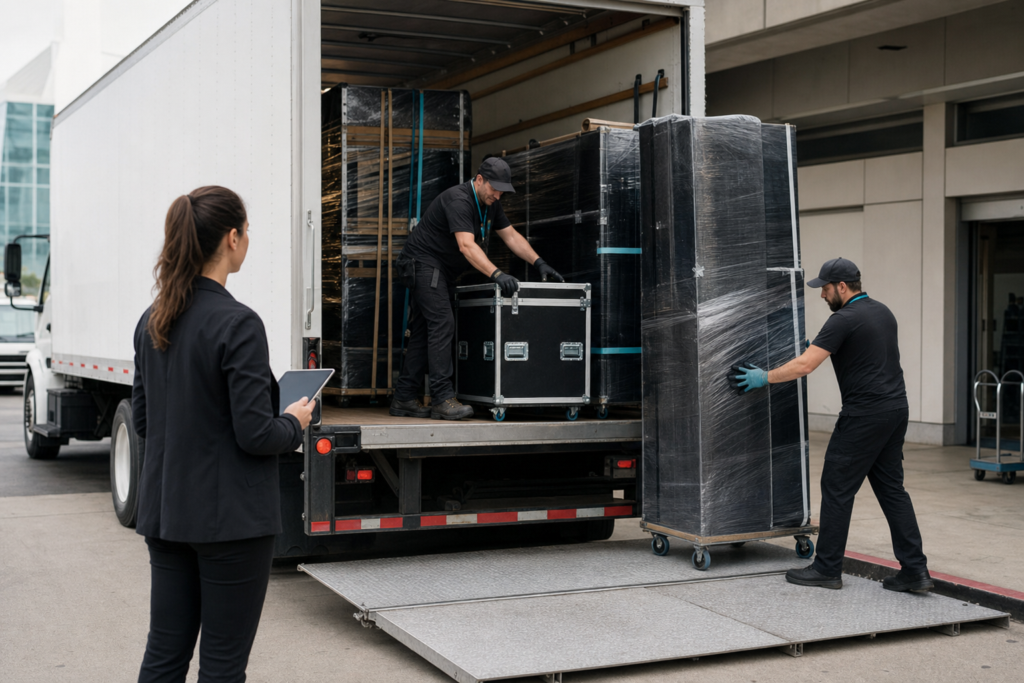
A trade show logistics provider is essentially your behind-the-scenes partner for getting exhibit materials, booth components and equipment to the right venue at exactly the right time. If you've ever tried shipping a custom booth setup through a standard freight carrier and watched it arrive late, damaged or at the wrong loading dock, you already know why these specialists exist. They coordinate advance warehouse deliveries, direct-to-show shipments, marshalling yard logistics and the inevitable last-minute schedule changes that come with live events. Think of them as the difference between hoping your freight shows up and knowing it will.
Authoritative Frameworks Referenced: Several established frameworks guide best practices in this space. The Event Logistics Lifecycle model, referenced in professional education materials from Cvent and EventCombo, divides logistics into strategic planning, detailed planning and procurement, execution and post-event optimization phases. Additionally, the Event Logistics Risk Management framework from Suomen Event Logistics provides a systematic approach to identifying and mitigating risks across transportation, customs, storage and on-site handling.
How is trade show shipping different from regular freight?
Here's the thing about trade show freight: it doesn't play by normal rules. Standard carriers optimize for efficiency, which means your shipment might sit in a terminal, get transferred between trucks or arrive within a general delivery window. Trade show freight needs to hit a specific dock, at a specific venue, during a specific receiving window, often coordinated with an advance warehouse or marshalling yard. Miss that window and your booth sits outside while the show opens without you.
The complexity goes deeper than timing. Venues have their own rules about what can come through which door, when trucks can access loading docks and how freight gets moved from the dock to your booth space. That last part, called drayage, is handled by the venue's appointed contractor and charged by weight. According to example rates from industry drayage calculators, you might pay around $97 per hundredweight for crated direct-to-show shipments but nearly $150 per hundredweight for uncrated ones.¹ Packaging decisions you make weeks before the show directly affect what you pay on-site.
A specialized provider understands all of these moving parts. They know which shows require advance warehouse delivery versus direct-to-show, they can coordinate with general service contractors and critically, they can react when schedules change. In live events, schedules always change. Your regular carrier isn't set up to reroute a shipment at 10 PM on a Thursday because the show moved your install time up by a day.
How far in advance should I plan trade show logistics?
Most experienced event planners start logistics planning at least eight to twelve weeks before a show, and for major exhibitions, even earlier. That might sound excessive, but the Event Logistics Lifecycle framework breaks the process into phases: strategic planning, detailed procurement, execution and post-event optimization. If you're cramming all of that into the last few weeks, you're essentially paying rush prices for everything and leaving zero margin for problems.
The advance warehouse is a perfect example of why early planning matters. Most shows set an advance warehouse receiving window that closes well before the exhibit hall opens. If you miss that window, your only option is direct-to-show delivery, which is more expensive and less flexible. Getting your freight to the advance warehouse on time means booking carriers early, confirming delivery appointments and building in buffer days for weather delays or carrier issues.
If you're a first-time exhibitor at a major show, start even earlier. You'll need to learn the venue's specific freight rules, understand the general service contractor's requirements and figure out whether your booth components need special handling. If you're exhibiting at multiple shows per year, the smartest move is building a logistics calendar at the start of the year so you're never scrambling.
Is specialized trade show shipping worth the extra cost?
That depends entirely on what's at stake. According to the Center for Exhibition Industry Research (CEIR), traditional trade shows contributed around $90 billion to the U.S. economy in 2023, representing roughly a 15 percent increase over the prior year.² That kind of economic activity means the shows themselves are high-value environments where your presence or absence, carries real financial weight. If your booth doesn't arrive, you're not just out shipping costs. You're out booth space fees, staff travel, marketing materials and potential leads.
The PCMA Convene Meetings Market Survey found that budget pressures top the list of event planners' biggest challenges, with rising venue, food and beverage and service costs squeezing every line item.³ So the instinct to save on shipping is understandable. But here's where cost-benefit analysis gets interesting: the premium for a specialized provider over a standard carrier might be 15 to 30 percent more, while the cost of a single failed delivery can dwarf your entire shipping budget.
That said, not every event justifies the premium. If you're shipping a simple tabletop display to a local conference with flexible setup windows, a standard carrier might work fine. Where specialized providers earn their keep is on time-critical moves, multi-booth shipments, high-value equipment and shows where schedule changes are common. The more complex your logistics, the more a specialist pays for itself.
What should I look for when choosing a logistics provider?
Start with communication. In trade show logistics, the ability to get a fast, clear answer at odd hours matters more than almost anything else. Events don't operate on a nine-to-five schedule, and neither should your logistics partner. Look for providers who offer real-time tracking, proactive status updates and a single point of contact who actually knows your shipment.
The Supplier Selection Process framework used in procurement, as described by Infosys BPM, recommends evaluating providers across price, quality, reliability and service using a formalized multi-criteria process. For trade shows specifically, you'll want to weight flexibility and responsiveness more heavily than you would for routine freight. Ask potential providers how they handle last-minute schedule changes, because those changes will happen. A provider who can reroute a shipment or adjust delivery timing without starting from scratch is worth significantly more than one who quotes a lower rate but can't adapt.
Also look at vehicle options. Trade show freight comes in all sizes, from a few cases that fit in a cargo van to full truckload booth builds. A provider with access to sprinter trucks, straight trucks, cargo vans and full truckloads gives you flexibility without needing to coordinate multiple vendors. And ask about their experience with specific venues or shows you attend. Knowing a convention center's receiving procedures and dock schedules can save hours of on-site headaches.
Should I ship to the advance warehouse or direct to the show?
Both options have trade-offs, and the right choice depends on your timeline, budget and risk tolerance. Advance warehouse shipments typically cost less in drayage, with example rates around $103 per hundredweight compared to $97 for crated direct-to-show and nearly $150 for uncrated direct-to-show.¹ But the advance warehouse also means shipping earlier, which ties up your materials longer and adds an extra handling step.
Direct-to-show gives you more control over timing and reduces the number of times your freight gets touched. Fewer touches generally means less damage risk. The catch is that direct-to-show delivery windows are usually much tighter, and if your carrier hits a delay, there's no buffer. You also pay more in drayage if your materials aren't properly crated, because the venue's contractor charges a premium for handling loose or uncrated items.
Here's a practical way to think about it: if you're shipping standard, well-packaged booth components and your schedule has some flexibility, the advance warehouse is usually the safer, more cost-effective choice. If you're shipping high-value items, custom displays that need careful handling or materials you need until the last possible moment, direct-to-show with a reliable provider gives you more control. Many experienced exhibitors use a hybrid approach, sending the bulk of their materials to the advance warehouse and shipping last-minute items direct.
How do I measure whether my trade show logistics worked?
The most obvious metric is binary: did everything arrive on time and undamaged? But smart event planners go deeper. The Trade Show ROI Framework, a five-step model described in industry literature from Audie Expo, breaks evaluation into cost justification, performance evaluation, budgeting discipline, revenue tracking and lead conversion analysis. Your logistics strategy feeds directly into at least three of those steps.
Start by tracking your total logistics cost per show, including freight, drayage, storage and any rush fees or damage claims. Compare that against your booth's lead generation or revenue outcomes. If you spent $8,000 on logistics for a show that generated $50,000 in qualified leads, that's a very different picture than spending $4,000 on logistics but losing half a day of booth time because freight arrived late.
Also track the intangibles that affect your team's experience. How much time did your event coordinator spend chasing shipment updates? Were there any surprises at the venue? Did schedule changes cause cascading problems? Over multiple shows, these patterns reveal whether your logistics approach is sustainable or whether you're burning out your team to save a few hundred dollars per shipment. The best logistics strategy is one you barely have to think about on show day.
When might a specialized trade show logistics provider not be worth it?
It's important to be honest about this: specialized logistics isn't always the right call. If you're attending a small, local event with a simple tabletop display and flexible setup windows, the premium for a specialized provider probably doesn't make sense. A standard carrier or even your own vehicle can handle straightforward, low-risk shipments just fine.
There are also data limitations worth acknowledging. Most information available about individual logistics providers comes from their own marketing materials rather than independently verified performance metrics.⁴ That means you'll need to do your own due diligence, asking for references, case studies and specific performance data rather than relying on published claims. Industry guides on trade show logistics are often authored by vendors who naturally emphasize the benefits of outsourcing without equally highlighting the drawbacks.
Additionally, drayage rates, shipping costs and service availability vary significantly by location, venue and show.⁴ Example rates and timelines you find online should be treated as rough indicators, not firm benchmarks. If you're working with a tight budget and your event logistics are genuinely simple, investing that money in your booth design or marketing materials might deliver a better return. The key is matching the complexity of your logistics needs to the level of service you're paying for.
What are typical costs for trade show shipping and drayage?
Costs vary widely, but let's put some real numbers on the table. According to industry drayage calculators, mid-range example rates run approximately $103 per hundredweight for advance warehouse shipments, about $97 per hundredweight for crated direct-to-show deliveries and roughly $149 per hundredweight for uncrated direct-to-show shipments.¹ Hundredweight means per 100 pounds, so a 1,000-pound booth shipped uncrated direct-to-show could cost nearly $1,500 in drayage alone, before you've paid a dime for the actual freight.
Grand View Research estimated the global event logistics market reached approximately $68.63 billion in 2023, with a projected compound annual growth rate of 6.3 percent through 2030.⁵ That growth means more demand, more competition for carrier capacity around major shows and potentially rising rates. Industry analysis suggests that event planner fees and corporate event budgets typically allocate 10 to 20 percent of total spend to logistics-related costs.⁶
The smartest way to control costs is through packaging and planning. Crating your materials properly can save you over $50 per hundredweight in drayage compared to shipping uncrated. Consolidating shipments, choosing advance warehouse delivery when possible and booking carriers well ahead of show dates all help keep costs predictable. Where most exhibitors get burned is on rush shipping and last-minute changes, which is exactly where having a responsive logistics partner pays off.
Key Takeaways
- Trade show freight requires precision timing that standard carriers aren't designed for.
- Crating your materials can save over $50 per hundredweight in drayage costs.
- One missed delivery can cost more than an entire year of logistics premiums.
- Start planning logistics at least eight to twelve weeks before any major show.
- Communication speed and schedule flexibility matter more than the lowest freight quote.
About This Topic
Trade show logistics providers specialize in the time-sensitive, high-coordination freight management that live events demand. Unlike standard carriers, these providers handle advance warehouse deliveries, direct-to-show shipments, marshalling yard coordination and the constant schedule changes inherent to exhibitions and conferences. Within the global event logistics market, valued at approximately $68.63 billion in 2023, trade show freight represents a critical niche where missed deadlines carry outsized financial consequences. These providers typically offer dedicated vehicles, real-time tracking, flexible scheduling and 24/7 communication to ensure exhibit materials arrive show-ready, on time and undamaged.
Comparative Analysis Table
| Factor | Option A | Option B | Notes |
|---|---|---|---|
| Schedule change handling | Standard carrier: Changes require rebooking, often with fees and delays | Specialized provider: Built to reroute and adjust timing on short notice | Specialized providers are preferable when show schedules are unpredictable or frequently shift |
| Shipment tracking and communication | Standard carrier: Automated tracking with limited proactive updates | Specialized provider: Real-time tracking with dedicated contact and proactive communication | Specialized providers are better for high-value or time-critical shipments requiring constant visibility |
| Vehicle and mode flexibility | Standard carrier: Typically limited to standard truck classes on fixed routes | Specialized provider: Access to cargo vans, sprinters, straight trucks, and full truckloads | Specialized providers offer more options when shipment sizes vary across different shows |
| Venue and drayage knowledge | Standard carrier: Delivers to address with no venue-specific coordination | Specialized provider: Understands advance warehouses, marshalling yards, and dock procedures | Venue knowledge prevents costly delivery mistakes and missed receiving windows |
| Cost | Standard carrier: Lower base rates for straightforward point-to-point shipping | Specialized provider: Higher rates reflecting coordination, flexibility, and expertise | Standard carriers may be sufficient for simple, low-risk local events |
| After-hours availability | Standard carrier: Limited to business hours with automated after-hours support | Specialized provider: 24/7/365 availability with live dispatch and coordination | Essential for events with early morning installs, weekend shows, or emergency recoveries |
How to Implement
-
Map Your Show Calendar and Logistics Timeline
Start by listing every show you plan to attend for the year. For each one, note the advance warehouse receiving dates, direct-to-show windows and your install and dismantle schedule. Build in buffer days for weather and carrier delays.
-
Audit Your Freight and Packaging
Weigh and measure every item you plan to ship. Determine what needs custom crating, what can ship in standard packaging and what qualifies as special handling. Remember that crated versus uncrated shipments can mean a $50 per hundredweight difference in drayage costs.
-
Choose Your Shipping Method for Each Show
Decide between advance warehouse and direct-to-show for each event based on your timeline, budget and the complexity of your booth. Consider a hybrid approach for shows where you need both early setup materials and last-minute items.
-
Vet and Select Your Logistics Provider
Evaluate providers on responsiveness, vehicle flexibility, venue experience and their ability to handle schedule changes. Ask for references from exhibitors at shows similar to yours. Request specific performance data rather than relying solely on marketing claims.
-
Confirm Every Detail in Writing Before Shipping
Lock down delivery appointments, contact information for on-site receiving, booth numbers and any special handling instructions. Share this information with your logistics provider and your on-site team so everyone is working from the same playbook.
-
Debrief and Optimize After Each Show
Track total logistics costs, delivery accuracy, damage incidents and time your team spent managing freight issues. Compare results across shows and providers to refine your approach for the next event cycle.
Troubleshooting FAQs
What do I do if my shipment is delayed and the advance warehouse window is closing?
Contact your logistics provider immediately and explore converting to a direct-to-show delivery. A specialized provider with access to expedited vehicles like sprinter trucks or hotshot carriers can often recover a delayed shipment and deliver it directly to the venue during the show's receiving hours. You'll pay more in drayage for direct-to-show, but it's far cheaper than missing the show entirely. Make sure you also notify the general service contractor at the venue so they're expecting the change.
My booth arrived damaged. How do I prevent this next time?
Document the damage immediately with photos and file a claim with both the carrier and the drayage contractor, since damage can occur at either stage. For prevention, invest in proper crating and internal padding designed for the specific items you're shipping. Avoid uncrated shipments whenever possible, as they're handled more roughly and cost more in drayage. Using a dedicated, exclusive-use vehicle eliminates transfers and cross-docking, which are the two biggest damage risk points in the shipping chain.
Implementation Stories
Best Practices Checklist
- Confirm advance warehouse receiving dates and direct-to-show windows at least ten weeks before each event.
- Crate all fragile or high-value items to reduce both damage risk and drayage costs.
- Request real-time tracking and a dedicated point of contact from your logistics provider.
- Build at least two buffer days into every shipping timeline to absorb unexpected delays.
- Keep a detailed post-show logistics report for every event to identify patterns and cost-saving opportunities.
- Verify your provider can handle schedule changes and after-hours communication before you commit.
Glossary
| Term | Definition |
|---|---|
| Drayage | The service of moving your freight from the venue's loading dock to your booth space, handled by the show's appointed contractor and typically charged by weight. |
| Advance warehouse | A storage facility designated by the show organizer where exhibitors can ship materials weeks before the event, with the contractor delivering them to the booth on setup day. |
| Marshalling yard | A staging area near the venue where trucks wait for their assigned time slot to access the loading dock, preventing congestion during show setup and teardown. |
| Hundredweight (CWT) | A unit of measurement equal to 100 pounds, commonly used to calculate drayage and freight charges for trade show shipments. |
| Exclusive use vehicle (EUV) | A dedicated truck or van assigned solely to your shipment with no other freight on board, eliminating transfers, cross-docking, and the delays or damage risks they introduce. |
References
- Exhibit Edge. "Drayage Calculator and Rate Examples". Exhibit Edge. Date accessed 7/1/26. https://www.exhibitedge.com/blog/drayage-calculator/.
- Center for Exhibition Industry Research (CEIR / IAEE). "CEIR — Center for Exhibition Industry Research". Center for Exhibition Industry Research (CEIR / IAEE). Accessed July 1, 2026. https://www.iaee.com/ceir/.
- PCMA. "Convene Meetings Market Survey". PCMA. Date accessed 7/1/26. https://www.pcma.org/32nd-convene-meetings-market-survey-results/.
- Brick Dynamics. "Trade Show Drayage Services: Costs, Tips & How It Works". Brick Dynamics. June 16, 2026. https://brickdynamics.com/trade-show-drayage-services/.
- Grand View Research. "Event Logistics Market Size and Projections". Grand View Research. January 1, 2023. https://www.grandviewresearch.com/industry-analysis/event-logistics-market-report.
- Great Event. "Event Planner Fees and Budget Analysis". Great Event. January 1, 2026. https://www.greatevent.com/how-much-do-event-planners-charge/.
Need help planning a shipment?
Talk with PEI about expedited freight, specialized freight, or your next shipping challenge.
