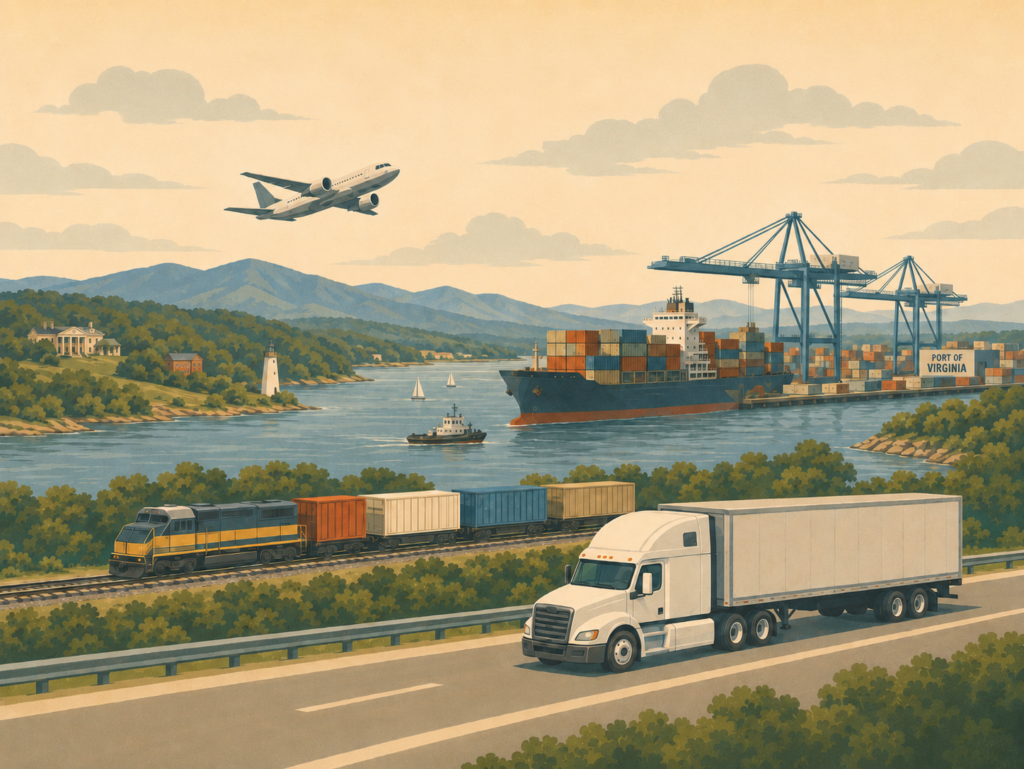
Freight moves through Virginia in a number of ways. The state serves as a major global and domestic logistics hub and processes hundreds of millions of tons of goods each year. The movement of freight here is supported by the states robust infrastructure, featuring major ports, key interstate highways, and extensive rail networks. Utilizing major interstates like the I-81 and I-95, the Port of Virginia and Class 1 railroads, including CSX and Norfolk Southern, means there are solutions whether you’re moving LTL, FTL or coordinating overseas transport in Virginia.
Top Industries Relying On Freight Movement In Virginia
Virginia is big on international trade, manufacturing and agriculture. The top industries that rely on freight movement through the state include:
- Automotive
- Retail & E-commerce
- Food
- Agriculture
- Manufacturing
- Energy & Coal
Major Roadways In Virginia
The busiest roads in Virginia tend to be vital interstate routes that connect major logistics hubs, including the Port of Virginia and inland distribution networks. Here is a list of the busiest roadways in the state, which should be taken into account when moving freight, to, through or from Virginia.
I-81
The I-81 is the number one interstate for moving freight in Virginia, running across the Western part of the state for 325 miles. It is one of the most heavily utilized freight corridors in the nation, running parallel to the Norfolk Southern rail lines and see’s more than 21 million truck trips per year. The Virginia Department of Transportation (VDOT) states that the I-81 moves more than one third of all trucks in Virginia and almost half of the state’s goods by value.
I-95
The I-95 is one of the busiest and most travelled highways on the East Coast, only after the I-81, and runs from the North to the South through Virginia. Around 9 million trucks move along the I-95 annually and due to the extensive use of the highway, it is prone to high traffic congestion with both freight and commuter traffic, especially during rush hours. Particularly bad congestion is around Springfield, Richmond and Petersburg, so always bare these areas in mind especially.
I-64
The I-64 is the main East-West freight corridor, with around 7 million trucks utilizing the route each year. It moves freight from coastal areas to inland and connects the Port of Virginia in Norfolk and Newport News to I-95 in Richmond and continues on West towards the Blue Ridge Mountains.
I-85
The I-85 is an important corridor for moving freight between Virginia and North Carolina and to the further South Eastern region. In fact, Vtrans lists the I-85 among the leading truck routes in the state.
I-77
The I-77 is ranked on Vtrans along with I-81 and I-95 as the most heavily travelled truck roadways in the state. It’s a key southwest Virginia route connecting Virginia, North Carolina and West Virginia.
I-66
The I-66 is an important freight route for moving goods between Shenandoah Valley, Northern Virginia and the Washington D.C. area. It’s not as popular with freight as the I-81 and I-95 but it’s still a major corridor.
Major Trucking Bottleneck Areas In Virginia
Major freight bottlenecks in Virginia are concentrated along three primary freight corridors, the I-95, I-64 and I-81. It’s important to factor in these congested areas when planning a freight route here. Getting stuck in one of these spots can slow down your supply chain, increase fuel consumption and ultimately create lengthy, costly delays. Watch the following routes closely:
⚠️I-95 in Springfield at Backlick Road
One of the most severe bottlenecks on approach to Washington D.C, causing major delays for northbound freight.
⚠️I-95 at Route 1 at Woodbridge area
This route experiences heavy traffic during peak congestion hours, which significantly affects freight movement speed through the area.
⚠️I-64 at I-264 Norfolk/Virginia Beach area
This is a primary route for freight in and out of the Port of Virginia’s major marine terminals.
⚠️I-81 at multiple sections
As a major corridor moving north-south, it typically experiences high truck volumes and the rural, steep gradient mixed in, regularly causes congestion.
⚠️I-64 at I-95 Richmond Interchange
A major route where north-south and east-west routes intersect, causing delays.
Restrictions Around Trucking Freight In Virginia
To move freight without having to obtain any oversize and overweight permits, freight must fall within these size and weight limits:
Size Limits:
Width – 8′ 6″
Height – 13′ 6″
Length (dependent on truck and trailer):
Semitrailer – Up to 53 feet
Twin Trailers – 28.5 feet per trailer
Single Unit Vehicle – 40 feet
Overall Combination – No overall limit for tractor semitrailer combinations with 48 or 53 foot semitrailers.
Weight Limits:
Gross Vehicle Weight – 80,000lbs
Single Axel – 20,000lbs
Tandem Axel – 34,000lbs
Any freight exceeding these or the size legal limits stated above, must seek appropriate OS/OW permits. Check the Virginia Department of Motor Vehicles for any permits that apply to your load, expect an additional cost to secure a permit.
Movement Restrictions Of Oversize Freight
Virginia limits the movement of overdimensional freight in different ways, particularly when it comes to the permitted dates and hours of travel.
Daylight Hours Movement
Monday through to Saturday oversize freight is restricted to movement until 30 minutes before sunrise and 30 minutes after sunset. With Sunday travel of oversize freight being strictly prohibited.
*However, this applies to oversize only freight, we’re talking about the freight that has an overhang. Overweight loads are not restricted to hours of travel, and can move through the state 24/7.
*Loads under 12 feet wide, 14 feet high and 115,000lbs may travel until noon on a Saturday.
Holiday Movement
The movement of oversize and overweight freight is not allowed on major holidays through Virginia, like most states, these dates include: New Year’s Day, Memorial Day, Independence Day, Labor Day, Thanksgiving and Christmas.
City Curfews
The movement of oversize and overweight freight is usually restricted during peak travel times in major cities. Restricted hours are typically between 7am-9am and 4pm-6pm.
Bridge & Tunnel Restrictions
There are a number of bridges and tunnels throughout Virginia, and they come with height, width and weight limitations. If you’re travelling through the state always double check your freight route for infrastructure restrictions, each one has different size and weight limits.
Air Freight
Virginia is the home to multiple airports facilitating air cargo movement. The three major cargo airports are:
1.Washington Dulles International Airport
The Washington Dulles International Airport handles over a whopping 300,000 tons of freight annually across seven large cargo buildings, that span 540,000 square feet, making it the busiest in Virginia . It’s an airport that is serviced by 41 airlines that can connect freight to 57 international and 86 domestic destinations. The strategic location of the airport means it is connected to all major U.S. markets via interstate routes and is within an overnight drive of over 50% of the U.S. population.
This airport is built for international trade. It has a foreign trade zone, that means international trade can be carried out in an efficient low cost way. There are bonded warehouses, secure facilities, refrigerated and ambient temperature controlled spaces, customs clearance, and cargo screening. This airport also offers 24 hour operations, so no restrictions around night time flights and it has the capacity to handle the largest aircrafts.
2.Richmond International Airport
Richmond International Airport is also one of the busiest cargo airports in the nation. There’s over 70,000 tons of of cargo handled here every year. Including, temperature sensitive freight, high-security goods, and overnight and priority freight for businesses and individuals. The airport has 142,000 square feet of cargo warehouse space and because of its strategic location, goods shipped out of Richmond airport can reach 50% of the U.S. population within 24 hours. The I-95 corridor adjacent helps with this, and seamlessly connects air freight with ground logistics.
3.Norfolk International Airport
Norfolk International Airport handles around 30,000 tons of freight each year. It is primarily served by FedEx, Mountain Air, and United Parcel Service and a large network of forwarders and customs brokers. Norfolk has two cargo terminals and 88,000 square feet of space to handle all kinds of freight.
Waterway Freight
A ton of freight moves through the Port of Virginia and then sometimes continues along the inland waterway, James River.
Port of Virginia
Waterway freight in Virginia relies heavily on the deepwater terminals of the Port of Virginia. It has the deepest shipping channel on the East Coast of the U.S. linking coastal and inland networks. The Port of Virginia’s central East Coast location means goods can reach 75% of the U.S. population within 2 days or less. This means businesses can reach major inland markets and key distribution centers through the Midwest and East coast. The port has great connectivity to expansive rail systems.Through a seven mile on dock track that connects the port further inland and also has fantastic connectivity to the nation’s third largest state maintained highway system.
James River
Connecting to the Port of Virginia, is the James River. The James River is home to the 64 Express, a successful container on barge service. It services freight between the Port of Richmond and Eastern Virginia’s global terminals. The mouth of the river empties into the Hampton Roads Harbor, one of the deepest harbors in the world and home to the major global terminals. The success of the barge network on the river comes largely from facilitating the movement of goods to and from inland Virginia, without solely relying on movement along the I-95. Therefore, easing not adding to even more congested road routes.
Rail Freight
Virginia has the most expansive rail reach on the U.S. East Coast, with two class 1 rail partners, Norfolk Southern and CSX and supported by nine Class 111 shortline railroads. It’s home to over 3000 route miles and over 6000 miles of track, because of this, rail solutions in the state are able to connect freight across and further beyond Virginia. These railroads move tens of millions of tons of goods each year, and play a huge part in connecting domestic businesses to international markets via the Port of Virginia.
Fun fact: On average, one rail carload removes the equivalent of 3.4 truckloads from Virginia’s highways. In 2025 it would have taken around 10.6 million trucks to move the amount of freight that moved via rail, again saving more congestion from our roads.
Planning Freight Movement In Virginia?
Virginia is not only a big player in the movement of domestic freight, but also international goods move here frequently. The state has it all, from major highways, to deepwater ports, inland barge routes, cargo airports and large class 1 railroads. There’s a wide range of shipping options here, meaning you can tailor freight movement depending on your needs, i.e. how quickly your shipments needs to move, where they’re coming from and what it is you’re moving.
But another thing the state has is congested highways, so it’s not only about choosing the nearest route, you must consider congestion around the key corridors, including: I-95, I-64, and I-81 as they can create lengthy delays, which need to be planned for.
Most find that to successfully move freight efficiently in Virginia utilizing a multimodal approach is the best way for them. Using the right combination of truck, rail, port, air and barge can help to manage costs, and reduce delays while keeping your freight moving. If you’re moving freight to, from or even passing through as part of a wider Southeast supply chain, understanding that planning is key will set you and your business up for successful moves.
PEI Can Help
But, no matter where in the states you need to move your freight, we’re based in Atlanta, but have locations across the U.S. that can find solutions for you. From truckload, LTL, expedited, oversize and more complex freight needs, our team can help you to find the route, equipment, and support for your shipment. Get in touch using the link below or call us on: 888-SHIP-911 . We’d love to hear from you! 😊
But also if you’re moving freight through other Southeastern states, and would love more information on each of them, then we’re building a mini-series, where we discuss how it looks to move freight through other states in the area, read more here.
Need help planning a shipment?
Talk with PEI about expedited freight, specialized freight, or your next shipping challenge.
