
When comparing expedited vs standard shipping making the right choice usually comes down to the specific needs of your freight. But it’s also important to figure out what the consequences would be for your business and your customers if a shipment is late.
In many cases standard shipping works out as the most cost-effective and practical option. However, when a longer transit time means increased costs down the line, delays in production, unhappy customers, etc. then an expedited shipping option could be worth the extra upfront expense. Because while expedited shipping does comes with a higher price tag, it is also designed to help freight move faster and more reliably. Whereas, standard shipping is a cost-effective solution for scheduled shipments that are not bound by a tight delivery timeframe. Weighing up needs, budgets, timelines and consequences of delays is truly the best way to make an informed decision.
In this blog we are going to compare expedited vs standard shipping solutions, touch on the key points of both and talk you through the best practice in choosing which option is best for your freight needs.
What Is Standard Shipping?
Standard shipping is the most commonly used choice across personal and business related shipments. It’s the chosen most cost-effective mode to move freight in a normal timeframe, when you do not have a tight deadline or a need for urgent transportation. It often means predefining schedules, using shared routes and consolidating multiple shipments, meaning it can be planned in the most cost-effective way. Usually businesses regularly replenishing inventory, moving non urgent materials, planned orders or freight not tied to a critical deadlines utilize this mode.
However, we are by no means saying that a standard shipping solution is unreliable, it just means that standard shipping freight is moving on a schedule rather than prioritising faster delivery. A lot of businesses find that standard shipping is the best option for them as it balances reliability, planning and cost.
The key to choosing a freight solution is understanding how much flexibility you have with a shipment, if delivery times aren’t specific then saving your dollars and opting for a standard solution could be the best fit.
What Is Expedited Shipping?
Expedited is a blanket term for the speed at which freight is moved, but it could be via multiple methods of transportation. Including ground expedite, straight trucks, cargo vans, team driver runs, next flight out (air), or air charters. They all share the same missions and they are to reduce touch points, hand offs, and delays.
Expedited shipping is the perfect option when you’ve got shipments on tight timeframes. It’s a solution that offers a faster, more direct movement from pick up to delivery with no stops or transfers in between. To enable expedited shipping to move freight as quickly and securely as possible freight partners dedicate a vehicle solely to that shipment. Typically companies using expedited shipping have tight delivery windows, limited time to schedule freight or they simply choose it when a delay could create bigger problems for their business. Usually these companies are also trying to protect something, whether that’s a production schedule, a customer commitment, a project deadline, installation date, or a piece of equipment needed to be back up and running asap. In these scenarios, shipping is coordinated and a solution is built around the required delivery time.
Because of all of this extra coordination, the expedited manner of the job, priority handling, and flexibility needed from the carrier or freight partner, it usually costs more than standard shipping. However, sometimes the extra outlay from the get go can be justified to avoid costly delays. If a shipment arriving late could risk production downtime, delay an order, damage a relationship, or create financial penalties, then paying for a faster solution could help to avoid a bigger problem. Weigh up the cost of waiting for a shipment and the cost of expediting it, to help make your decision.
Expedited vs Standard Shipping: The Main Differences
The main difference when comparing expedited vs standard shipping options is urgency. But there are more, just as equally important differences between the two which we will delve deeper into below.
1.Cost
Cost is one of the biggest differences between the two options. Standard shipping is almost always the cheapest option as it’s a baseline solution and there is more flexibility around scheduling and equipment availability. Standard shipping is usually priced on an LTL or FTL tariff and when this type of freight can be planned in advance, there are more options and opportunities to find a solution at a lower rate.
Whereas, expediting a load costs significantly more due to priority handling, tighter schedules, direct routing and dedicated transport to meet the stringent requirements of time critical freight.
The most important thing to keep in mind is that although standard shipping seems cheaper at a first glance. The cost of business due to delays, unhappy customers, missed deadlines, downtime, etc. can mean that expedited can work out as the more cost effective solution after all, if things go south.
2.Speed
Speed is the most obvious difference. Standard shipping follows a transit schedule, which works great when the movement is pre planned, there is a degree of flexibility on the delivery date and no inherent rush. Whereas expedited shipping, as the name insinuates, focuses on urgency, and a solution built around getting a shipment to its destination as quickly and reliably as possible. But, transit times still depend on distance, availability, equipment, regulations, and the freight itself. However, when comparing the two, there is no competition really expedited is a much quicker option.
3.Planning
Standard shipping is usually planned and booked way in advance. This helps to avoid last minute pressures, and find the most competitive rate and solution. This makes standard shipping a strong choice for regular freight, or loads that are a part of a predictable supply chain.
Whereas planning an expedited load is completely different. It often involves last minute and emergency bookings that require highly dynamic and reactive planning and collaboration.
4.Flexibility
Both options require a degree of flexibility. But in different ways, standard freight works best when there is flexibility in pick up and delivery time frames. If a shipment can arrive within a reasonable window without causing disruption, then standard shipping can provide a balanced option between cost and reliability.
On the flip, businesses need expedited solutions when there is less room for delays and delivery windows are fixed. This could be for a number of reasons, but ultimately when freight needs to arrive to avoid further problems. Basically, when there isn’t any wiggle room, expedited steps in, but in these scenarios there needs to be more flexibility in the budget.
5.Risk
Risk is arguably the most important things for shippers to consider, and risk increases significantly when the shipping mode does not match urgency needs. Although standard shipping is a great option and less risky when the freight movement is straight forward, sometimes it just isn’t good enough if the freight requires more urgency. Expedited helps to reduce risk by moving the freight quickly, with coordination and control. This doesn’t mean that every shipment needs to be expedited though, when standard freight is planned, flexible, and doesn’t meet the needs for an expedited service then standard shipping options can be more than sufficient.
6.Reliability
Both methods are reliable, but in their own way. Standard shipping offers a reliable (when working with a great freight partner), routine, solution for scheduled, regular shipments and can be a dependable and cost-effective solution.
Whereas, expedited shippings reliability is tied more closely to time. When freight needs to move quickly, relying on a standard shipping method won’t cut it. For a reliable solution designed around a tight delivery window an expedited freight method would be the best bet.
When Standard Shipping Is Good Enough
If a shipment can arrive in a normal time frame without causing disruption, isn’t highly valuable, fragile or perishable then a standard method without the extra frills can offer a great balanced option. It is the most economical choice, if there is buffer time in the schedule as it can take anywhere between three and seven business days to get your goods delivered, depending on the distance and the deal with the carrier/broker. In other words, if urgency and that extra level of protection from not consolidating isn’t key, then standard could be good enough.
When Should Shippers Pay For Speed?
Where we just spoke about standard shipping taking up to a week to deliver above, expedited could cut that time down to around 24 to 48 hours or less, that time saving could make a huge difference. With all of this said, we would recommend expediting your cargo if delays are expensive, project delays are detrimental, production downtime has a big knock on effect or your cargo is high-value or fragile. The extra care from less hand offs and a dedicated vehicle add an extra layer of protection to your freight.
Although, remember that on average expedited shipping can cost around two to three times more than a standard service. So a question for shippers to think about is instead of “how much does expedited cost?” should be “what could a delay of this shipment cost the business?” both are important questions, but the latter could save on not only money, but also reputation, relationships, other financial penalties, etc. When thinking of the bigger picture, the higher upfront cost of expedited might be easier to justify.
Is Expedited Always Better?
Long answer short, no. Both methods are great in their own way and when matched with specific freight needs. The fastest option is not always best, if your freight simply does not need a speedy service. In many situations businesses find standard shipping solutions to be comprehensive enough to match their cargo needs. Some shipments need to move quickly, while others need to move economically. Standard shipping gives businesses a practical way to move their goods without paying extra for a level of urgency that they do not need.
A good freight partner should never automatically push for the fastest and most expensive option. They should work with the shipper to figure out risks involved, the unique shipments needs and which method expedited vs standard shipping will give the best overall outcome.
Use this table to help sum up expedited vs standard shipping in a nutshell.
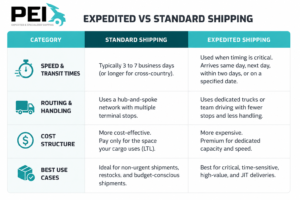
Points To Consider Before Choosing Expedited vs Standard Shipping
Choosing the right shipping option is super important to keeping your goods on track and protecting your bottom line. Be sure to always consider the following:
- What does your delivery timeline look like? I.e. how urgent is your shipment? If time is not on your side, then opt for expedited shipping.
- What is your cargo? If your goods are fragile, high value, perishable, etc. then expedited could be the safest way to go.
- What is your budget? A higher budget could cover the cost of an expedited option, standard shipping is a useful option when your squeezing the most out of a tight budget.
- Do you need real-time in depth visibility? Expedited shipping gives a better level of tracking.
- Is your delivery window fixed or flexible? Fixed might need expedited, whereas flexible could use standard shipping.
- What happens if your delivery arrives late? Would a delay be tied to an extra cost elsewhere in the business?
- Would the cost of a delay be more than the cost to expedite? Weigh this up, if the risk of impact from a delay is high and there is room in your budget to expedite, it might be the way forward.
Once you consider these factors, the right choice should become clearer.
How Can PEI Help?
Choosing a freight partner to trust with your shipments can be daunting. Especially when your freight is urgent, specialized, high-value, oversize or tied to critical deadlines requiring an expedited solution. While standard shipping has its place particularly for planned freight with flexible delivery windows, which we’re great at and can move any goods, anywhere, but for the shipments that need more than a basic point A to point B solution, this is where PEI can really help and make a difference.
Businesses with all kinds of shipping needs trust us with their freight. Our goal isn’t to push every shipment into the fastest, most expensive option, instead it is to help shippers make the right decision for their business. If you want to partner with a reliable, trustworthy, fair and expert team in the U.S. for your ground freight solutions, then we’d love to hear from you.
We offer a full menu of services from:
- Expedited shipping
- Emergency shipping
- Specialized shipping
- FTL shipping
- LTL shipping
- Standard ground freight solutions
- Dedicated truckload
- Flatbed shipping
- Heavy haul shipping
These are just some of our offerings. But, it’s important to note that we also work super fast too, our team can find the right solution for your job, no matter the requirements and move your freight same day, next day, or when it’s needed. To learn more about our expedited shipping solution, click here ➡️ “PEI expedited shipping” or get in touch using the below. ⬇️
Need help planning a shipment?
Talk with PEI about expedited freight, specialized freight, or your next shipping challenge.
