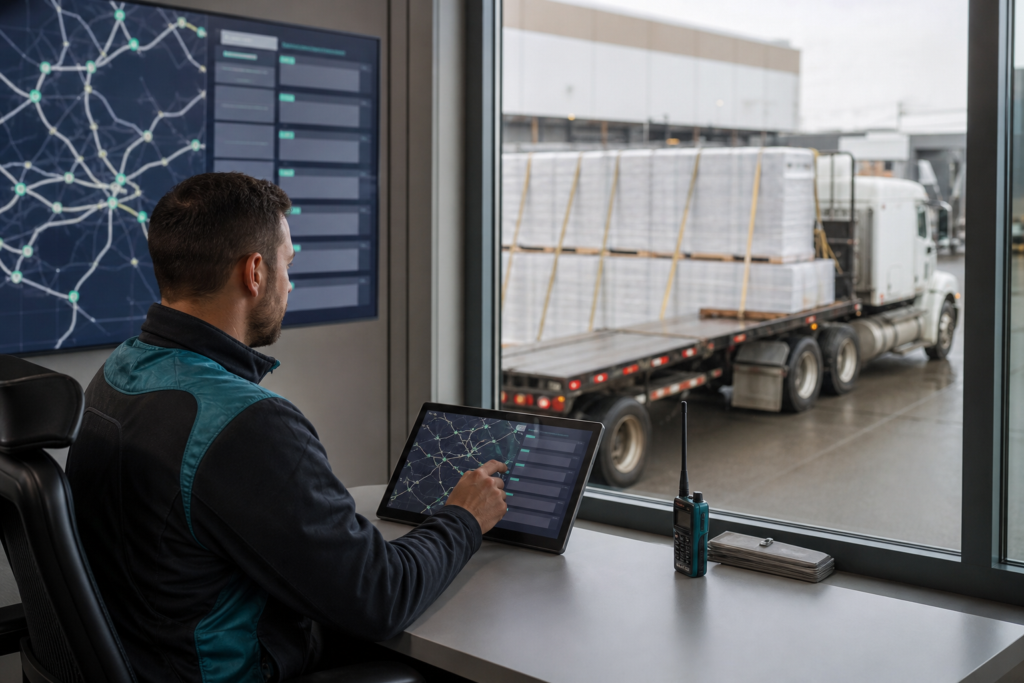
An expedited freight provider gives you a dedicated truck, van or straight truck that moves your shipment directly from pickup to delivery with no hub transfers, no cross-docking and no delays from shared loads. You get continuous GPS tracking so you know exactly where your freight is at any moment, not just when it passes through a terminal. Think of it as the difference between tracking a rideshare car in real time versus getting an email that your package left a warehouse somewhere. If your cargo is time-critical, high-value or headed to a live event with a hard deadline, this is the service tier that keeps you in control.
Authoritative Frameworks Referenced: The Real-Time Visibility Framework distinguishes between traditional track-and-trace systems, which provide historical milestone updates at checkpoints and true real-time tracking that offers continuous location and condition monitoring throughout transit. A Cost-Benefit Analysis Framework for expedited freight evaluates whether premium shipping costs are justified based on disruption avoidance, revenue protection and customer satisfaction metrics. The Risk Management Framework for High-Value Cargo integrates carrier vetting, insurance requirements, secure handling and real-time tracking into a layered protection strategy for valuable or sensitive shipments.
How is expedited freight different from standard shipping?
Here's the core difference: standard freight shares truck space with other shippers' cargo. Your pallet gets picked up, moved to a terminal, sorted, consolidated with other loads, maybe transferred again and eventually delivered. Each handoff adds time and risk. Expedited freight typically means your shipment gets an exclusive-use vehicle, often called an EUV, that goes straight from your dock to the destination with no stops, no transfers and no cross-docking.
The speed advantage is obvious, but the reliability piece matters just as much. When your freight doesn't change hands or sit in a sorting facility overnight, the chance of damage, loss or delay drops dramatically. You also get flexibility that standard carriers simply don't offer. Need a pickup at 2 a.m. on a Sunday? Need to change the delivery address mid-transit because a job site shifted? A good expedited provider operates 24/7/365 and can adapt on the fly.
The tradeoff is cost. Expedited rates can run two to five times higher than standard LTL or truckload rates for the same lane. That's why the decision isn't really about speed alone. It's about whether the consequences of a late delivery, whether that's a grounded aircraft, a dark trade show booth or an idle production line, cost more than the shipping premium.
How does real-time tracking actually work for freight?
Modern GPS tracking provides location accuracy within 3 to 10 meters for fleet vehicles, which means you're not just seeing a city name on a status page. You're seeing your truck's position on a map, updated continuously.¹ The tracking hardware in the vehicle communicates its coordinates through cellular or satellite networks to a visibility platform you can access online or through a mobile app. Some providers layer in additional IoT sensors that monitor temperature, humidity or shock events, which matters if you're shipping sensitive equipment or electronics.
What's important to understand is the difference between real-time tracking and what the logistics industry calls track-and-trace. Track-and-trace gives you milestone updates, like "picked up" or "arrived at terminal" or "out for delivery." Real-time tracking gives you a continuous feed. You can see your shipment moving down the highway right now, check the estimated arrival time and make decisions based on live data rather than stale updates from hours ago.
That said, GPS accuracy does degrade in certain environments. Urban canyons with tall buildings, tunnels and heavily obstructed areas can reduce signal quality.¹ For most over-the-road expedited moves, though, the tracking is remarkably precise and gives you the kind of visibility that lets you coordinate receiving crews, installers or production schedules with confidence.
What types of cargo actually need expedited shipping?
The most common scenario is anything where downtime costs more than the shipping premium. Aerospace AOG parts, which stands for "aircraft on ground," are a classic example. When a commercial or military aircraft is grounded waiting for a replacement component, every hour it sits represents enormous cost. Getting that engine part or avionics module delivered in hours instead of days isn't a luxury; it's an operational necessity.
Trade show and live event freight is another huge category. If your exhibit booth, display materials or AV equipment doesn't arrive before the show floor opens, you don't get a second chance. These shipments often require coordination with marshalling yards, advanced warehouse deliveries and precise timing that standard carriers aren't built to handle. Schedule changes are common in event logistics, and the ability to react quickly when a show manager moves your setup window is critical.
Beyond those, think about high-value industrial equipment, manufacturing components needed for just-in-time production, medical devices and any situation where a customer relationship is on the line. According to a QIMA supply chain visibility survey, only 13 to 16 percent of businesses report having full visibility into their supplier networks.² That gap is exactly where expedited providers with real-time tracking fill a critical need, giving you eyes on your freight when the stakes are highest.
When is paying the premium for expedited freight worth it?
The math is actually pretty straightforward once you quantify what a missed delivery costs you. If you're a manufacturer and your production line goes down because a part didn't arrive, you're burning through labor costs, missing output targets and potentially defaulting on customer commitments. An Accenture study found that supply chain disruptions collectively caused firms to miss an estimated 1.6 trillion dollars in revenue.³ Obviously not all of that is a freight problem, but it illustrates how quickly disruption costs compound.
If you're an event company shipping booth materials to a major trade show, the cost of a no-show isn't just the freight. It's the booth rental, the staff travel, the lost sales opportunities and the reputational damage. In those situations, spending three or four times the standard shipping rate is cheap insurance.
Here's a useful rule of thumb: if the cost of failure exceeds the cost of the expedited premium by a factor of three or more, it's almost always worth it. If you're routinely using expedited services for shipments that aren't truly urgent, though, that might signal a planning issue in your supply chain rather than a shipping need. Overuse of premium transportation can mask deeper problems with forecasting, inventory management or supplier reliability.
What equipment options exist for expedited shipments?
Vehicle flexibility is one of the biggest advantages of working with an expedited provider. Depending on your shipment size, weight and urgency, you might use a cargo van for small, ultra-urgent deliveries like a single aerospace part or a set of medical instruments. Sprinter vans handle slightly larger loads while still being fast and nimble. Straight trucks, sometimes called box trucks, cover the middle ground for shipments that are too big for a van but don't need a full trailer.
For full truckload expedited moves, you're looking at standard dry vans, flatbeds or specialized equipment like step-deck trailers, lowboys, RGNs (removable gooseneck trailers), Conestogas and extendable trailers for oversized or overweight cargo. Some of these require special permits and route planning, particularly for loads that exceed standard height, width or weight limits.
The key is matching the right equipment to your specific freight. A good expedited provider doesn't force you into one vehicle type. They assess what you're shipping, where it's going and when it needs to arrive, then recommend the most efficient option. That might mean a hotshot on a sprinter for a 200-pound emergency part, or a permitted heavy-haul move for industrial machinery. The flexibility to scale up or down based on the situation is what separates specialized expedited operations from standard carriers.
What regulations affect expedited trucking operations?
The Federal Motor Carrier Safety Administration, or FMCSA, sets the baseline rules that every expedited carrier must follow. Hours-of-service regulations limit how long drivers can operate before mandatory rest breaks, which directly affects transit time calculations. Electronic logging devices, or ELDs, are required to track compliance automatically and these same devices often double as the GPS tracking hardware that feeds your real-time visibility platform.⁴
If your shipment involves hazardous materials, that adds an entirely separate layer of regulatory requirements including special placarding, driver certifications and routing restrictions.⁴ Many expedited providers choose not to handle hazmat due to the insurance requirements and liability exposure, so it's worth confirming coverage before you book.
On the environmental side, regulations are evolving quickly. California's Advanced Clean Trucks regulation, for example, mandates that 5 to 9 percent of truck sales in the state be zero-emission vehicles in its early phases.⁵ While this is currently state-specific, similar rules are being considered elsewhere and they'll gradually affect fleet composition and operating costs across the industry. For shippers with sustainability goals, it's worth noting that expedited modes generally carry a larger carbon footprint per unit of cargo than consolidated standard shipping, simply because you're dedicating an entire vehicle to your load rather than sharing capacity.
How do you evaluate an expedited freight provider?
Start with responsiveness. When you call at midnight on a Friday with an emergency shipment, how fast do you get a quote and a truck committed? The best expedited providers measure their response time in minutes, not hours. This isn't just a nice-to-have; it's the entire value proposition. If you're waiting until Monday morning for a callback, you don't have an expedited partner. You have a standard broker with a fancy website.
Next, look at communication throughout the process. Real-time tracking technology is only useful if someone is actually monitoring it and proactively updating you. Ask how they handle exceptions. What happens if a truck breaks down, if weather closes a route or if the delivery appointment changes? The answer should involve immediate notification and a backup plan, not a shrug and a claim form.
Finally, evaluate the relationship, not just the transaction. Providers who invest time understanding your business, your typical freight challenges and your pain points will perform better than those who treat every call as a one-off. The best partnerships develop when your expedited provider knows your facilities, understands your industry's rhythms and can anticipate problems before they become emergencies. That kind of institutional knowledge doesn't come from a rate sheet. It comes from working together consistently over time.
When might expedited freight with real-time tracking not be worth it?
There are genuine scenarios where the premium doesn't make sense. If your shipment isn't truly time-sensitive and a two-day delay won't impact operations, revenue or customer commitments, standard LTL or truckload service at a fraction of the cost is the smarter move. Paying expedited rates for routine replenishment freight is like taking an ambulance to a scheduled doctor's appointment.
Technology limitations are also worth considering. GPS tracking accuracy degrades in urban canyons, tunnels and heavily obstructed environments, so if your delivery point is deep inside a dense industrial complex or underground facility, the real-time visibility you're paying for may have gaps.¹ Additionally, the environmental math deserves honest consideration. Dedicating an entire vehicle to a single shipment means a larger carbon footprint per unit of cargo compared to consolidated loads. If your organization has aggressive sustainability targets, frequent expedited shipping may conflict with those goals.⁵
Perhaps most importantly, if you find yourself relying on expedited freight regularly for the same types of shipments, that pattern often signals upstream supply chain issues like poor demand forecasting, unreliable suppliers or inadequate safety stock. In those cases, the better investment might be fixing the root cause rather than repeatedly paying premium freight rates to compensate for planning gaps.
Key Takeaways
- Expedited freight uses exclusive-use vehicles with no transfers or cross-docking.
- Real-time GPS tracking provides 3 to 10 meter location accuracy for fleet vehicles.
- Only 13 to 16 percent of businesses have full supply chain visibility.
- The premium is justified when failure costs exceed shipping costs by three times or more.
- Consistent expedited overuse may signal deeper supply chain planning problems.
About This Topic
Expedited freight with real-time shipment tracking is a specialized logistics service that uses dedicated, exclusive-use vehicles equipped with continuous GPS monitoring to move time-critical, high-value or event-sensitive cargo directly from origin to destination. Unlike standard freight that passes through terminals and shares truck space, expedited shipments travel on a single vehicle with no transfers, no cross-docking and no consolidation delays. The service operates 24/7/365 and accommodates mid-transit schedule changes, making it essential for scenarios where the cost of a late or missed delivery far exceeds the premium shipping rate. Common applications include aerospace AOG parts, trade show and event logistics, manufacturing line-down emergencies and any shipment requiring precise timing, special handling or constant communication.
Comparative Analysis Table
| Factor | Option A | Option B | Notes |
|---|---|---|---|
| Transit Model | Standard LTL: Hub-and-spoke with terminal transfers and consolidated loads | Expedited EUV: Direct point-to-point on a dedicated vehicle with no stops | Choose expedited when any delay or handling risk is unacceptable |
| Tracking Visibility | Standard: Milestone-based track-and-trace with periodic status updates | Expedited: Continuous real-time GPS with live map positioning | Real-time tracking is critical for coordinating receiving crews or event setup |
| Cost | Standard: Lower per-shipment cost, shared capacity | Expedited: Two to five times higher, but dedicated capacity | Standard is preferable for routine, non-urgent replenishment freight |
| Schedule Flexibility | Standard: Fixed pickup and delivery windows, limited weekend or holiday service | Expedited: 24/7/365 availability with mid-transit schedule changes | Expedited wins for trade shows, emergencies, and last-minute changes |
| Damage and Loss Risk | Standard: Multiple handling points increase exposure | Expedited: Single load, single vehicle, minimal handling | High-value or fragile cargo benefits from reduced touch points |
| Environmental Impact | Standard: Lower carbon footprint per unit through shared capacity | Expedited: Higher per-unit emissions due to dedicated vehicle | Organizations with sustainability mandates should weigh this tradeoff |
How to Implement
-
Define Your Shipment Urgency and Consequences of Delay
Start by calculating what a late or missed delivery actually costs you. Include production downtime, missed event deadlines, customer penalties and reputational damage. This number determines whether the expedited premium is justified.
-
Specify Your Freight Details and Equipment Needs
Gather the dimensions, weight, commodity type and any special handling requirements before you call. Knowing whether you need a cargo van, sprinter, straight truck or full truckload speeds up the quoting process and ensures the right equipment is dispatched.
-
Request Quotes From Providers Who Specialize in Your Freight Type
Look for providers with demonstrated experience in your industry, whether that's aerospace, trade shows, manufacturing or heavy equipment. Ask about their response time, communication protocols and how they handle mid-transit changes.
-
Confirm Real-Time Tracking Capabilities Before Booking
Ask specifically whether you'll receive continuous GPS tracking or just milestone updates. Confirm how you'll access the tracking, whether through a portal, app or direct communication with a coordinator and what proactive notifications you'll receive.
-
Establish Communication Expectations and Escalation Procedures
Agree on how often you'll receive updates, who your point of contact is and what happens if something goes wrong. The best expedited relationships have clear protocols for breakdowns, weather delays and schedule changes before they happen.
Troubleshooting FAQs
What happens if my expedited shipment encounters a delay mid-transit?
A reliable expedited provider monitors every load in real time and will notify you proactively the moment an issue arises, whether it's a mechanical problem, weather event or road closure. They should already have a contingency plan, which might include dispatching a backup vehicle, rerouting or coordinating with you to adjust the delivery window. The key difference from standard shipping is that you find out immediately, not after the delivery window has already passed.
How do I know if I'm overusing expedited freight instead of fixing supply chain issues?
Track how often you're booking expedited shipments and why. If the same type of shipment keeps showing up as an emergency, whether it's the same part from the same supplier or the same replenishment cycle running late, that's a pattern worth investigating. Occasional emergencies are normal and exactly what expedited services are designed for. But if you're spending more than 10 to 15 percent of your total freight budget on expedited moves, it's worth analyzing whether better forecasting, additional safety stock or supplier diversification could reduce that dependency.
Implementation Stories
Best Practices Checklist
- Calculate your cost of delay before comparing shipping rates so you can make informed decisions about when expedited service is justified.
- Confirm that your provider offers continuous GPS tracking, not just milestone-based track-and-trace updates at terminal checkpoints.
- Establish a single point of contact with your expedited provider who understands your business and can make decisions quickly during emergencies.
- Build the relationship before the emergency by sharing your typical freight profiles, facility requirements and peak seasons with your provider in advance.
- Review your expedited shipping frequency quarterly to identify patterns that might indicate upstream supply chain issues worth addressing.
- Verify equipment flexibility by confirming your provider can scale from cargo vans to full truckloads and specialized trailers based on your needs.
Glossary
| Term | Definition |
|---|---|
| EUV (Exclusive Use Vehicle) | A truck or van dedicated entirely to your single shipment, meaning no other freight shares the vehicle and your cargo goes straight from pickup to delivery with no stops or transfers. |
| Hotshot | An urgent, often smaller expedited shipment typically moved by a sprinter van, cargo van, or small straight truck for maximum speed on time-critical deliveries. |
| AOG (Aircraft on Ground) | An aerospace industry term for a situation where an aircraft is grounded and unable to fly due to a missing or failed part, triggering the highest priority for replacement part shipping. |
| Marshalling Yard | A staging area near a trade show or event venue where freight is received, organized, and sequenced before being moved to the show floor for setup. |
| Cross-Docking | A logistics practice where freight is unloaded from one vehicle and loaded directly onto another at a terminal, adding handling time and damage risk. Expedited EUV shipments avoid this entirely. |
References
- Geotab Inc. "The accuracy of geographical positioning systems". Geotab Inc. July 8, 2025. https://www.geotab.com/blog/accuracy-geographical-positioning-systems/.
- QIMA. "Supply Chain Visibility Survey". QIMA. January 1, 2024. https://blog.qima.com/traceability/supply-chain-visibility-trends.
- Accenture. "Supply Chain Disruption Cost Analysis". AIMMS (summary of Accenture study). January 1, 2024. https://www.aimms.com/story/supply-chain-disruption-costs/.
- Federal Motor Carrier Safety Administration. "Hazardous Materials Transportation Guide". FMCSA. January 1, 2024. https://www.fmcsa.dot.gov/regulations/hazardous-materials.
- California Air Resources Board. "Advanced Clean Trucks Regulation". State of California. January 1, 2024. https://ww2.arb.ca.gov/our-work/programs/advanced-clean-trucks.
Need help planning a shipment?
Talk with PEI about expedited freight, specialized freight, or your next shipping challenge.
