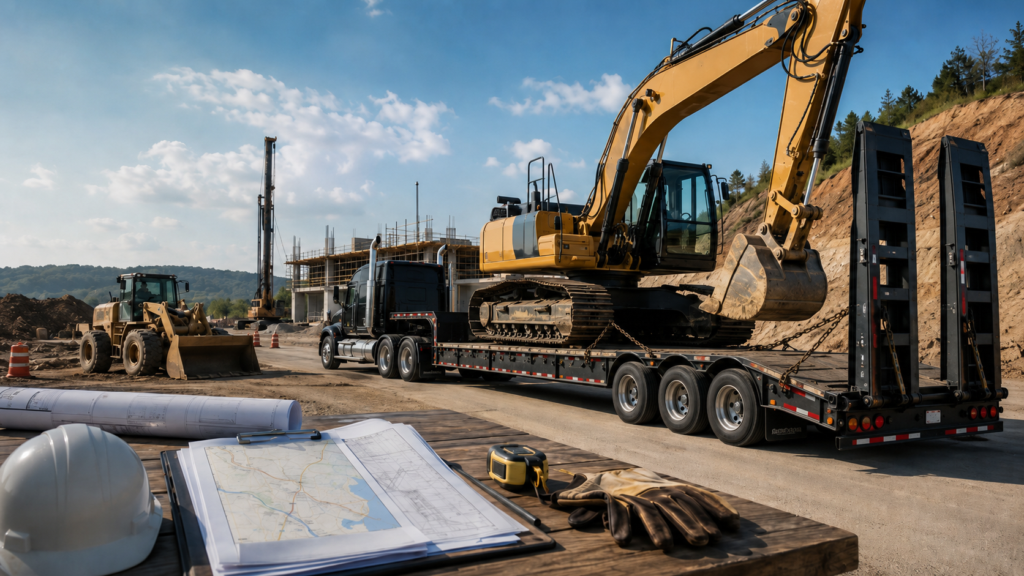
Construction equipment hauling is no simple feat (for a standard freight partner 😉). These kinds of shipments are often oversized, heavy, difficult to load and unload and require more than a standard trailer. Some construction equipment can be transported without the need of a special permit, while larger machines may require oversize permits, a lowboy trailer, multiple axles, pilot cars and carefully approved routes.
Some other practical details to consider for construction equipment at both ends of the journey are; Can the equipment move under it’s own power? Is there enough space at the pick up and delivery site for the truck to access? Will a crane or winch be required? Are there overhead cables, weak surfaces or restricted operating hours? So, with all of this in mind let’s take a deeper look into what it takes to haul construction equipment in the United States.
What Does Construction Equipment Hauling Involve?
Construction equipment hauling requires a reliable service, because more often than not construction projects have no room for delays. So, before moving any machinery, thorough preparation is required to prevent project downtime, equipment damage, to remain compliant and avoid highway violations. A reliable shipping partner should organize on your behalf:
- Choosing and arranging appropriate trailer selection – Verifying that the gross vehicle weight rating covers the combined weight of the machine and the trailer. Also check dimensions to ensure any overhangs or tall freight are accounted for in permits, escort vehicles and securing equipment.
- Carry out in depth route surveys where needed and route planning – Checking the route for low hanging bridges, weight restricted roads, and tight turns.
- On time pick up and delivery – Plan realistic pick up and delivery times around site access and operating schedules.
- Apply for and obtain necessary permits – Apply for necessary permits needed for safe and compliant movement through different states.
- Loading and unloading assistance – Arranging ramps, cranes, winches and other specialist equipment for freight that needs it.
- Pilot and escort cars – Coordinate the appropriate escort vehicles dependant on the freight and state requirements.
- A dedicated team of specialists to handle the entire movement – Providing a dedicated team to oversee every aspect of the movement.
Where Is Construction Equipment Generally Hauled To?
Construction equipment hauling refers to the movement of construction machinery by truck and trailer between two or more locations. It can be moved almost anywhere, but it’s most commonly shipped along these kind of routes:
- Between construction sites
- From dealer to customer
- To or from an equipment auction
- Between rental locations
- To and from maintenance and repair facilities
- From manufacturer to a distributor
- To a port or rail terminal
- Into storage between projects
How To Prepare Construction Equipment Ready For Hauling
Moving shipments of this nature requires not just planning but also a lot of preparation. Here’s some tips to help you prepare your freight ready for it to be hauled.
1.Clean the equipment/vehicle
Thoroughly clean any dust, mud or other dirt from the equipment, while being sure to remove any dirt and loose debris from the tires, track and body to prevent it from flying off and damaging any other vehicles nearby.
2.Pre-haul inspection
Once the equipment has had a good clean, a thorough inspection can find any damage before hauling and while performing this inspection check for cracks, rust and loose bolts. It’s important to record any existing issues with photographs before transportation. At this stage you should also check:
- Oil and coolant levels
- Fuel levels
- Tyre and track coordination
- Fluid leaks
- Loose panels or components
3.Review clearances
Double check measurements, height, width and weight to be sure that the freight is compliant and the necessary permits cover the movement of your shipment.
4.Reduce the shipment where possible and necessary
Remove loose accessories, like blades, buckets, etc. Hauling these separately can reduce the overall weight, height and width, which in turn could make it easier to move.
5.Immobilize hydraulics
To immobilize hydraulics you need to retract and lock mobile components, like excavator arms or bulldozer blades and relieve internal hydraulic pressure. This is super important to make sure the freight does not bounce, shift or leak during transportation.
6.Lock moving parts
Utilize locks, safety pins and latches to secure components and stop them swinging or shifting during transit.
If you’re new to moving this sort of equipment and have any questions about the preparation stages, don’t hesitate to ask your shipping partner. They will be able to advise on best practices to keep your goods safe during transportation.
Shipping Partners Preparations Before Transit
Once all of this preparation is done, then the shipment is ready to be loaded. This is usually where your freight partner will take over. These steps include:
- Loading on level ground.
- Positioning the equipment to distribute the weight.
- If the machinery was driven onto the trailer then engaging the park brake and turning off the machinery, removing the keys and locking any cab doors, even unhook the battery to avoid them becoming drained as an extra precaution.
- Securing both sides of any tires with wedges or wheel chocks to prevent it from rolling.
- Chain down the equipment, according to DOT you must use at least four heavy duty transport chains to secure the equipment.
- Even tensioning by making sure there is no slack and crank the binders until they’re fully locked.
- Heavy duty ratchet straps can also be used to support the chains and secure delicate parts.
- If the equipment is travelling as an oversize load, then safety banners, lights and signs must be added to the vehicle and equipment.
Construction Equipment Frequently Shipped
There is a wide range of construction equipment that can be transported via road, whether they’re wheeled vehicles, tracked or static. Most common examples include, but are not limited to:
Excavators (Standard & Mini)
These range in size from compact rubber tracked models to massive steel tracked vehicles.
The mini versions tend to range from 1-6 tons and measure between 1-2.5m wide and can be moved using a vehicle with a capacity of 3.5 tons. Typically a heavy duty pick up truck will suffice if the total weight of the trailer and cargo is 3.5 tons. However, a medium duty class 4-5 commercial truck may be required if you need the vehicle to carry 3.5 tons of weight on the trailer bed.
A standard excavator that ranges from 10-45 tons will actually require a specialized flatbed trailer for movement.
Skid Steers & Compact Track Loaders
Again these types of machines range in size from smaller models (around 1,000-3,000lbs) to large frame machines (10,000-13,000lbs). While they’re not the hardest thing on the planet to move, their weight and width mean they require a heavy duty trailer and towing vehicle.
Bulldozers
Bulldozers are categorized into three different sizes, each requiring different measures for safe movement via road.
Small dozers – Typically weighing between 8-10 tons, they’re able to travel on standard flatbed or tag along trailers.
Medium dozers – Weighing between 15-35 tons, a medium bulldozer blade often exceeds 8.5 feet, because of this, they require oversize load permits and a dedicated lowboy trailer.
Large dozers – These typically weigh between 50-125+ tons, classifying them as a “superload”. Moving these loads requires a real specialist in the field. Someone who can pre-approve routes, arrange police escorts, and partially disassemble to meet clearance limits.
Wheel Loaders
Wheel loaders range in size from 2,000lbs to over 500,000lbs, but as a standard construction loaders typically weight 10,000-80,000lbs. Hauling equipment of this size is highly regulated and requires a flatbed or RGN trailer with specific tie downs and oversize permits for width and height.
Backhoe Loaders
This machinery typically weighs between 7,000-20,000+lbs and measures between 18-24 feet long and 8 feet wide. Due to their size, they can be hauled on a heavy duty truck, flatbed or drop deck trailer. As long as DOT securement regulations are followed.
Telehandlers
These are large pieces of equipment weighing between 5,500-over 40,000lbs, with average dimensions between 20-25 feet long, 8.5 ft wide, and 8.5 feet tall. Meaning compact models can travel on standard flatbeds, and heavy construction models need a specialized lowboy, heavy duty towing rig and oversize permits.
Cranes
Cranes vary in size dramatically. Ranging from 20,000lb – 10 million lbs, hauling them is incredibly complex. They require complete disassembly, and movement across multiple flatbed trailers or specialized multi axle trailers and have to be moved with all of the correct oversized and overweight permits.
For exact requirements across different state lines, you can check regulations using the individual Department of Transportation for each and the Federal Highway Administration for your loads needs.
Common Mistakes Made Hauling Construction Equipment
Hauling heavy equipment in the states requires strict compliance with the Department of Transportation (DOT) and the Federal Motor Carrier Safety Administration (FMCSA) regulations. The most common and costly mistakes when moving these goods involve improper load securement, miscalculating gross vehicle weight, ignoring bridge clearances, and failing to secure loose attachments.
These errors can lead to significant consequences, poorly secured machinery might shift during transit, damaging the equipment, destabilizing the trailer, or even endangering other road users. Incorrect weight calculations can result in fines, permit violations and roadside delays while the load is repositioned or partially unloaded. Failing to account for the full loaded height can also cause infrastructure damage and road closures. Moveable components should be lowered and secured and pre departure checks are essential to ensuring your load remains compliant and safe during movement. All of the measures when put into place can minimize the risk of costly and even dangerous outcomes.
Choosing A Partner To Move Your Construction Equipment
Construction equipment movement is not a job for any shipping partner. The needs are complex, the equipment and machinery is very expensive and projects depend heavily on the timely arrive of their freight. Even the smallest delay can have serious wider consequences and increase overall project costs.
A reliable partner will work with you to understand the complexity and entire needs of your freight. They should confirm every piece of necessary information before putting any plans into place to move the goods.
Clear communication, careful planning and most importantly experience with oversized or heavy machinery is essential. The right partner will work to manage the entire move safely, compliantly and with minimal disruption.
Plan Your Construction Equipment Shipment With PEI
No two pieces of construction equipment are the same to haul, and nor are the construction sites and facilities exactly alike. Which is why we build every construction hauling equipment plan differently, around the individual machine, route, schedule and site conditions.
To help us begin planning for your shipment, please have available as much of the following information:
- Equipment make and model (this helps us to gather in depth information about the requirements of moving the equipment)
- Exact dimensions including: width, length, height and weight
- Details of buckets, blades or other attachments
- Whether the machinery can move under its own power
- Pick up and delivery address
- Information about access restrictions at either location
- Preferred pick up and delivery dates
- If cranes, ramps, winches or any additional loading support is required
Once we have these details, our team can get to work on figuring out the best fitting solution for you. From the most appropriate transportation equipment to applying for permits, arranging escorts, and creating a practical plan for loading, routing and delivery.
PEI can oversee every aspect of your shipment, so if you’ve got a large, awkward, oversized or complicated move coming up, then let us handle it for you. This is exactly the kind of work that we specialize in.
You can call us directly on: 888-SHIP-911 to chat to one of our team members about your needs or use the “ship it now” link below and enter your details. Together, lets get your heavy haul freight where it needs to be safely, compliantly and right on schedule. 😊⬇️
Need help planning a shipment?
Talk with PEI about expedited freight, specialized freight, or your next shipping challenge.
